

December 2, 2025
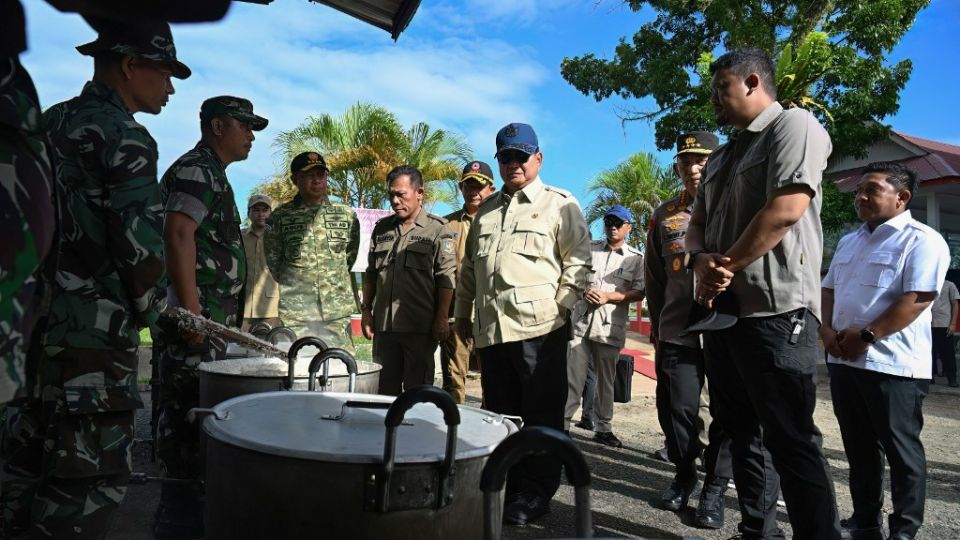
JAKARTA – President Prabowo Subianto visited flood- and landslide- hit areas in northern Sumatra on the sixth day after the disaster, promising to address urgent food and fuel shortages as thousands face dwindling supplies and the growing threat of hunger, while damaged roads continue to hamper relief efforts.
Prabowo departed from Jakarta’s Halim Perdanakusuma Air Force Base on Monday morning and flew directly to Central Tapanuli in North Sumatra, one of the worst hit-areas where pockets of affected communities remain isolated due to severed transportation routes and downed communication networks.
Speaking to reporters after inspecting several sites, Prabowo said the government’s immediate priority is delivering essential aid, particularly fuel, to cut-off areas.
“Several villages remain isolated, but God willing, we can reach them soon,” he said. “We have deployed numerous helicopters, Hercules aircraft and other assets, and with strong teamwork we can overcome this disaster and quickly ease people’s hardships.”
The President continued his visits to affected areas in Aceh and West Sumatra, meeting locals and reiterating his promise to expedite the restoration of severed transport routes and damaged homes.
Read also: Pressure mounts on govt to declare national emergency in Sumatra
Prabowo’s visit comes six days after Tropical Cyclone Senyar made landfall on Sumatra on Nov.25, unleashing intense rain and strong winds across Aceh, North Sumatra and West Sumatra. Within two days, all three provinces declared two-week provincial-level emergencies.
According to the National Disaster Mitigation Agency (BNPB), the disaster has so far impacted 1.4 million people, killed 502 and injured some 2,500. Over 500 people remain missing.
Hunger crises
Severed transportation networks have crippled aid distribution, leaving thousands of flood and landslide survivors facing hunger as food supplies run dangerously low.
Reza Syahputra, a resident of Takengon in Central Aceh, said his family ran out of rice on Sunday and local wholesalers had already sold out.
“Today we could not eat rice anymore, so we ate boiled bananas instead,” he said on Monday, urging authorities to immediately send aid immediately.
Central Aceh Regent Haili Yoga confirmed a severe logistics crisis after roads were cut off by the floods and landslides.
“Our region became isolated after the disaster, causing supplies to run low,” he said. “We continue to plead for aid so residents do not suffer further.”
Conditions were similarly dire at evacuation centers in Pidie regency, Aceh. Armi, a resident of Lamkawe, said assistance from the Social Affairs Agency had been extremely limited and inadequate for the thousands displaced.
“After two rounds of cooking, the aid was gone. We have run out of food,” she said.
In Medan, North Sumatra, market vendors told The Jakarta Post they have been unable to restock and are selling whatever remained before the disaster struck. Fuel stations across the city have also become overwhelmed, with lines stretching more than 100 meters and motorists waiting over an hour to fill their tanks.
Read also: Cyclone havoc signals heightened climate crisis, environmental destruction
Many residents in Matur, Agam Regency, one of the hardest-hit areas in West Sumatra, have been surviving without electricity and fuel for nearly a week. By the time some managed to reach nearby Bukittinggi, about 20 kilometers away, to buy basic commodities, the prices had already skyrocketed.
“One sack of rice, which usually costs around Rp 170,000 [US$10], has risen to Rp 250,000 […] and Pertalite is being sold at Rp 35,000 per liter, [increasing from Rp 10,000],” said Muhammad Rifan, 26, a humanitarian volunteer. Having visited several affected locations across the province, he added that many villages remain completely isolated, with no information available on their conditions or casualty figures.
The worst has passed?
Despite mounting pressure to declare a national emergency, Prabowo said on Monday that he believed “the worst had passed” and that the current provincial-level emergency status was sufficient.
“I believe the situation is improving, and the current [emergency status] is sufficient.”
Coordinating Human Development and Culture Minister Pratikno added that, since the disaster first hit Sumatra, the President had already instructed a nationwide response “with the full deployment of the BNPB, the National Search and Rescue Agency [Basarnas], the military, the police and all relevant ministries and agencies, working closely with regional administrations”.
Disaster management expert Mizan Bisri of the Asian Disaster Reduction Center (ADRC) said the scale of the disaster in Sumatra and local administrations’ struggle to cope warranted a national emergency designation. He urged the government to stay alert to the cross-sectoral impacts that will continue to unfold.
Mizan added that a thorough post-disaster review is needed to assess the scale of the devastation and hold those responsible accountable.
The disaster has renewed attention to climate change, which has intensified monsoon seasons and tropical storms across Southeast Asia, including Thailand and Malaysia. To this end, Prabowo acknowledged the need for more proactive climate measures.
“The government must function properly to protect the environment and anticipate future conditions. Local administrations must also be prepared to face climate impacts,” he said.
Environmental groups, meanwhile, highlighted how the scale of the devastation reflects the severe weakening of Sumatra’s ecological buffers due to lax oversight of extractive industries.
Satya Bumi executive director Andi Muttaqien argued that the impact of the floods and landslides could have been far less severe if the government had enforced stricter controls on land clearing and forest use.
“The high number of casualties should push the government to restore damaged landscapes and reassess permits granted to environmentally destructive companies,” Andi said on Saturday.