

December 2, 2025
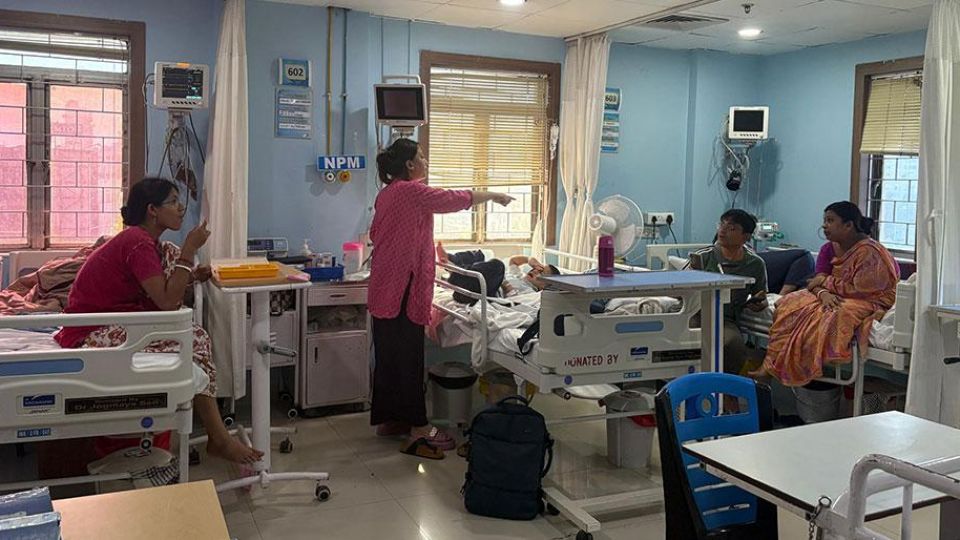
KOLKATA – In the bustling corridors of Kolkata’s private hospitals, a community moves almost invisibly. They do not appear on rosters, yet their presence is indispensable. They arrive quietly, blending into the long lines of families outside admission desks. They are not patients. They are not medical staff. Yet a patient’s comfort is tethered to their care. They are medical escorts – companions to Bhutanese patients referred to India for treatment.
Many arrive thinking their duty will last only a few days. More often than not, they land up spending weeks, sometimes even months, in these hospitals.
Dorji (name changed) had expected his trip with his wife to be brief. By the end of the first day in Kolkata, he understood what it meant to vanish into a city that never slows down.
Every month, dozens of Bhutanese escorts arrive at hospitals, struggling with language barriers, navigating bureaucracies, and translating medical jargon into words that matter. Their job appears simple – help the patient, submit bills – but behind the routines lies a quiet, relentless endurance.
The nine hospitals in Kolkata that are officially designated to treat Bhutanese referral patients are Tata Medical Center (TMC), the Institute of Neurosciences (INK), Fortis Hospital, Manipal Hospital (AMRI), Manipal Hospital (Medica), Rabindranath Tagore Hospital (RNT), Sankara Nethralaya Hospital (SNK), Peerless Hospital, and Durgapur Mission Hospital (DMH).
“The hardest part isn’t the paperwork,” said a man in his 40s, who had escorted his wife three times over a year. “It’s being away from home for weeks, sometimes months, watching someone’s pain and knowing you can’t fix it.”
Most escorts are relatives, civil servants on rotation, or volunteers. All of them operate in a space that is part compassion, part survival.
In crowded waiting halls, they form small communities, sharing advice and snippets of news from home. It is a world within a world, mostly invisible to doctors rushing by. Yet without them, the referral system that sends hundreds of Bhutanese patients abroad each year would falter under its own weight.
A 39-year-old medical escort caring for his hospitalised uncle described the practical and emotional toll. “My uncle is paralysed and requires constant assistance,” he said, “yet we are not permitted to stay with him. This prevents us from bridging the communication gap and providing the care he needs.”
Another attendant, accompanying his 55-year-old cousin, recalled a young Bhutanese woman arriving with her mother, who could not speak English. Lost and overwhelmed, the daughter relied entirely on fellow Bhutanese attendees. The situation highlighted a troubling reality: what happens if no compatriot is available to help? Even when a translator is officially assigned, the fear persists.
Journey to Kolkata
As soon as the flight lands, patients and attendants are herded onto a hospital bus waiting at the airport. Shoulder to shoulder, they ride through a city alive with horns, humidity, and a kaleidoscope of motion. The bus finally halts at a tall hospital building guarded by weary faces. Nurses call out names, sometimes mispronouncing them. Patients are wheeled into wheelchairs, wristbands clipped on, escorted by companions dragging luggage over thresholds.
The “Emergency Patients Holding Area” is a small room, heavy with waiting and worry. Four or five patients sit in wheelchairs, their escorts standing close enough to catch every word the doctor utters.
“What is the problem? Any allergies?” questions are repeated, answers swallowed by the next.
Hours stretch.
Once paperwork is complete, the escort follows the patient to the ward. Another floor, more questions, another wait. At last, a nurse looks up, almost kindly: “You can go now.” The patient has already been absorbed into the ward, into the rhythms of machines and staff, leaving the escort without a place to go.
Phones aren’t allowed in the ward, and escorts must sign forms if a patient needs one. Without an Indian SIM, they can’t call or use data and without a visa stamp, they can’t get a SIM. Only one shop in the new city in Kolkata makes exceptions.
By the next day, a SIM finally arrives, a small lifeline against isolation. If they are lucky, they share a room with another Bhutanese patient. If not, they spend their days in quiet isolation, surrounded by strangers.
Hospital protocols strip away the personal: clothes are replaced with uniforms, meals and medicine provided strictly from within the ward. Escorts are bound by visiting hours – one hour in the late morning, another brief visit in the evening, just enough to reassure, check in, and remind patients they are not alone.
Accommodation and daily life
The men’s hostel – some call it a guesthouse – is a few metres from the hospital, while the women’s quarters is a short walk away. Each contains three small rooms crowded with bunk beds. A narrow kitchen barely accommodates two rice cookers and a curry pot; a single fridge stores vegetables and perishables.
Some escorts spend their days inside, waiting for updates and resting between calls. Others venture into the city, trying to unwind from the monotony of hospital hours. This becomes the rhythm of their days until the patient is discharged, a routine of waiting, phone calls, and brief moments of relief. Occasionally, a meeting with a doctor at an outpatient hospital provides a window for news, reassurance, and hope.
Tashi Penjore, Bhutan’s Consul General in West Bengal, said two health liaison officers are stretched thin, overseeing nine hospitals. “The significant workload creates challenges in coordination and timely support,” he said, highlighting the urgent need for an additional officer.
“Many referred patients and their escorts come from rural Bhutan and face language difficulties. Health Liaison Officers provide special assistance to bridge communication gaps and ensure comfort and understanding,” he said.
A community away from home
Over time, escorts form bonds. Strangers become companions, sharing meals, numbers, and stories from home. Laughter punctuates the worry, often through small absurdities from the wards.
One young man in his twenties shrugged, recalling how he became an escort: “No one else wanted to come. He begged me, so I packed my bag. I didn’t even know where the hospital was.”
He laughed remembering a moment when his cousin asked a nurse for a day’s leave to explore the city. “The nurse didn’t even blink. “No, sir.” That was it. His grand adventure ended before it began.”
Another light moment involved a 70-year-old patient asking his escort to fetch his clothes from the guesthouse. The patient intended to slip out for a walk, but the nurse intercepted him at the door. The old escort could only shake his head and laugh.
Humour often arises from cultural missteps. One attendant, new to Kolkata, asked a cafeteria counter if they sold beef momo. The person behind the counter froze, unsure if he had heard right. A few people in line turned to stare.
What the attendant didn’t know is that beef is largely restricted in Kolkata. Though the city is more tolerant than many parts of India, the sale of beef is largely restricted in Kolkata out of religious sensitivity. When the attendant learned this, her embarrassment turned to laughter, and the story became a nightly ritual among the Bhutanese escorts.
Lunchtime is a quiet rebellion. Escorts smuggle food past nurses – doma wrapped in tissues, chillies tucked near rice, tea and juice in flasks. A patient’s grin upon receiving a taste of home is worth the risk, though discovery inevitably leads to scolding.
A 74-year-old recalls hiding doma like a schoolboy, only to meet the nurse’s firm finger wag. Yet such moments strengthen camaraderie and resilience.
These stories – some heavy with worry, others light enough to provoke laughter amid tears -reveal a hidden layer of care in Kolkata’s hospitals. The escorts, invisible to most, form an intricate network of endurance, humour, and companionship. Their presence ensures that Bhutanese patients abroad are never truly alone.