

December 24, 2025
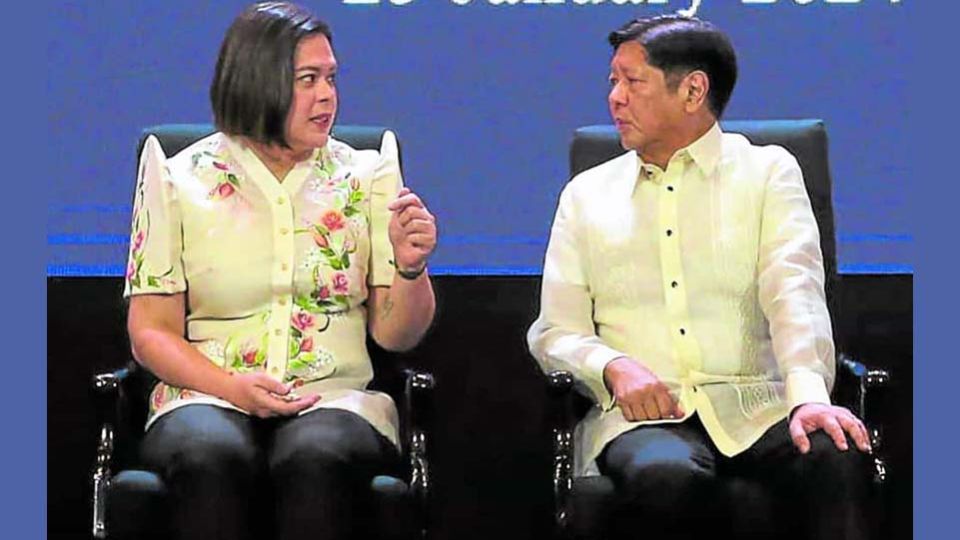
MANILA – After projecting an image of “unity” when they ran for the nation’s two highest offices, the partnership between President Ferdinand Marcos Jr. and Vice President Sara Duterte has deteriorated beyond repair by the end of 2025, with impeachment proceedings and relentless attacks only further widening the rift within what was once known as the “UniTeam.”
Even at the start of 2025, reconciliation between the country’s two highest officials appeared unlikely, as their relationship had already reached its worst the previous year.
From Sara Duterte’s intense feud with then-Speaker Martin Romualdez to her revealing that she ordered a supposed kill plot against Marcos, his wife, First Lady Liza Araneta Marcos, and cousin Romualdez, these served as the foundation for furthering impeachment plans against Duterte and what was to unfold between the President and vice president in early 2025.
January
Almost right at the start of the year, Marcos issued an executive order reorganizing the National Security Council (NSC), removing Duterte as a member because he said her position was no longer relevant to the council’s responsibilities.
READ: Marcos reorganizes NSC, removes VP as member due to irrelevance
Executive Order No. 81, signed on Dec. 30, 2024, cited the need to “further guarantee that the NSC remains a resilient national security institution, capable of adapting to evolving challenges and opportunities both domestically and internationally.”
This move further diminished — if not entirely eclipsed — Duterte’s role in the Marcos administration.
Meanwhile, Duterte’s most notable movement at this point was her private trip to Japan — the first of many in 2025 — where she met with overseas Filipino workers (OFWs).
READ: Sara Duterte went to Japan for ‘private trip’ over the weekend – OVP
It was there when she first declared that she was “seriously considering” running in the 2028 elections, though she did not specify what position she had her sights on.
Her declaration was met with heat, with the Palace tagging it as “too premature” as Marcos has barely even reached the midpoint of his six-year term.
READ: Palace tags Duterte declaration to run in 2028 ‘too premature’
February
On Feb. 6, the House of Representatives voted overwhelmingly to impeach Duterte, the first time in the post-EDSA People Power era that a sitting vice president has been pushed to the brink of removal.
The impeachment complaint stemmed from the inquiry of the House committee on good government and public accountability into the use of confidential funds by the Office of the Vice President and the Department of Education, which Duterte then concurrently headed.
READ: Sara Duterte impeachment: What you need to know
With his worsening feud with Duterte being seen as a possible trigger to the impeachment, Marcos later clarified that he had no involvement in the vice president’s impeachment in the lower chamber of Congress, emphasizing that the executive branch played no role in the process.
“No. The executive cannot have a hand in the impeachment. The executive had no role in the impeachment,” Marcos said in a mix of English and Filipino in a Palace briefing when asked if he played a part in Duterte’s impeachment.
READ: Marcos says nothing he can do to stop impeachment complaint
A day later, Duterte casually brushed off her impeachment in the House, even claiming that losing a boyfriend or girlfriend would be more painful than being impeached by the lower chamber.
Duterte kept her response to her impeachment simple, leaving it to a higher being to “save the Philippines.”
READ: VP Sara Duterte on her impeachment: ‘God save the Philippines’
“Despite my statements regarding the impeachment plan in the past months, all I can say at this point is God save the Philippines,” said Duterte in a press conference.
In fact, Duterte — who did not look troubled at all during the press conference — simply said she was “okay,” even with her impeachment.
She then dismissed rumors that she would resign, even reiterating that despite being impeached, she continues to “seriously consider” running for office in 2028.
READ: Impeached VP Duterte still ‘seriously considering’ running in 2028 polls
But Duterte’s obstacles did not stop there. In the same month, just a few days after being impeached, the National Bureau of Investigation filed criminal cases against Duterte before the Department of Justice, stemming from the supposed kill plot she earlier revealed in 2024.
However, even at this point, Duterte projected a calm persona — only stating that the cases came “as expected.”
READ: VP Duterte on NBI’s filing of cases of sedition, grave threat: ‘As expected’
In fact, Duterte was again seen in Japan, this time posing with her sister, Veronica “Kitty” Duterte, as her revealed on in a series of posts by her younger sister documenting the two of them traveling together in the Land of the Rising Sun.
It was then a week later when Duterte filed a petition before the Supreme Court to block the impeachment complaint filed against her in Congress, naming her father, former President Rodrigo Duterte, as one of her legal counsels in the impeachment.
March
After being impeached, something happened that further inflamed Marcos and Duterte’s feud, as well as the latter’s allies’ anger against Marcos: on March 11 and 12, Rodrigo Duterte was arrested on returning from a trip in Hong Kong and was sent to The Hague in the Netherlands to face the International Criminal Court (ICC) on his alleged crimes against humanity.
Vice President Duterte quickly followed suit, traveling to The Hague the same day.
Meanwhile, as with the impeachment of the vice president, Marcos maintained that he had no role in the arrest of the elder Duterte and dismissed claims that it was an act of political persecution.
READ: Marcos: Arrest of Duterte not ‘political persecution’
He pointed out that the case against Duterte was initiated in 2017, when the Philippines was still a member of the ICC and Duterte was still in office.
“So, I don’t see how that can be political persecution on my part because it was initiated before I came into the picture,” Marcos said.
Davao City Mayor Sebastian Duterte, meanwhile, called Marcos ungrateful and cursed at him for allowing the ICC to take custody of his father.
“My father [Rodrigo Duterte] allowed your father [Ferdinand Sr.] to be buried, but you had my father jailed. You son of a b****,” the mayor said in Filipino during the 88th Araw ng Dabaw celebration in Davao City.
READ: Mayor Duterte curses Marcos over father’s arrest, detention in ICC
Meanwhile, once Sara arrived in The Hague to support her father, she attended a series of meetings while waiting for the chance to visit her father.
She spent weeks in The Hague, with helping her father seemingly becoming a stronger priority than her duties as vice president, eventually leading the Palace to remind her not to forget her responsibilities.
However, she maintained that it is her responsibility as the country’s second-highest official to ensure her father’s return to the country from the ICC.
“As vice president, I also have a duty to a fellow countryman, a Filipino citizen who is being held against his will here at the ICC detention center,” Duterte said while in The Hague.
“Let’s not think of him as my father. Let’s just focus on the fact that I’m the vice president, and I’m doing everything I can to bring a Filipino back to our country,” she added.
READ: VP Duterte: It’s my duty to work on return of Filipino citizen held by ICC
Despite her father’s arrest, the vice president said she was not angry, even admitting the slim chances of her father returning home from his ICC arrest.
“Honestly, I don’t feel anything at all. I’m not angry, I’m not disappointed. Nothing at all. Because it’s pointless to harbor any feelings about what happened. It can’t be undone, President Duterte can no longer be brought back to the Philippines,” Duterte said.
She then stayed in The Hague until April 7, even leading various protests in The Hague calling for her father’s release.
April
After returning home from The Hague, Sara went back to preparing for the impeachment proceedings against her.
On April 22, Sara expressed confidence in winning the proceedings, citing her lawyers, who apparently told her that “they are more than confident in winning the impeachment trial.”
She also used this as the reason for playing down rumors about her endorsement choices for the 2025 senatorial elections, as she allegedly chose to endorse allies who would help her against her impeachment by siding with her once the Senate convenes as an impeachment court.
May
At the conclusion of the May 2025 elections, only three of the PDP-Laban’s “DuterTEN” entered the Magic 12 — reelectionist Senators Christopher “Bong” Go and Ronald “Bato” dela Rosa, as well as former House Rep. Rodante Marcoleta.
However, two other candidates endorsed by Sara also made the cut, Camille Villar and loyal Duterte-ally Imee Marcos, despite being the president’s sister.
Sara then expressed her disappointment over the results, but then vowed to build a “powerful” opposition against the current administration.
READ: Sara Duterte disappointed; vows to build ‘powerful opposition’
“While the outcome was not what we had hoped for, our commitment to the people remains unwavering. We will continue to hold the government accountable, advocate for the issues that matter, and work tirelessly to serve as a strong and constructive opposition,” she said.
Despite Sara’s disappointment, she effectively secured five allies in the impeachment trial against her.
With conviction requiring 16 votes, or two-thirds of the senator-judges in the impeachment court, Sara Duterte needed only two additional votes for acquittal — assuming that the trial would be held during the 20th Congress — having already seven firm allies, including Senators Robinhood Padilla and dela Rosa.
Meanwhile, come May 19, in a somewhat surprising turn of events, Marcos claimed in his podcast that he was willing to make peace with the Dutertes.
READ: Does Marcos want to make peace with Dutertes? ‘Yes, I don’t like conflicts’
“I don’t like conflicts. What I want is to get along with everyone,” he said.
“It’s better… I already have a lot of enemies; I don’t need more. What I need are friends,” he added.
However, nothing came of his statement, as the rift between the two leaders continued to widen.
By the end of May, the vice president once again left the country for a private trip, this time to Qatar to meet with OFWs and the Netherlands to celebrate her birthday with her father and participate in a gathering by various Filipino groups in front of the ICC in The Hague.
June
Come June, Sara’s impeachment proceedings were further delayed to June 11 by then-Senate president Francis “Chiz” Escudero.
June 11 fell on the day the Congress would adjourn, but Escudero said that the impeachment was delayed so that the Congress could pass priority legislation before adjourning sine die.
This meant the impeachment trial against the vice president could spill over from the 19th Congress to the 20th Congress.
This development was met with heated debates, as many argued that the Senate leadership was ignoring the “forthwith” component in the context of impeachment proceedings in the Constitution, where Article XI, Section 3 (4) states that if a complaint is filed by one-third of the House members, the trial by the Senate “shall forthwith proceed.”
The Palace then once again distanced Marcos from this clamor, stating that Marcos would not interfere with the ongoing debates regarding Duterte’s impeachment trial.
READ: Marcos won’t interfere in debate on Duterte impeachment trial
On June 11, the Senate, acting as an impeachment court, returned the Articles of Impeachment against the vice president to the House of Representatives — effectively cancelling the scheduled presentation set for June 11.
While this development was not tantamount to the dismissal or termination of the case, this effectively meant that the continuation of the impeachment process would fall to the 20th Congress, with a new set of senator-judges.
In the same month, Sara then traveled to Australia for another personal trip to once again attend a rally calling for her father’s release from the ICC.
It was in Australia that the vice president finally responded to Marcos’ earlier pronouncement of being open to making peace with the Dutertes.
According to Sara, despite Marcos’ sentiments, she has never received any request to meet with the president.
She then declared that she had “no ill feelings” against Marcos, even claiming that the “political persecution” she was experiencing under his administration was merely a part of a politician’s life.
However, Duterte clarified that while she has no hard feelings for the president regarding her “persecution,” she still had problems with Marcos in his role as president, especially with his supposed “violations of the law” on the arrest of her father before the ICC, which she tagged as “an affront to Philippine sovereignty.”
She claimed in the same interview that Marcos had been consistently giving “conflicting statements” since the beginning of his administration, labelling him as having the “hallmark of a scammer.”
READ: Sara Duterte: Marcos busy with national concerns? ‘People don’t see it’
Meanwhile, while Marcos did not always take jabs against Duterte, Palace press officer Claire Castro was on hand to defend him whenever the vice president had something to say against him
This year, the verbal sparring between Castro and Sara frequently made headlines, as neither appeared willing to back down.
One notable instance was when Sara, during her trip to Australia, questioned where and how the government spent its P16-trillion national debt.
Castro dismissed this by reminding Sara of the trillions of pesos in debt incurred during her father’s administration.
Castro also labeled Duterte a “source of fake news” after the latter claimed that Marcos smelled of alcohol early one morning when he received her resignation as education secretary in June 2024.
“These stories against President Marcos Jr. are not true. It is easy for them to make up stories and propaganda, especially since former President Duterte admitted that he is an expert in planting evidence and creating intrigue,” Castro said in Filipino.
“All of her stories are meant to discredit the president because she wants to remove him from office and become president herself,” she added.
July
Marcos delivered his third State of the Nation Address (Sona) in July, with one notable absentee: the vice president.
Sara skipped Marcos’ Sona for the second consecutive year, this time simply stating that she did not see any significance to the occasion.
“I do not intend to attend the State of the Nation address of President Marcos since I don’t think he will be providing anything substantial about our country,” said Duterte in an interview in June.
READ: Where is Sara Duterte? VP to skip Marcos’ Sona again as rift widens
Meanwhile, in his third Sona, Marcos issued a warning to officials involved in corruption related to flood control projects, which often result in substandard infrastructure and severe flooding during periods of heavy rain.
READ: Sona 2025: Marcos on corrupt people in flood control deals: ‘Shame on you’
“Have some shame, especially towards fellow Filipinos,” he said in Filipino.
The pronouncement opened the floodgates for all of the almost 10,000 flood control projects completed in the past three years, and he himself revealed that P100 billion — or about 20 percent of the entire P545-billion budget for flood mitigation projects undertaken by his administration from July 2022 to May 2025 — was awarded to only 15 contractors.
But this disclosure still drew criticism from Duterte, who said that, if the president were truly serious, the probe could be completed in a single day. She maintained that Marcos could easily identify those responsible for corruption in the budget, but that the public was instead being treated to what she described as a “zarzuela.”
READ: Palace sends scathing reply to Sara Duterte’s ‘zarzuela’ remark
Castro responded by saying that Marcos does not conduct investigations in a “tokhang-style way.”
“President Marcos Jr. does not conduct investigations in a tokhang-style manner. He respects due process and human rights, which is why everything goes through the proper procedure,” she said in Filipino
Castro’s “tokhang” remarks were a jab at the vice president’s father, former President Rodrigo.
It was also in July when the Supreme Court unanimously ruled that the impeachment complaint against the vice president was unconstitutional, effectively halting the Senate’s scheduled trial.
The court held that the complaint violated the Constitution’s one‑year bar on filing multiple impeachment cases against the same official and denied Duterte’s right to due process, since earlier complaints counted toward this limit.
This meant that the Senate could not proceed with the trial, and a new complaint could only be filed after February 2026.
August
It was in August when Sara’s impeachment trial officially concluded. On Aug. 6, after hours of debate, the Senate ruled to archive the impeachment case against Vice President Sara Duterte, citing the Supreme Court decision.
Nineteen senators, including then-Senate President Escudero, voted in favor of Senate Majority Leader Joel Villanueva’s motion to archive the complaint against Duterte, while four voted against it.
READ: Senate archives impeachment case against VP Sara Duterte
The vice president and her legal team then hosted a thanksgiving celebration right after the Senate’s decision.
September onwards
From September onwards, much of the public attention shifted to the corruption scandal involving flood control projects and other governance issues, eclipsing the impeachment case in public discourse.
Sara, for her part, voiced her opinions about the issue, questioning the government’s handling of the probe, calling on Marcos to “go beyond flood control.”
READ: Sara Duterte on Marcos anti-corruption drive: Go beyond flood control
On Sept. 21, tens of thousands of Filipinos took to the streets to protest against corruption and call for accountability of those involved in the controversy — both Marcos and Duterte expressed their support for the movement.
On Nov. 13, Sara expressed her belief that Marcos should be investigated and jailed over the flood control anomalies, insisting on the role he played in signing the annual budget despite questions.
READ: Sara Duterte: Marcos should jail himself over flood control mess
She then later claimed that Marcos Jr. was facing “a profound crisis of confidence” amid allegations of corruption stemming from the flood-control scandal.
READ: Sara Duterte: Marcos faces ‘profound crisis of confidence’
“The President now faces a profound crisis of confidence, especially in the way these corruption investigations are being handled, which appear to lack both direction and resolve,” said Duterte in a video statement.
“We also seek clear answers on how a budget that deprived Filipinos of billions and billions of pesos was approved under his watch,” she added.
Marcos, for his part, pressed forward with his pledge to investigate anomalous flood control projects.
READ: Tumultuous months: From impeachment to flood control mess
On Nov. 21, Marcos announced that arrest warrants have already been issued against former Ako Bicol Rep. Zaldy Co and 17 others involved in anomalous flood control projects.
A month later, on Dec. 19, he then announced that warrants of arrest had also already been issued against controversial public works contractor Cezarah “Sarah” Discaya and her nine co-accused in relation to an alleged anomalous flood control project in Davao Occidental.
While Marcos essentially ignored Sara’s criticisms amid the flood control controversy — leaving it to his press officer, Castro, to respond — developments this year prove that the alliance that once delivered a landslide victory in 2022 by promising a “united” country had not only collapsed but has effectively hardened into a political rift arguably wider than ever before.
What initially started as internal tensions in early 2024 escalated into impeachment proceedings, criminal cases, international arrest warrants, and even sustained public attacks.
These events permanently altered Marcos and Duterte’s partnership, with the once-dominant UniTeam becoming nothing more than a reminder of their partnership’s campaign promise that was never realized.
As the country heads into 2026, the fallout between Marcos and Duterte continues to shape Philippine politics. Sure to serve as a defining feature of Marcos’ second half in office, only time will tell how it will further escalate and affect not only his administration, but the entire country.