


November 7, 2025
MALANG – The .BDG Lights 2025 festival opened this year’s 5th Bandung Design Biennale (BDB), transforming the old Laswi Heritage warehouse complex into a playground of light, sound and reflection.
Held from Oct. 3 to 5, the three-day event served as the opening act of the biennale, which ran until Oct. 25 across Bandung.
The festival’s theme, Menata Gelap (Looking after the Dark), invited artists and designers to rethink what darkness means to the city, not as an absence, but as a condition full of potential.
“Darkness can be explored as a source of ideas and imagination,” said Prananda L. Malasan, curator of BDB 2025 and an assistant professor at Bandung Institute of Technology’s (ITB) Art and Design Faculty ahead of the festival’s opening.
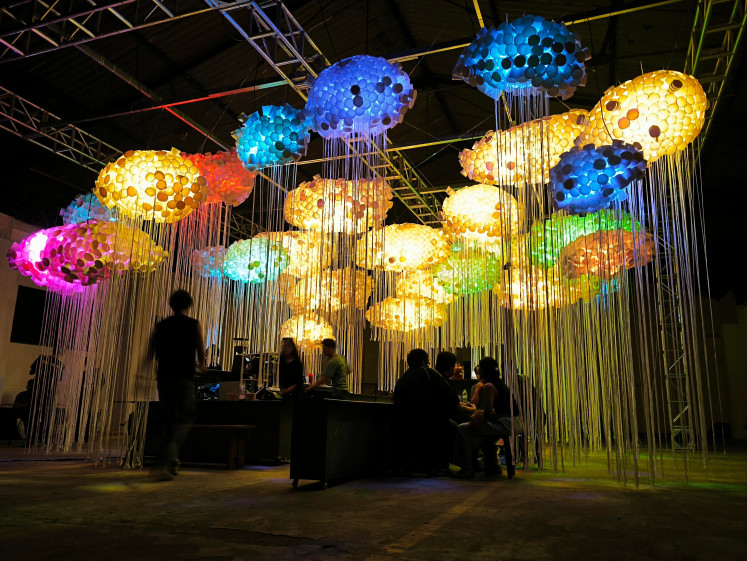
Coffee under constellations: Visitors chat and enjoy coffee on Oct. 3, 2025, inside Constellation Neverland 4.0, an installation by Sembilan Matahari Studio, during .BDG Lights 2025 at Laswi Heritage in Bandung. PHOTO: THE JAKARTA POST
The organizers brought together 25 collectives and artists to explore the relationship between light and shadow in Bandung’s urban spaces.
Among them, artist Dearista, in collaboration with OSTUDIO, presented Resonora, an installation made of plain, recycled fabric sheets illuminated by shifting projections of color. The hues, derived from sound recordings taken across different corners of the city, turned the space into a glowing acoustic landscape. Visitors moved among suspended cloths, immersed in a sensory reconstruction of the city’s layered moods.
Nearby, Studio Sembilan Matahari, active since 2007, collaborated with Modularbar on Constellation Neverland 4.0, an ethereal canopy of paper cups, threads and video projections. Beneath it, they opened a small coffee counter where visitors could sip coffee under rain-like threads illuminated by colored light – a quiet meditation on finding beauty amid the environmental crisis.
Illuminating urban issues
.BDG Lights evolved from the ITB Light Festival: Kinarya Immersiva, continuing its mission to strengthen Bandung’s identity as a creative city while addressing contemporary urban challenges through art.
Prananda noted that the festival was inspired by real urban conditions: unsafe pedestrian zones, dim corners, an overreliance on private vehicles and poor waste management systems.
“Many people have grown too accustomed to these urban problems,” he said. “We wanted to bring them back into awareness, to look at the dark, not ignore it.”
That concern took shape in Arup’s interactive installation Nyalakeun Bandung (Light Up Bandung). The piece featured a large screen projecting cityscapes alongside a set of multiple-choice questions for visitors.
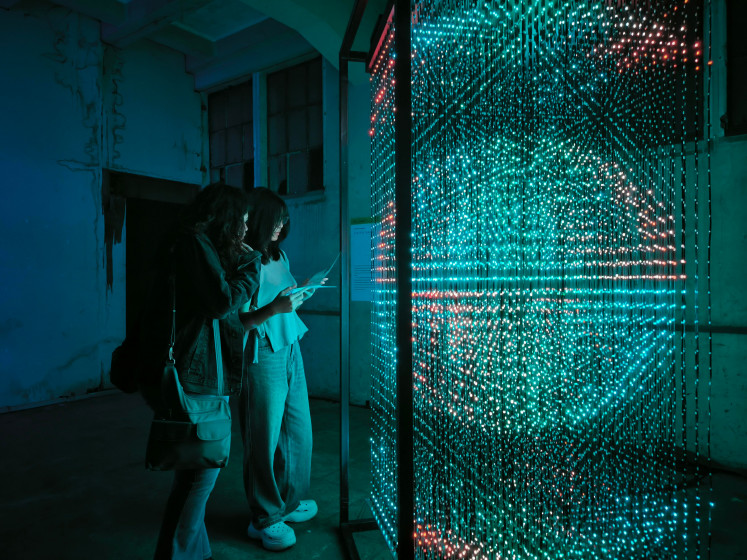
Threads of Light: Two visitors admire Digital Weave, an installation by Convert Texture that uses thousands of LED lights, on Oct. 3, 2025, during .BDG Lights 2025 at Laswi Heritage in Bandung. PHOTO: THE JAKARTA POST
Participants could select prompts like: “What’s Bandung’s biggest problem?”, or “If a public space feels dark, what lighting would you use – streetlights, wall fixtures or hanging lamps?”
Each response appeared in real time on the screen, turning the work into a living survey that visualized collective reflections on the city’s social and spatial conditions.
One of the most talked-about works was Under Constant Light by Era Premakara and [lamarina] Studio, which combined CCTV cameras, infrared sensors and artificial intelligence. As visitors stepped before the screen, abstract line drawings mirrored their movements, tracing their bodies in ghostly contours.
“It felt playful at first,” said Becca, 21, a student from Bogor studying in Bandung. “But then I realized there’s no privacy anymore. Everything is being watched.”
For Domus, 47, an ITB alumnus who visited with his son, the festival offered a glimpse into the possibilities of future art.
“It showed the endless possibilities that come from the collaboration between aesthetics and technology,” he said. Domus intentionally avoided reading the labels beside the artwork. “I wanted to experience the pieces without moderation. As an exhibition of dialectics, it was fascinating.”