

December 2, 2025
ISLAMABAD – Protecting children is not just limited to the provision of food, shelter, and education; it is also about ensuring their mental and emotional well-being.
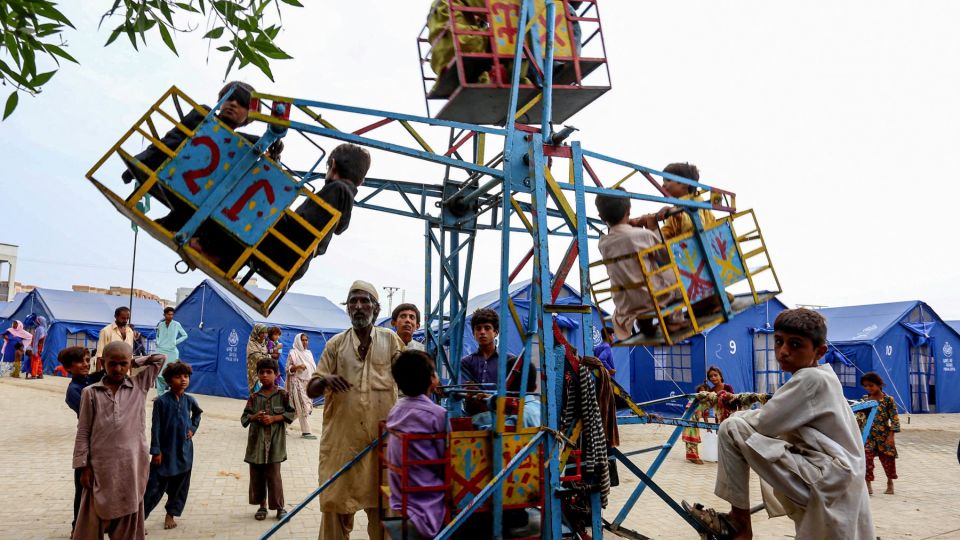
“My son used to be a happy child. Now, he won’t even step outside to play,” says a 28-year-old mother from Sanghar, a district in Sindh reeling from the devastation wreaked by the disastrous 2022 floods. “He clings to me and says that if he goes far, the floods will come again.”
“He fears he will lose me,” she adds.
The mother’s concerns and her son’s fears reflect a dimension of climate change that eludes discussions in policy circles: the psychological toll of disasters on children. While Pakistan has taken steps toward building climate resilience in recent years, this one fundamental gap remains unaddressed.
For many children across Sindh, Balochistan, Southern Punjab, and Khyber Pakhtunkhwa, floods do not end when the waters recede; they simply move inward. This boy’s trauma is not an isolated case; in fact, it shows a much larger, growing crisis.
Based on interviews conducted with parents in Sindh following the 2022 floods, approximately 70 per cent of participants reported that their children exhibited depressive symptoms linked to the fear of floods. Although the study provides valuable insights, research on the mental health impacts of climate-related disasters on children in Pakistan remains limited.
Nonetheless, similar challenges have been observed in other provinces, suggesting that flood-related anxiety and depression among children represent a broader, nationwide concern.
Unmasking trauma
These mental health challenges extend beyond the borders of Sindh, spreading far across the country, into villages nestled between mountains and ancient towns sitting on riverbanks.
Children in low and middle-income countries, such as Pakistan, are particularly vulnerable to climate change and the disasters it triggers, due to several biological, social, economic, and infrastructural factors. The same was also highlighted in a review published in PubMed Central, the premier source for biomedical literature.
Yet, despite growing attention to climate-resilient infrastructure and disaster response, Pakistan’s policies largely ignore the emotional aftershocks of catastrophic events.
In Sanghar, the 28-year-old mother sees the tremor of the 2022 disaster in her son every day. “If we force him to go to school in the morning, he complains of a headache or tummy pain,” she sighed. “But the doctors say there is nothing physically wrong with him.”
But psychologically, these aches mask deeper anxiety and trauma.
Unfortunately in Pakistan, mental health services are almost non-existent, and field visits to flood-affected districts reveal this stark reality. The seats of clinical psychologists at local health facilities and the positions for psychiatrists often remain vacant.
Without these services, children and families cannot fully recover or benefit from social protection measures.
Scattered promises
Pakistan’s social protection system comprises initiatives such as the Benazir Income Support Programme and the Benazir Nashonuma Programme, which primarily focus on income transfers, food security, and infrastructure support during and after emergencies.
They are vital lifelines for many families. But rarely do these programmes include mental health screening, counselling or community-based trauma support.
And this — ignoring psychosocial needs — undermines recovery. It is important to understand that a child struggling with anxiety cannot fully benefit from education or cash support programmes, and parents coping with trauma face additional barriers in rebuilding livelihoods.
Even though promising efforts have been undertaken in recent times, these attempts remain scattered.
In Khyber Pakhtunkhwa, the government is piloting a Mental Health and Psychosocial Support (MHPSS) model in partnership with German development agency GIZ, training a “Hamdard Force” of 500 community volunteers, equipping 80 primary-care doctors to identify and manage common mental health conditions, and deploying clinical psychologists to guide and supervise care.
This is one of the few government-led initiatives aimed at building a tiered mental health system at the community level. As important as these efforts are, they are still fragmented, provisional and donor-dependent, with no integration into Pakistan’s broader climate or social protection policies.
That said, Pakistan’s National Disaster Management Authority (NDMA) and National Climate Change Policy are increasingly integrating resilience planning, structural defences, and early-warning systems to address escalating risks from floods, glacial lake outburst floods, and shifting monsoon patterns.
Notably, the NDMA’s National Disaster Risk Reduction Policy (2025–2030) acknowledges the need for psychosocial support in recovery. However, such support is still not embedded as a consistent or well-funded component, and much of the actual service delivery for disaster-affected populations continues to rely on non-government organisations and short-term interventions.
The cost of ignoring mental health
When the mental health of our children is ignored, the cost borne is not just that of social injustice, but also economic. According to a 2022 National Commission for Human Rights report, the economic burden of untreated mental illness in Pakistan has been estimated at $6.2 billion, due to reduced productivity, lost opportunities, and underemployment.
The report also warns that because mental health services are poorly regulated, many unqualified actors provide counselling, thus exposing vulnerable people to human rights abuses, as the state fails to invest in ethical and accountable mental health care effectively. These figures underscore how mental illness is not only a health crisis but a drain on national development and resilience.
Untreated trauma in children has consequences that are seen far beyond the immediate fiscal loss. Persistent anxiety, depression, and post-traumatic stress disorder can impair cognitive development, reduce school attendance, and limit future productivity, which in turn undermines investments in education and social protection.
If Pakistan is serious about adaptive social protection, mental health must be treated as non-negotiable. Practically, this means integrating psychosocial support into disaster response, training community health workers and school counsellors nationwide, establishing trauma support units in high-risk districts, incorporating mental health indicators into social protection targeting, and ensuring that every climate response plan addresses emotional well-being.
Recent climate-related disasters have brought to the forefront the reality of not only rising water but also rising emotional vulnerability. Children exposed to such catastrophes face a higher risk of psychological illnesses, resulting in long-term consequences, including chronic mental health conditions, impaired social development and difficulty in coping with adulthood. If left unaddressed, this burden can accumulate across generations, undermining the effectiveness of broader social protection efforts.
It is therefore essential to open conversations on this crisis — invisible but indispensable. Protecting children is not just limited to the provision of food, shelter, and education; it is also about ensuring their mental and emotional well-being.
The fears of the child in Sanghar, who is afraid of losing his mother to another flood, are not only heartbreaking but also preventable. If Pakistan wishes to build genuine resilience, it must ensure that policies and social protection measures systematically integrate mental health interventions alongside disaster response and recovery efforts.
The author is a clinical psychologist and assistant professor at the Institute of Business Administration.