

December 8, 2025
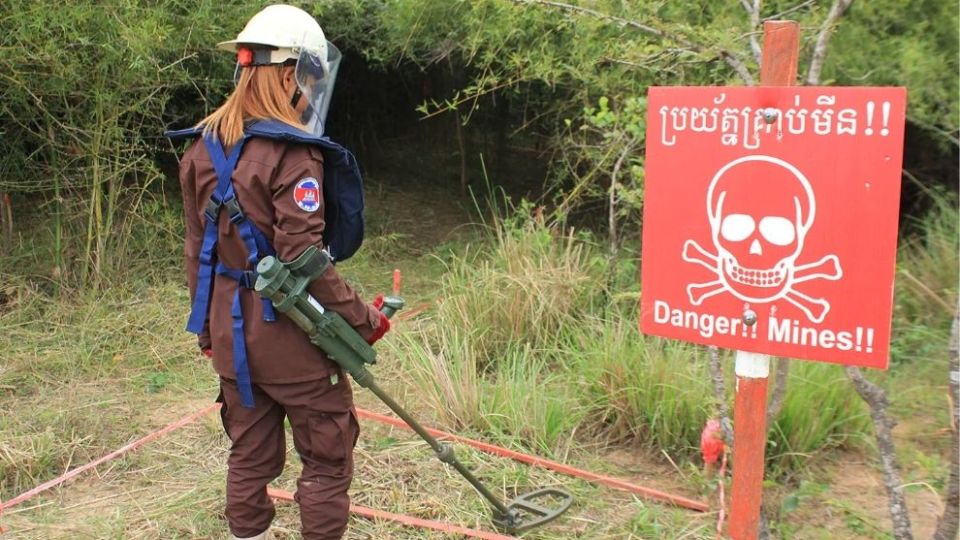
PHNOM PENH – Cambodia has received formal approval for a new deadline to complete its nationwide anti-personnel mine clearance, after state parties to the Anti-Personnel Mine Ban Convention unanimously backed the country’s third extension request, during a meeting in Geneva from December 1–5.
The decision sets December 31, 2030, as Cambodia’s revised target for fulfilling its obligations under Article 5 of the Ottawa Convention, an extension to the Kingdom’s decades-long effort to eliminate landmines left from past conflicts.
According to the Cambodian Mine Action and Victim Assistance Authority (CMAA), the approval reflects strong international confidence in Cambodia’s mine action programme and its “sustained leadership, strong commitment and substantial efforts” in recent years.
Cambodia became a state party to the Ottawa Convention in 2000 and has already requested two previous deadline extensions: the first from 2010 to 2019, and the second from 2020 to 2025. The Kingdom has faced several challenges meeting the previous deadlines, including a lack of resources and the discovery of additional contaminated areas, particularly along the Thai-Cambodian border.
Cambodia has cleared 3,300 square kilometres of contaminated land and destroyed more than four million landmines and explosive remnants of war (ERWs) to date — work that has reduced casualties, boosted community safety and supported economic development across former conflict areas.
Despite this progress, the convention members and Cambodian officials acknowledged that the hardest work lies ahead, particularly in heavily contaminated border zones where thick forests, mountainous terrain and extensive minefields continue to pose extreme risks.
“These areas remain difficult to access and require additional resources and strengthened partnerships,” the CMAA noted, warning that clearing the remaining contamination will demand sustained international support.
Cambodia used the Geneva meeting to renew its appeal to friendly nations, development partners, mine action operators and the private sector to continue backing its push toward a “Mine-Free Cambodia 2030”.
The CMAA expressed gratitude to donors and partners for their long-standing assistance, saying their contributions have been instrumental in transforming former battlegrounds into productive farmland, transportation routes and community settlements.
As Cambodia enters the final stretch of mine clearance, the new 2030 deadline serves as both an opportunity and a warning: the country is closer than ever to achieving its mine-free ambition, but the remaining challenges are some of the most complex it has faced.
ICRC urges stronger global commitment
The International Committee of the Red Cross has urged governments to reinforce their commitment to the Anti-Personnel Mine Ban Convention, warning that global support for the treaty is beginning to erode at a time when armed conflicts are increasing.
Addressing the 22nd Meeting of States Parties, the ICRC Vice-President Jürg Lauber said mine casualties climbed to more than 6,000 last year — 90 per cent of them civilians — underscoring the severe humanitarian and economic toll of landmine use.
The ICRC called on states to act in four areas: first, fully implementing the convention at the national level; second, strengthening the stigma against anti-personnel mines by clearly condemning any use; third, urging countries considering withdrawal to remain committed; and fourth, pressing non-member states to join without delay.
The ICRC pledged continued support, stressing that political will is essential to maintain the convention as a cornerstone of civilian protection.
Cambodia’s role in the Ottawa Convention
Cambodia has been a committed member of the Anti-Personnel Mine Ban Convention since signing the treaty on December 3, 1997, and formally ratifying it on July 28, 1999, with the Convention entering into force for the country on 1 January 2000.
As a state party, Cambodia is legally bound to eliminate anti-personnel mines, destroy stockpiles and clear all known contaminated areas under Article 5 obligations.
Its longstanding participation places Cambodia among the earliest adopters of the Ottawa Convention in Southeast Asia, reflecting the country’s determination to address one of the region’s heaviest legacies of landmines.
Cambodia’s continued engagement — most recently through its request for a third extension to complete nationwide clearance — underscores its status as a frontline State Party implementing the treaty’s humanitarian and security goals.