

December 11, 2025
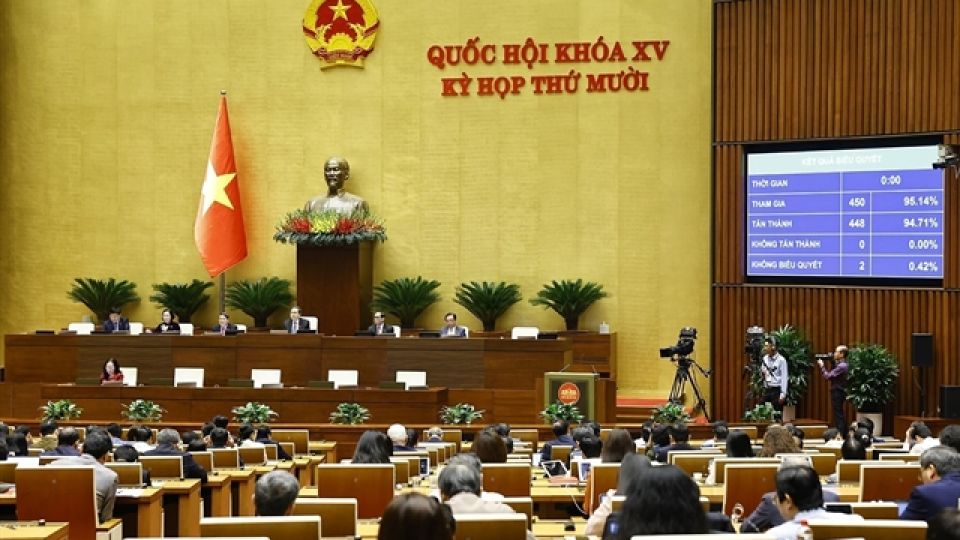
HANOI – With the amended Population Law passed by the National Assembly (NA) on Wednesday, working mothers giving birth to their second child will receive seven months of maternity leave, an increase of one month compared to the previous regulations.
Their husbands will also receive 10 more days of paternal leave for the birth of their second child. If the couple have twins, the second child policy will be applied.
The revised Population Law, approved by 448 out of 450 NA deputies, marked a shift in policy focus from family planning to population and development.
Notably, it abolishes regulations limiting the number of children, revoking the decades-old phrase ‘each couple should only have one to two children’ in the Law on People’s Health Protection.
These are replaced by policies aimed at maintaining replacement fertility (an average of 2.1 children per woman of reproductive age), in which individuals and couples have the right to decide the number of children, timing and spacing of births.
According to the health ministry’s Department of Population director Lê Thanh Dũng, Việt Nam was the first country in the world to develop and approve a law on population.
Per the revised law, the State will provide financial support to women from extremely small ethnic communities, in areas with low fertility rates, or who have two children before the age of 35.
Individuals who bear two children or more will be prioritised in purchasing, renting or rent-to-own social housing.
The updated Population Law also tightens regulations to reduce sex imbalance at birth, strictly prohibiting all forms of fetal sex selection. Notably, informing or disclosing fetal sex for sex-selective abortion is defined as a prohibited act. Health practitioners who disclose fetal sex for this purpose will have their medical licenses suspended.
Regarding policies on adapting to population ageing and improving population quality, the law encourages people to prepare financially, physically and psychologically for old age early on, and to participate in social insurance and public or private health insurance.
The State will also prioritise the development of geriatric hospitals and human resources for elderly care.
Premarital counselling and health check-ups are encouraged. Depending on budget conditions, provincial authorities may decide to provide financial support for these services.
Screening costs for certain congenital diseases in pregnant women and newborns will be covered by the State budget and public health insurance according to a phased roadmap.
The Population Law takes effect on July 1, 2026. Provisions on financial support for women in low-fertility localities and for women who have two children before age 35 take effect six months later, on January 1, 2027.
Disease prevention law
On the same day, the NA also voted to pass other important new and updated laws, including the Law on Disease Prevention.
This law, taking effect on July 1, 2026, introduces breakthrough financial mechanisms for periodic health check-ups and screenings.
Accordingly, Vietnamese citizens will be guaranteed at least one free annual medical check-up or screening, in alignment with a phased implementation and prioritised groups. Funding sources include the State budget, private resources, and the national health insurance fund.
Unlike previous regulations that focused primarily on infectious diseases, the new law dedicates separate chapters to mental health and nutrition.
It also specifies incentive policies for grassroots health workers and preventive health facilities, notably scholarships for studies in preventive medicine and public health as well as financial support for students enrolled in health-related public education institutions.