


December 23, 2025
DHAKA – On a wintry Sunday night in late November 2025, in the northern Bangladeshi district of Ishwardi, a housewife and mother of a four-year-old boy gathered eight beautiful newborn puppies, wrapped them in a sack, and drowned them in a nearby pond. The mother of these street puppies was not around when this “inhuman” act took place. When she returned, she was not only visibly distressed and disoriented, but also in physical pain, her body heavy with unweaned milk—a visual display of this agony is circulating on social media.
This human-made tragedy, however, was partially remedied by “humans” themselves. A young man brought two newborn puppies from his own pet dog and gently introduced them to the grieving mother. He let her milk soak the puppies’ fur so that they would not smell unfamiliar, then placed them beside her. After some hesitation, she accepted them. The next day, by coincidence, a dog in a neighbouring district died, leaving behind two puppies. They, too, were brought to the mourning mother. With this second adoption, her family, in some fragile way, was restored.
Beyond the immediate question of what counts as “human” or “inhuman”, this story opens onto themes that we get to know little of. It was later learned that the housewife—whose act of clandestine violence was testified to by her own young son—had acted on the advice of a beggar who walked that neighbourhood daily. For a mobile street beggar, a lane free of dogs is a territorial issue: fewer animals to compete with for scraps, fewer sudden threats on the road. That territorial anxiety is rooted in a chronic scarcity, for both men and dogs, that ebbs and flows with the seasons.
November—or Agrahayan, in the Bengali calendar—is the time when paddy is harvested; there is relatively more food, a bit of spare cash, a little more abundance, and a little more waste. Street dogs with new litters and itinerant beggars seeking extra leftovers are both responding, in different ways, to this seasonal opening.
So the headline that ignites public outrage—”Cruel housewife kills eight puppies”—is really just the tip of a long, submerged pyramid of stories. Beneath it are cascading layers that draw us into the tangled realities of human and more-than-human lives, all sharing the same streets, seasons, and scarcities.
How, then, do we locate this story within the emerging field of environmental humanities? It clearly illuminates interspecies relations and care, the psychology of fear and scarcity, questions of animal welfare, and the silences or ad hoc reactions of local governance. But it also exposes the epistemic boundaries of the discipline itself. Like many powerful ideas of the last few centuries, environmental history and environmental humanities were incubated primarily in the Global North. It is encouraging that institutions and scholars in the Global South—from South Asia to Latin America and Africa—are now entering these conversations. Yet the epistemic gap remains: how much does the Global North really know, or want to know, about the everyday ecological and ethical worlds of the Global South?
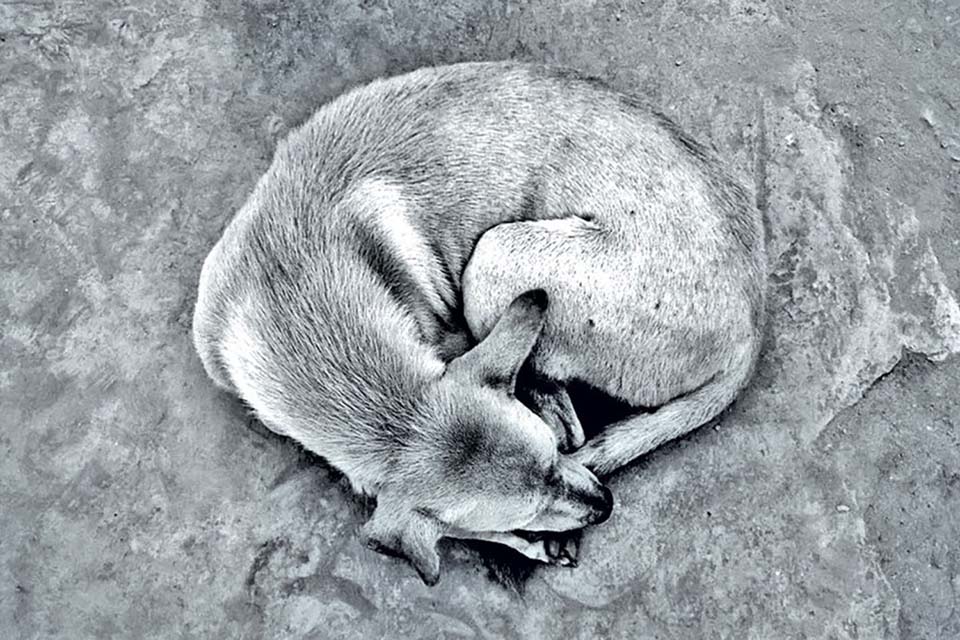
The writer says: “Long live an environmental humanities that dares to think with grief, with poverty, and with mummy dogs in places like Ishwardi—an unknown town in a small country in the Global South.” PHOTO: COLLECTED/THE DAILY STAR
That gap is not just about knowledge; it is built into the material conditions that shape the vulnerability of non-human species and the historical construction of global spatial inequality. If environmental humanities is serious about interspecies ethics, it has to remain open to questions of inequality, poverty, and precarity, especially under climate change, which adds new territorial and existential contests that see a slow erosion of empathy across species lines. This emerges from a situation in which humans—good, bad, and the nonchalant—are left with limited choices for being and becoming in relation to nature.
Late-twentieth-century environmental history in the United States, where the discipline took shape, was criticised for sometimes reflecting a largely middle-class conservation sensibility. One hopes that environmental humanities, with its enormous critical potential, will avoid a similar censure. Long live an environmental humanities that dares to think with grief, with poverty, and with mummy dogs in places like Ishwardi—an unknown town in a small country in the Global South.
Dr. Khondker Iftekhar Iqbal is an Associate Professor at Universiti Brunei Darussalam. He can be contacted at [email protected]