

February 3, 2026
TOKYO – Learning makes life rich regardless of how old a person is. More and more universities are offering courses for middle-aged and senior citizens to learn and study again.
How are such people, who have plenty of life experience, spending their time on campus?
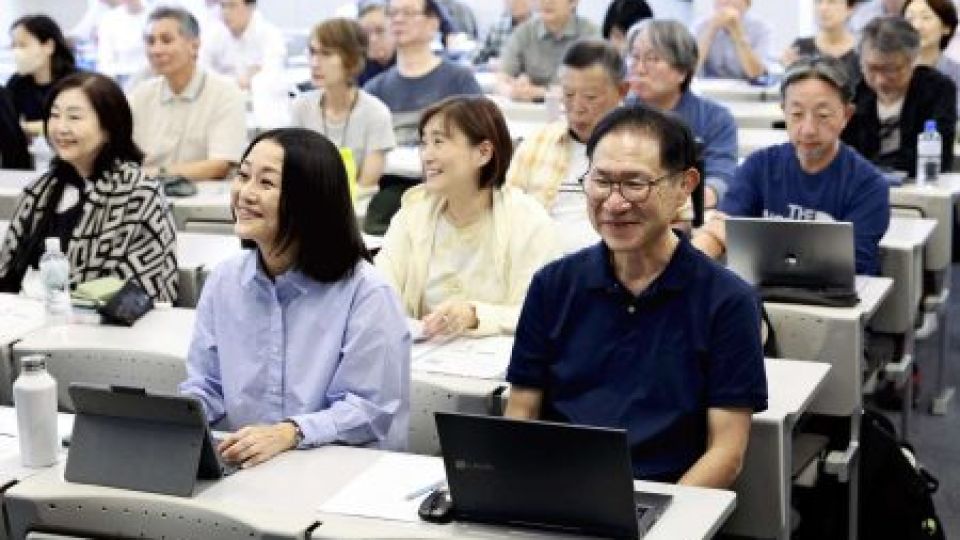
On Rikkyo University’s Ikebukuro campus in Tokyo, which is known for its ivy-covered brick buildings, a lecture on finance theory was being held in late September.
The about 60 students enthusiastically listening to the lecturer were older than the typical university student.
The lecture was part of the Rikkyo Second Stage College course. The university launched the course in 2008 for people aged 50 or older to return to study and take on fresh challenges.
In this one-year general course, students attend lectures and seminars mainly on weekday afternoons. If they get a total of 18 college credits, they are given a certificate of having completed the course curriculum under the School Education Law. For people who want to study further, a further year in a specialized course is available.
The average age of students taking these courses is 63 to 64. Their backgrounds vary, from those who have retired to those who are studying while working as company employees.
Tamaki Kubomura, one of the students, quit a job at a major manufacturing company in 2024, before reaching the mandatory retirement age. She considered taking another job at a different company, but then she thought, “I want to upgrade myself by learning about artificial intelligence.”
She passed the college’s entrance exam, which comprised a themed essay and an interview, and enrolled this year.
She attended lectures on the topic of sports and the media, then researched professional baseball and the Olympics. In a class about designing study activities based on art, she made pictograms.
“As opposed to studying in my teens, which I felt I was obliged to do, I feel deeply that learning makes my life richer and studying does not have an end,” she said.
She added with bright eyes, “Attending lectures made me notice there are piles of social issues still to be tackled. For such purposes as helping seniors who are left behind by all the digital technology in today’s society, I want to contribute by utilizing AI skills.”
Hitoshi Masuyama, another student at the college, said: “I had done everything I needed to do as a worker. I wanted to place myself in a new world and consider what I would do next.”
He previously graduated from a resource engineering faculty at a university, worked in environment-related operations at a nonferrous metal maker for many years and then enrolled at Rikkyo Second Stage College after quitting due to reaching the mandatory retirement age in 2024.
“I wanted to study in a field that was not familiar to me,” he said. So, he proactively took subjects about literature and history. He also learned about and became interested in nonprofit organizations and volunteering.
It is appealing to him to be able to make friends unrelated to his former employer. He took an overnight trip with fellow students from a seminar to Atami, a hot spring resort in Shizuoka Prefecture.
Regarding his future, Masuyama enthusiastically said: “Japanese society today lacks awareness about mutual help. I want to belong to NPOs or volunteer organizations so that I can engage in cultural promotion and international exchange.”
Building on practice, experience
Teinengo Laboratory, a general incorporated association, conducts research and provides training for careers and ways of living after the mandatory retirement age. Takeshi Ikeguchi, head of the lab, spoke to The Yomiuri Shimbun about what it means for middle-aged and senior citizens to study again at university. The following is a summary of his comments.
“Because the career paths of Japanese company employees are driven by company-led placements and position transfers, many of them struggle to think about a career after retirement. Most of them have little experience of changing jobs, and it is hard for them to realize their own strengths and potential.
“One benefit of studying at university again is that they can combine research-backed insights from experts with their own skills and experience. It is also an opportunity for them to discover whether their knowledge and experience could be useful for society and how to utilize them. It is also a great way to associate with people they wouldn’t have met through their company jobs.
“If they enroll in such courses while still employed, there are likely to be many opportunities to apply what they have learned to their jobs, and they will be better able to set goals for their post-retirement years. Even if they do not have a clear career path, such as getting a new job, learning at university can satisfy their intellectual curiosity, and walking around a campus with lively young people can be a great stimulus.
“It is important that they leave behind the names of their employers or job titles when coming to the class. Being able to do things that are not an extension of their career is the appealing thing. Interacting on the same level can lead to a new phase of life.”
More courses for adults offered at schools
An increasing number of universities have launched reskilling courses for working adults, as Rikkyo University did.
According to the Education, Culture, Sports, Science and Technology Ministry, the number of universities with course curriculum programs, in which students can obtain certificates of having completed course curricula, was 239 in total in fiscal 2023.
The number rose by 56 from fiscal 2019, when there were 183.
Subjects vary widely. For example, Waseda University’s Career Recurrent College course is for working adults aged 40 to 65. Students learn how to design their careers for the latter half of their lives, including while working as employees.
For about half a year, the students learn how to think for themselves without leaning on the organizational structures of companies through lectures and group work among students of different ages, occupations and backgrounds.
Meiji University opened a smart career program for women with two courses. One is a six-month general business course for those aiming to become leaders or managers. The other is a four-month basic business course to learn business culture.