

March 5, 2026
SEOUL – President Lee Jae Myung on Wednesday set out priorities for a new phase of economic cooperation with the Philippines centered on energy, infrastructure modernization and manufacturing, urging business leaders to invest and seize emerging opportunities.
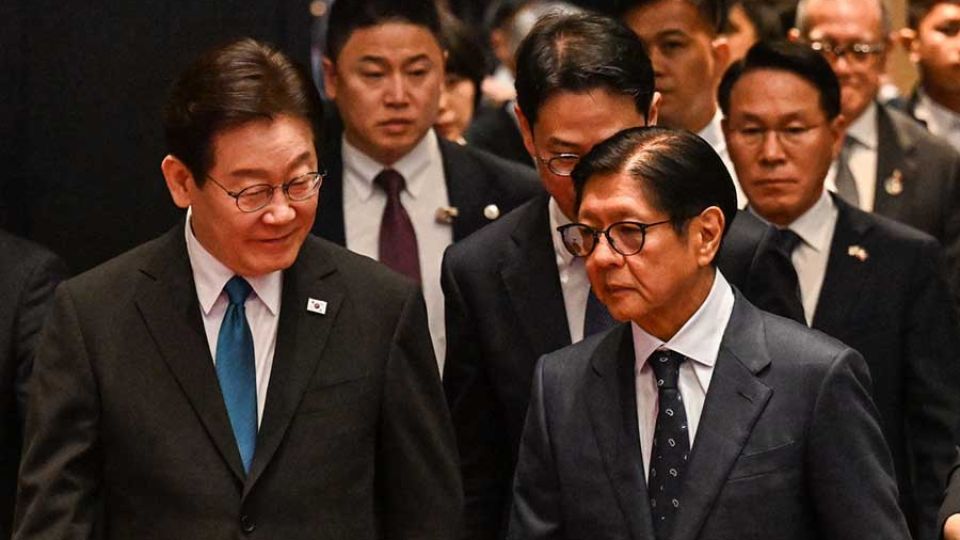
Lee delivered the remarks at the Korea-Philippines Business Forum on Wednesday, which he attended alongside Philippine President Ferdinand Marcos Jr. and about 250 business leaders and government officials from both countries.
He underscored the importance of “manufacturing cooperation to build a more solid foundation for trade.”
“The Philippines has critical minerals such as nickel and cobalt, while Korea has advanced manufacturing technologies in high-tech industries such as semiconductors and electrical and electronics,” Lee said during the business forum — the first such event held in Southeast Asia since his inauguration in June 2025.
“Based on this mutually complementary industrial structure, the two countries will be able to generate strong synergies,” Lee added, calling for both countries to move toward future-oriented manufacturing cooperation, including AI-driven manufacturing.
Lee expressed hope that Seoul and Manila would deepen “mutually complementary economic cooperation,” citing ships built by HD Hyundai Heavy Industries — the world’s largest shipbuilder — at the Subic shipyard in the Philippines.
“I am confident that before long, ships built at the Subic shipyard will carry products produced in the Philippines to markets in Asia and around the world, opening a new era of trade.”
On energy cooperation, Lee noted that the Philippines is working to introduce commercial nuclear power by 2032 and is moving to expand renewable energy, such as solar.
“If Korea’s world-class nuclear technology and clean-energy supply capabilities are combined with these efforts, the two countries could build a stable and environmentally friendly energy system together,” he said.
Concerning infrastructure cooperation, Lee noted that the Philippines is pushing ahead with large-scale infrastructure modernization, with many Korean companies taking part and expanding cooperation. The Luzon Economic Corridor project and the Marcos administration’s flagship Build Better More infrastructure development program are the key examples.
In his speech, Marcos underscored the importance of partnership, saying “resilience is built not in isolation, but in partnership.”
“Together we can secure a future where both nations are self-sustaining, competitive and prepared for the demands of tomorrow.”
Heavyweights from Korea, Philippines pack forum
From the Korean side, major companies in the shipbuilding, electrical and electronics, automobile and consumer goods sectors participated. From the Philippine side, companies from various sectors, including finance, distribution and food manufacturing, joined to discuss ways to expand economic cooperation between the two nations.
The 150 Korean attendees included Lotte Group Chairman Shin Dong-bin, HD Hyundai Chairman Chung Kisun, SK Vice Chair Lee Hyung-hee, Samyang Foods Vice Chair Kim Jung-soo, Samsung Electronics President Kim Won-kyong and LG Electronics President Jeong Dae-hwa.
Around 100 Philippine attendees included SM Prime Holdings Chair Hans T. Sy, President and CEO of Alliance Global Group Kevin Andrew Tan, President of Cathay Pacific Steel David Chua and President of Cathay Metal and Cathay Land Jeffrey Ng.
Ryu Jin, chair of the Federation of Korean Industries and head of Poongsan Group, and Ferdinand Ferrer, president of the Philippine Chamber of Commerce and Industry, also attended the event.
Nuclear power, shipbuilding, critical minerals
On the occasion of the business forum, a total of seven memorandums of understanding in areas such as shipbuilding, nuclear power, food, medical devices and others were signed in the presence of the industry ministers of both countries, according to Cheong Wa Dae.
Notably, Korea Hydro and Nuclear Power, the Export-Import Bank of Korea and the Philippines’ Manila Electric Co. signed an “MOU on New Nuclear Power Cooperation.” Cheong Wa Dae explained that the memorandum aims to “collaborate on the joint development of business and financial models related to the introduction of new nuclear power plants.”
South Korea and the Philippines have been focusing their nuclear energy discussions on the possible restart and completion of the long-dormant Bataan Nuclear Power Plant, which has never entered commercial operation since its completion in 1984. Both sides signed a memorandum of understanding on a joint feasibility study for the potential resumption of construction at the Bataan plant on the sidelines of a bilateral summit in Manila in October 2024.
HD Hyundai Heavy Industries and the Philippine Technical Education and Skills Development Authority signed an agreement on cooperation for the technological development of the shipbuilding industry.
The memorandum is “expected to accelerate the training of skilled shipbuilding personnel and the expansion of the related workforce supply,” according to Cheong Wa Dae.
South Korea ranks second and the Philippines fourth in the world in terms of shipbuilding output.
Korea Mine Rehabilitation and Mineral Resources Corp. and the Philippines’ Mines and Geosciences Bureau under the Department of Environment and Natural Resources inked a memorandum. Cheong Wa Dae explained that the agreement aims to “strengthen the critical minerals value chain and (push) for joint exploration and development,” information sharing and other aims.
Before attending the business forum, Lee visited the Korean War Memorial Pylon — a monument commemorating 112 Filipino soldiers who perished during the 1950-53 war — and met surviving Filipino veterans and their families.
The Philippines was the first Asian country outside the Korean Peninsula to dispatch troops to the Korean War, and it was the largest troop contributor among Asian countries.
Before returning to Seoul, President Lee wrapped up his state visit to the Philippines with a luncheon meeting with members of the Korean community.
After returning home, Lee is set to convene an extraordinary Cabinet meeting on Thursday, in addition to the regular weekly Cabinet meeting on Tuesday, to receive briefings from the Ministry of Economy and Finance and the Foreign Ministry on the ongoing and widening war in the Middle East, as well as to review and discuss the government’s response.