

March 26, 2026
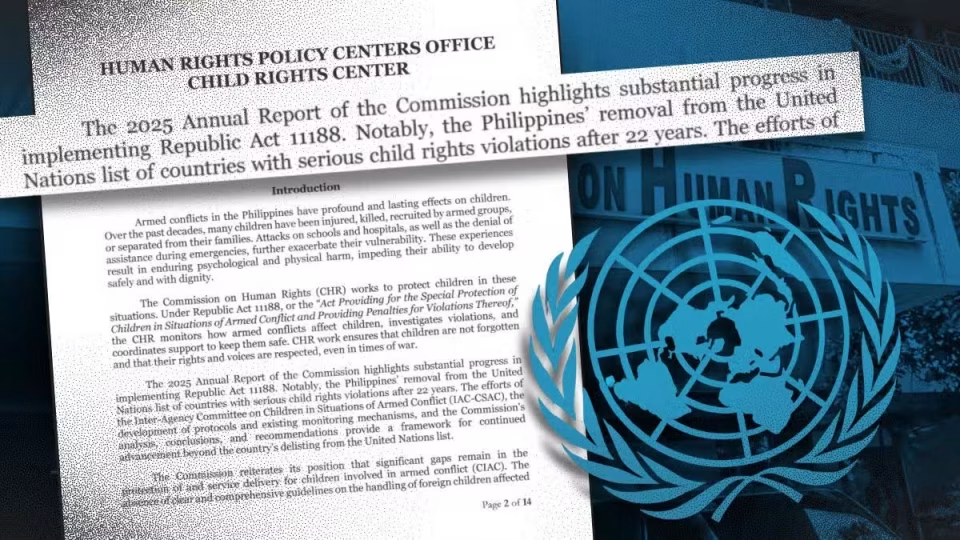
MANILA – The Commission on Human Rights (CHR) welcomed the Philippines’ removal from the United Nations (UN) list of grave child rights violations related to armed conflict, calling it a milestone in efforts to protect children in areas affected by fighting.
The CHR said the delisting highlights “sustained national efforts to strengthen the implementation of Republic Act 11188,” also known as the Special Protection of Children in Situations of Armed Conflict Act.
Enacted on Jan. 10, 2019, the law declares children as “Zones of Peace” and mandates special protection for minors younger than 18 who are involved in or affected by non-international armed conflicts.
The CHR said the development is detailed in its 2025 Annual Report on Children in Situations of Armed Conflict (CSAC), which pointed to key institutional mechanisms established by the government and civil society to protect children, particularly the Inter-Agency Committee on CSAC.
READ: UN voices concern over child warriors in PH
The Philippines was first listed in 2003 because of the recruitment, use and killing of children by armed groups.
RELATED STORY: UN records the highest number of ‘grave violations’ against children in conflicts
As stated in the UN Security Council’s first resolution on children and armed conflict in 1999, the six grave child rights violations are: killing and maiming of children, recruitment or use of children as soldiers, sexual violence against children, abduction of children, attacks against schools or hospitals, and denial of humanitarian access for children.
READ: Violence against children hit ‘unprecedented levels’ in 2024 – UN
The CHR said government protocols also strengthened child protection systems, including how the Armed Forces of the Philippines ensures that children encountered in operations are treated as “victims and rights-holders.”
‘All-in’ work
Meanwhile, the Department of Social Welfare and Development leads the care, custody and referral of children, recognizing them as survivors in need of protection and rehabilitation.
The Department of Education has issued guidelines promoting schools as Zones of Peace and discouraging their use for military purposes.
Civil society groups also worked for the milestone, the CHR said. These include the International Committee of the Red Cross, Plan International and Sulong Peace through programs on psychosocial support, education assistance and child protection advocacy.
The CHR also highlighted the Philippines’ participation in the UN Country Task Force on Monitoring and Reporting, which implements the UN Security Council Resolution No. 1612 Monitoring and Reporting Mechanism on grave child rights violations.
“[The] CHR continues to strengthen child protection in conflict settings,” it said.
These efforts include:
- Nationwide monitoring of grave child rights violations to improve response systems
- Development of CHR guidelines on monitoring, reporting and responding to CSAC cases
- Issuance of a Human Rights Advisory identifying gaps in the implementation of RA No. 11188
- Launch of a CSAC e-Course to address knowledge gaps among frontline service providers
- Conduct of Kabataan Karapatan Caravans to expand grassroots awareness of children’s rights
Protection gaps
The CHR recognized, however, that despite the milestone, resource and operational constraints, limited access to specialized psychosocial and mental health services, and gaps in reintegration programs continue to affect protection outcomes.
“Duty-bearers must consistently recognize children in conflict situations as victims whose rights and futures must be safeguarded,” it said.
The CHR said it remains committed to fulfilling its mandate to protect the rights of every Filipino child, including those in conflict-affected areas.
“Upholding children’s rights is a shared responsibility among government, civil society and communities to ensure that every child can grow in a society where their dignity and well-being are promoted and protected.” /dm