

May 28, 2026
SINGAPORE – Foreign Minister Vivian Balakrishnan has encouraged North Korea to engage constructively with the region and to keep channels open for dialogue, including by attending the ASEAN Regional Forum (ARF), stressing that such communication is more important than ever amid the ongoing global uncertainty.
Dr Balakrishnan was in North Korea on May 26 and 27 at the invitation of his counterpart, Ms Choe Son Hui, as part of a broader trip through North-east Asia, which also includes China and South Korea.
“We had a candid and wide-ranging exchange of views on regional security and international developments. I expressed my hope that our countries would continue to do our part to support peace and stability amid the challenging developments in the region,” Dr Balakrishnan said in a Facebook post on May 27, referring to his talks with Ms Choe.
Singapore’s Ministry of Foreign Affairs (MFA) said in a statement that he invited Ms Choe to attend the ARF, a diplomatic and security dialogue. North Korea has been a member of the forum since 2000.
“Our ties are friendly, built on mutual respect and continued engagement over the decades,” Dr Balakrishnan wrote on Facebook.
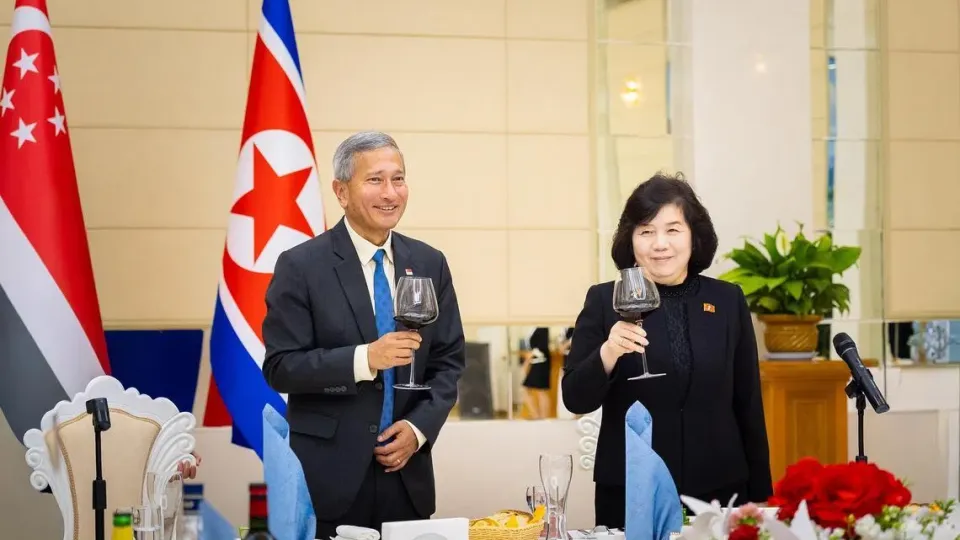
Both ministers also reaffirmed the “longstanding cordial and friendly relations” between Singapore and North Korea, said MFA. Dr Balakrishnan was also hosted to a welcome banquet by Ms Choe.
The visit comes as Singapore and North Korea marked the 50th anniversary of diplomatic relations in 2025 and took place against a more volatile backdrop on the Korean peninsula. Pyongyang said on May 27 that it test-fired new missile weapon systems, raising fresh concerns over security and stability in the region.
It was Dr Balakrishnan’s second trip to the reclusive country since 2018, when he visited Pyongyang ahead of a summit between US President Donald Trump and North Korean leader Kim Jong Un in Singapore in June that year.
In his Facebook post, Dr Balakrishnan noted that he was “glad to be back in Pyongyang” since his last visit, adding that he has encouraged his North Korean counterpart to attend the ARF.
“The DPRK remains an important member of the ARF, especially at a time when dialogue and diplomacy are needed more than ever,” he wrote, referring to North Korea by its official name, the Democratic People’s Republic of Korea.
North Korea did not attend the forum in Kuala Lumpur in July 2025, the first time it skipped the forum since joining in 2000. It was not invited by Malaysia, which was the ASEAN chair at the time. The Malaysian Ambassador to South Korea later told the Korea JoongAng Daily it was because the two countries had yet to restore diplomatic ties after Pyongyang cut ties in 2021.
The Philippines is set to host the 33rd edition of the ARF in Manila on July 23.
In Pyongyang, Dr Balakrishnan also called on Mr Jo Yong Won, chairman of the Standing Committee of the Supreme People’s Assembly, North Korea’s legislature. Mr Jo briefed Dr Balakrishnan on recent political developments in the country, while both men recalled Mr Kim’s historic visit to Singapore for the first US-North Korea summit.
Mr Trump and Mr Kim met three times during the US President’s first term, as the Republican leader worked to convince the North Korean leader to scale back his nuclear programme, efforts which ultimately failed.
Mr Kim was reported by state media as saying on Feb 26 that North Korea could “get along well” with the US if Washington accepted Pyongyang’s nuclear status.
Dr Balakrishnan’s stop in North Korea followed his meetings in Beijing earlier in the week, where he met Chinese Foreign Minister Wang Yi on May 25. Following the talks, both called for an immediate ceasefire in the Middle East and an end to the blockade of the Strait of Hormuz.
Dr Balakrishnan departed for South Korea on May 27 for the final leg of his working trip, on which he is being accompanied by officials from the MFA.
Daryl Loo is a senior correspondent covering China for The Straits Times.