

December 18, 2025
BUMTHANG – “I am drinking a cup of coffee,” His Majesty the King once told a group of college graduates. “The mug is from Thailand. The Milk Mate is Everyday. The coffee is Nestlé. So, the only thing from Bhutan is the water.”
The royal message landed quietly, but powerfully. It distilled a larger and more uncomfortable truth about Bhutan’s economy: the quiet ubiquity of imports, even in the most ordinary rituals of daily life, and the absence of trust in what the country can produce for itself.
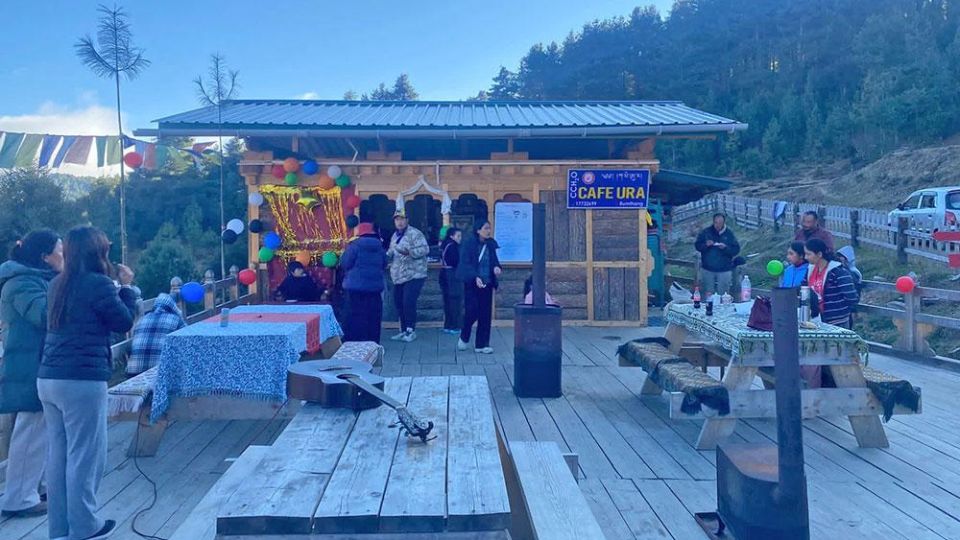
Three months ago, that profound thought took on a tangible form in a small café in Ura, Bumthang. CCH2O Café is modest in scale but it carries an unusually deliberate ambition. Its premise is simple and quietly radical: that a cup of coffee served in Bhutan can be Bhutanese from start to finish.
The beans are sourced from Tsirang. The cups are produced through the DeSuung Skilling Programme (DSP). The water comes from Kurjey. The bread is baked from locally grown buckwheat.
Each choice is intentional. The café gently challenges a long-held belief that café culture must rely on imported brands and products.
Behind the counter stands Karma Jurmin, a certified barista in his fifties, trained through DSP. For him, CCH2O is not merely a business venture. It is his personal response to His Majesty’s call for economic self-reliance.
His son, Karma Tenzin Dorji, 25, remembers the moment when the idea began to feel more real and less abstract. “I was at the hospital when my father showed me the video of His Majesty’s speech,” he said. “He told me this café wouldn’t be an ordinary café. It would come from those words.”
CCH2O stands for Coffee Cup Water.
“We named it Coffee Cup Water because we planned to have our own Bhutan-made coffee cups and water,” he said.
Motivated by that vision, Karma Tenzin Dorji enrolled in bakery training under DSP. There, he met two Desuups, who shared his enthusiasm and his uncertainty about what would follow. Two earlier members had left, leaving empty slots in the team. What seemed like a setback soon became an opening.
Today, CCH2O Café is run by five desuups trained in culinary arts, barista skills, bartending, and entrepreneurship development. The team – Karma Jurmin, Phurpa Wangmo Sherpa, Tsedhen, Ram Kumar Tamang, and Karma Tenzin Dorji – ranges in age from the early twenties to the fifties. They work across generations, combining youthful ambition with lived experience, learning and enduring together in close quarters.
“My father initially had eight desuups friends who trained in barista and food and beverage services. I was the ninth to join,” Karma Tenzin Dorji said. “By the time we were ready to build the café, only five of us remained. My father told us he would absorb the loss. So, we decided to go ahead.”
The early days were marked less by optimism than by persistence. The team stayed in a guest house provided by Karma Jurmin, their commitment outpacing their financial security. As construction began, practical obstacles emerged – funding gaps, logistical delays, and the physical strain of Bumthang’s unforgiving winter cold.
“Thanks to His Majesty’s blessings, we were able to overcome every issues,” Karma Tenzin Dorji said.
Support arrived quietly. The Bumthang Dzongkhag Administration provided land without charging rent and helped identify a site near a public washroom – an unassuming location that proved unexpectedly well-suited to foot traffic.
The café’s first coffee machine was purchased with Karma Jurmin’s personal savings. Additional equipment was obtained through a DSP loan. DSP also supplied cups, small gestures that carried outsized significance at the outset.
“We try to use local products as much as possible,” Karma Tenzin Dorji said. “That is the heart of what we are doing.”
The reality, however, is far from romantic. Long hours in the cold take a physical toll, and business is uneven. “Some days we have many customers,” he said. “Other days, barely enough. After repaying the loan, whatever remains is what we pay ourselves. For now, we are just managing.”
The five desuups come from different educational backgrounds. None of them has studied beyond Class XII.
What they may lack in formal qualifications, they make up for with skill, commitment, and shared belief in the idea they are serving.
Despite the uncertainty, the team is already looking ahead. Plans are underway to open another café in Tsirang, closer to the source of their coffee beans, an expansion that would complete a small but deliberate circle.
For the 118th National Day celebrations in Bumthang, the team has set up a temporary stall in Chamkhar town. It is a modest presence amid the ceremony, carrying a profound meaning – a national vision can sometimes be poured, patiently, one cup at a time.