

August 14, 2025
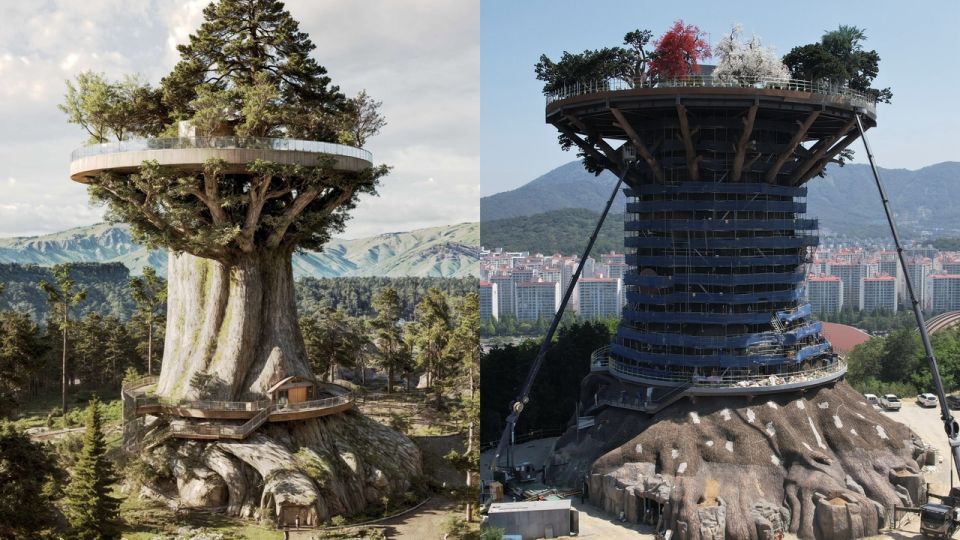
SEOUL – A South Korean port city’s attempt to build a landmark attraction to draw visitors has run into public backlash, with critics calling its new 34.4 billion won ($24.8 million) “Big Tree” observation tower a costly disappointment.
The Big Tree, which rises 46.5 meters in Changwon, southeastern South Korea, was inspired by the towering Supertrees at Singapore’s Gardens by the Bay. It was designed to anchor Daesang Park, a public-private partnership development worth about 1 trillion won ($720 million), and to serve as a draw for both domestic and international visitors.
The tower offers 360-degree views of Masan Port, Dotseom Island and Muhaksan mountain, but as recent local media reports and public commentary have noted, its squat proportions, sparse artificial foliage and incongruous decorative animal statues have left many residents underwhelmed.
Changwon, home to just over one million people, is an industrial and shipping hub near the southeastern tip of the Korean Peninsula. It became a “special city” in 2022 under South Korean law, granting it some additional autonomy over development projects.
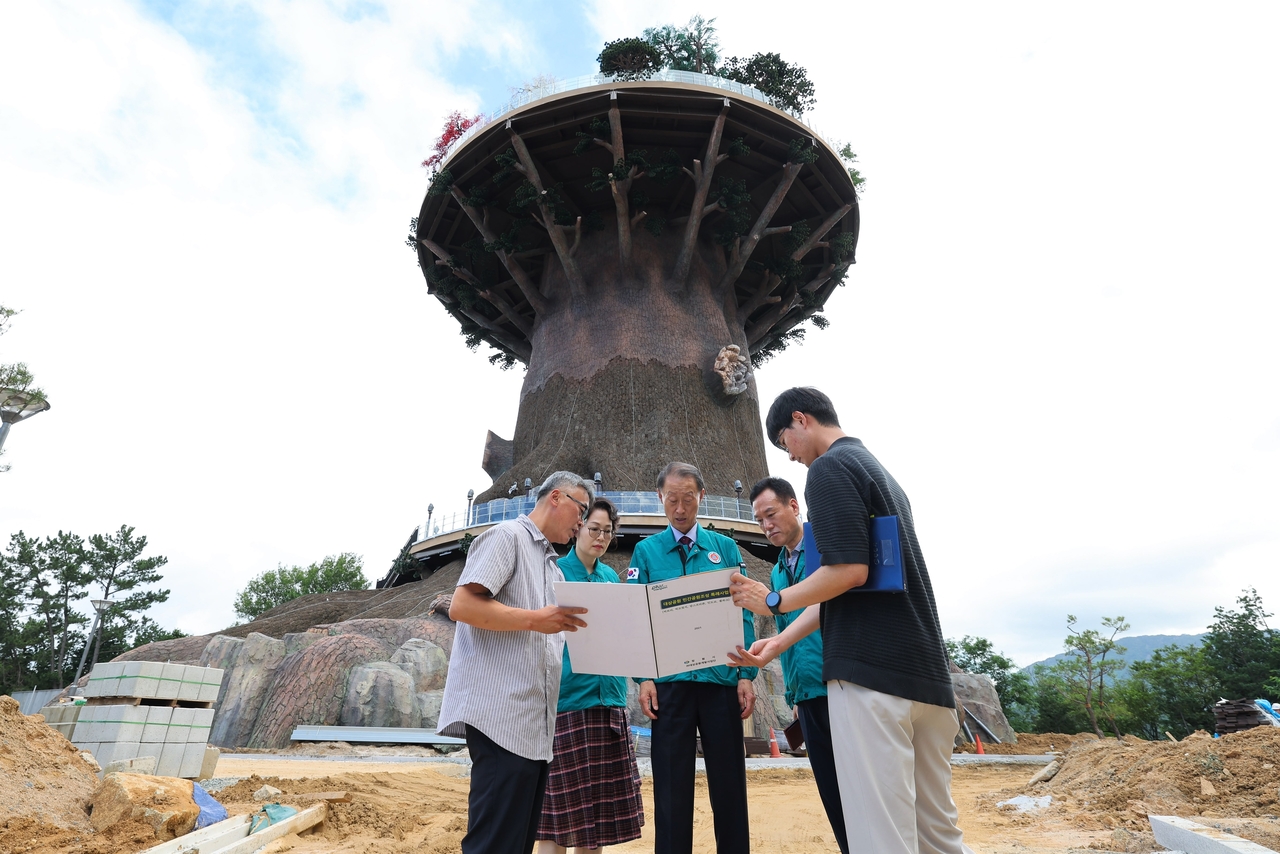
Changwon City Council Chair Son Tae-hwa (centre) reviews construction progress on the Big Tree at Daesang Park on July 21 as part of the city’s public–private park development project. PHOTO: CHANGWON CITY/THE KOREA HERALD
City officials promoted the Big Tree as a signature tourist attraction that could help alleviate South Korea’s long-standing problem of tourism being concentrated in Seoul. According to the Korea Culture and Tourism Institute, 78 percent of foreign visitors in 2024 spent time in the capital, compared to just 16.5 percent in Busan, 11.2 percent in Gyeonggi Province and 10.9 percent on Jeju Island.
The tower was built under a public-private partnership, a model widely used by Korean municipalities to avoid losing undeveloped urban parkland to private use under the country’s “urban park sunset law” that took effect in 2020. In Changwon’s case, the private developer agreed to build most of the park facilities, including the Big Tree, and transfer them to the city, while retaining about 12.7 percent of the site for a 1,779-unit apartment complex and other revenue-generating properties.
City officials have now confirmed that the Big Tree’s upper structure will be redesigned, but they expect this process to take at least a year. The redesign will be selected through a nationwide competition and citizen consultations. Even if work proceeds smoothly, the city estimates construction could only start in the second half of 2026.
In response to negative feedback, Changwon has decided not to charge an entry fee when the tower begins official operations on Oct. 1.
Local media inspections in recent weeks described artificial leaves arranged so sparsely they seemed unfinished, and interior plant sculptures that were clearly fake. Some small details, such as a few realistic-looking faux plants, drew brief curiosity, but most of the decorative elements were identified as looking “too artificial.”

Changwon City Council Chair Son Tae-hwa (second from left) inspects construction progress on the Mom’s Free Zone facility at Daesang Park on July 21. PHOTO: CHANGWON CITY/THE KOREA HERALD
Another key feature of Daesang Park is the “Mom’s Free Zone,” a literal translation from Korean that may sound awkward in English. The name reflects its original idea: a safe indoor space where mothers could take a break — “free” from childcare — while children played in a clean, pollution-free environment.
Proposed in 2020 amid public concern over fine dust, it was envisioned as a mix of play areas, lounges, and cultural spaces.
The 5,000-square-meter building, costing about 25 billion won (around $18.1 million), sits next to a new 1,779-unit apartment complex being built under the same public–private project.
It was designed with these future residents, especially young families, in mind. But nearly five years on, the facility is still an empty shell, with no set plan for its contents or operator, and no dedicated parking.
A consulting study due in September may propose uses such as a kids’ café, library, or coffee shop, but the city has already extended the completion deadline to February 2026, long after the apartments open this October.