

March 23, 2026
KUALA LUMPUR – A pass in the SPM History Paper is listed as one of the requirements for Chinese independent school graduates with Unified Examination Certificate (UEC) to apply to public universities.
How different is the history taught in Chinese independent school compared to national school?
Sin Chew Daily spoke to veteran historian Tang Ah Chai, former Associate Professor Dr Helen Ting Mu Hung from Institute of Malaysian and International Studies, Universiti Kebangsaan Malaysia and retired educator Dr. Cheong Yuen Keong to find out the similarities and differences, based on the curricula and teaching materials.
Tang, Dr Ting and Dr Cheong are consultants for the History subject committee under the Dong Jiao Zong independent school working committee, who have long been involved in research and discussions relating to history curriculum and teaching materials.
In their view, the aspiration captured in the slogan “Hopes and consensus: our shared history” represents both the vision and the guiding principle for discussion on history textbooks.
Most importantly, they agree that the content of history must be based on historical facts where the histories of all ethnic groups are to be presented in a comprehensive and balanced manner.
Tang Ah Chai: Chinese independent schools must have an overall plan for history textbooks
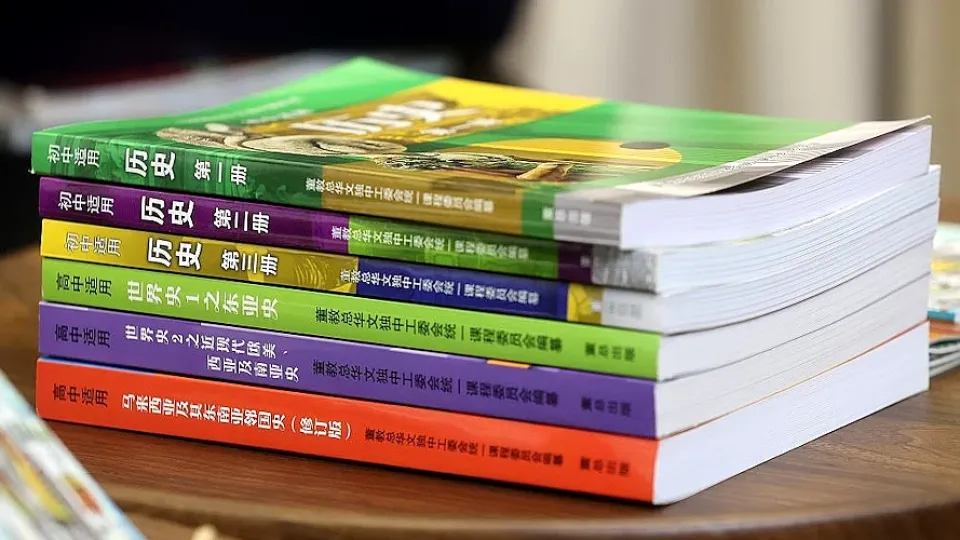
Tang said that the history textbooks used in Chinese independent schools are compiled by the History Subject Committee under the Dong Jiao Zong Independent School Working Committee, with contributors made up of academic researchers and experienced teachers who have spent many years in the classroom.
He explained that the independent school history textbooks have been developed with comprehensive consideration given to theory, conceptual framework, and practical teaching needs—including how the curriculum should be structured and how many lessons are required to cover the material adequately.
“In fact, the difference in the number of school years between independent schools and national schools is one of the key points of divergence between the two sets of history textbooks,” he said.
As an example, independent school history textbooks are divided into six volumes—three for lower secondary (Form One to Form Three) and three for upper secondary (Form Four to Form Six).
National school textbooks follow a five-year structure from Form One to Form Five, comprising five volumes.
Besides Malaysian history, independent school textbooks cover considerably more international and world history, spanning Southeast Asia, East Asia (China, Japan, and Korea), and South Asia (India and Pakistan).
Broad coverage and clear classification
The Chinese independent school history textbooks have undergone several revisions in terms of writing approach and content presentation. Earlier editions were largely organized by country—Chinese history, Southeast Asian history, European history—before gradually shifting toward an integrated approach, such as a combined history of Malaysia and Singapore with other neighboring countries.
Regional classification has also been refined, with East Asian history (encompassing China, Japan, and Korea) now forming a distinct category.
Tang described the overall scope of Chinese independent school history textbooks as comparatively broad.
When addressing world civilizations, these textbooks tend to present the development of major civilizations in a relatively even-handed manner—including Chinese, Indian, Greek, Mesopotamian, and Babylonian civilizations—resulting in a more comprehensive and balanced overview.
National school history places greater emphasis on national identity
By contrast, national school history textbooks display several distinctive characteristics: a stronger emphasis on national identity, a higher proportion of content dedicated to Malay civilization, and a particular focus on Islamic civilization.
From Tang’s perspective, while the two sets of textbooks differ in many respects, they also share common ground. Both the first volume of history in the Chinese independent school and the Form One national school textbook begin with the foundational concepts of history, establishing a basic understanding of the discipline before moving forward.
“In terms of national history, the two also overlap considerably—both cover the British colonial period, the experience of World War II, national independence, the formation of Malaysia, and the country’s development after independence,” he said.
However, the two textbooks differ in how they present national narratives and social participation. Independent school textbooks, for instance, go beyond mainstream national narratives to include local development and acknowledge the contributions of non-Chinese communities in nation-building.
In comparison, national school textbooks devote relatively less space to the role of non-Malay communities in shaping the country.
In summary, Tang said the Chinese independent school history textbooks are characterized by a broader perspective and greater diversity in terms of content, while national school history textbooks are more focused on national identity, Malay civilization and Islamic civilization.
Dr. Helen Ting Mu Hung: Older national school curriculum was controversial for using the term ‘Ketuanan Melayu’
In Dr Ting ‘s recollection, national school history textbooks have gone through multiple revisions. The most controversial version was the one introduced between 2002 and 2004.
By comparison, the KSSM (Kurikulum Standard Sekolah Menengah) edition introduced between 2016 and 2020 represented a significant improvement, with content that is considerably more inclusive overall.
She noted that the older textbook version (2002–2004) drew criticism for its use of the term “Ketuanan Melayu” (Malay supremacy).
“From independence until that point, this term has never appeared in the textbooks—but it was introduced in that edition, with a very strong emphasis on Malay sovereignty,” she said.
Half of 10 units devoted to Islamic history
Besides the use of controversial term, Dr. Ting pointed to the disproportionate coverage of Islamic history as another area of controversy.
In the older Form Four history textbook, for example, five of the 10 units were dedicated to Islamic history and the development of Islam in Malaysia.
The biggest problem with the older textbooks was the lack of objectivity in how certain groups were portrayed.
Some content depicted non-Malay communities as “outsiders,” even suggesting that they sought to exploit the country’s resources.
New edition adopts a more neutral tone
These portrayals have since been removed in the updated textbooks, which adopt a more neutral and objective approach overall.
“The previous version was problematic because of the non-objective language it used, and the way non-Malay communities were described—as though they were foreigners trying to exploit the country’s resources.
“None of that exists in the new version. It is relatively objective, more neutral, and a significant improvement,” she said.
She also noted changes in the new Form One textbook’s coverage of world history: out of eight units, only one now deals with Islamic history.
In contrast, the older textbooks had presented Islamic history in a subjective manner from an exclusively Muslim point of view.
Acknowledging non-Malay contributions to nation-building
On the KSSM Form Four history textbook, Dr. Ting acknowledged it as a considerable improvement, one that more positively recognizes the historical role of non-Malay communities and acknowledges the contributions of multi-ethnic groups in building the nation.
However, she identified remaining gaps in the treatment of the colonial era. The content tends to focus primarily on relations between British colonizers and Malay Sultans, while the development of civil society—and in particular the economic and social contributions of Chinese and Indian immigrants to the building of Malaya—receives insufficient attention.
“This period of history could more fully illustrate how diverse communities came together to shape the country. There is still room for improvement here,” she said.
She also noted that while the new textbook has begun to acknowledge the influence of Indian civilization on the region’s early history, the overall narrative remains centered on the period following the Malaccan Sultanate.
Still, compared to earlier editions, the new version is more inclusive in its orientation.
On the use of the word “Ummah,” she observed that the new textbook interprets it as encompassing all citizens of the nation—not just Malays or Muslims—reflecting a more pluralistic understanding of what it means to belong to the country.
Dr. Cheong Yuen Keong: Both curricula aim to develop historical literacy
From the perspective of educational purpose, objectives, and academic orientation, Dr. Cheong Yuen Keong said that the history curricula of Chinese independent schools and national schools share a common foundation in developing core competencies.
Both aim to cultivate historical literacy in students, emphasizing an understanding of historical context, the analysis of historical sources, and the development of critical thinking and argumentation skills.
However, the two curricula differ in content orientation. The national school history curriculum is guided by national education policy, with Malaysian history at its core, designed to foster national identity and civic consciousness.
National schools center on domestic history
“Chinese Independent schools likewise value national identity and patriotism, but the Chinese independent school history curriculum covers a broader scope. In addition to Malaysian history, there is a stronger emphasis on diverse histories, and considerably more world history content is included,” Dr. Cheong said.
He noted that when developing their history syllabus, Chinese independent school curriculum committees did not only refer to the Ministry of Education’s national secondary school syllabus but also history curricula from secondary schools around the world—which accounts for the different weightings between the two.
In general, national school history curricula devote approximately 70% of the content to domestic history and 30 percent to foreign or other history.
Chinese independent school curricula are the inverse—around 30 percent domestic history and 70 percent world and international history, he said.
Even so, Chinese independent school history curricula cover most of the core content found in the national school curriculum; the differences lie primarily in proportion and approach.
Dr. Cheong noted that for national school, the emphasis on domestic history is not improper. Most countries around the world structure their secondary school history curricula around national or local history as the core, supplemented by world history—the variation is simply in the balance.
New edition removes non-neutral language
In Dr. Cheong’s assessment, the revised textbooks that came with the KSSM curriculum brought significant changes—in particular, the removal of language that had previously been unfair to non-Malay communities, and the inclusion of certain left-wing social movements in the historical narrative.
Overall, however, he believes the national school history textbooks still fall short in their coverage of non-Malay history and world history, and that both areas warrant further strengthening.