

January 19, 2026
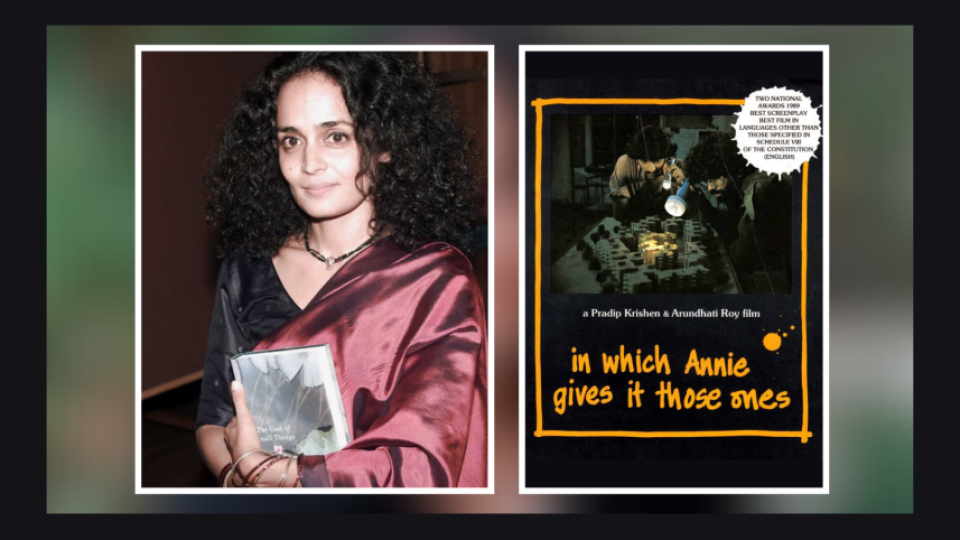
DHAKA – Arundhati Roy’s early, little-seen film “In Which Annie Gives It Those Ones” is stepping back into the light. A 4K-restored version of the 1989 film will screen at the 2026 Berlin Film Festival under the Berlinale Classics banner, giving international audiences a rare chance to see the work that marked Roy’s first major foray into cinema.
Written by Roy and directed by Pradip Krishen, the TV film is one of ten titles selected for the festival’s prestige restoration section. Both Roy and Krishen are expected to attend the screening.
Originally made for Doordarshan, the film is set in an architecture school in Delhi in the mid-1970s. It follows Anand Grover—nicknamed Annie—an idealistic but reckless student whose sharp tongue lands him in trouble after he mocks the authoritarian principal YD Billimoria, known to students as Yamdoot. Part campus comedy, part social portrait, the film captures a generation negotiating ambition, rebellion and uncertainty.\
Roy not only wrote the screenplay but also appeared in a major role. Long before her Booker Prize fame, she drew heavily on her own years at the School of Planning and Architecture in Delhi, turning student life into story. “In Which Annie Gives It Those Ones” was her first screenplay.
The cast included several faces who would later become major names. Shah Rukh Khan and Manoj Bajpayee appeared in small but striking roles, both then active in Delhi’s theatre scene. Lead performances came from Arjun Raina, Roshan Seth and Roy herself.
Roy and Krishen had already worked together on the 1985 colonial-era drama “Massey Sahib”. They would reunite again in 1992 for “Electric Moon”, with Roy writing and Krishen directing. But “Annie” remained their most intimate collaboration, rooted in shared memory and observation.
Krishen has said the film was unusual for its time because it portrayed an English-speaking student subculture using its own slang and rhythms—voices rarely heard in Indian cinema then. Yet after a single television broadcast, the film quietly disappeared from circulation.
“When we made ‘In Which Annie Gives It Those Ones’ almost four decades ago, it was unique in the sense that no one was making films about people like us, about the English-speaking student subculture where the characters spoke their own patois. But the film went out of circulation after a single screening on television,” Krishen said.
Its revival began when he donated his materials to the Film Heritage Foundation. The foundation led a painstaking 4K restoration using the original 16 mm camera negative and a 35 mm print, working with L’Immagine Ritrovata’s laboratory alongside the National Film Development Corporation and the National Film Archive of India.
“When I donated my film material to Film Heritage Foundation, I didn’t imagine that the film would be restored and have a second innings. I am delighted that the restoration has been selected for a world premiere at the Berlin Film Festival where a film that virtually went underground will be presented to the world on such a major platform,” he said.
The film had already earned critical recognition in its time, winning two National Awards—best screenplay for Roy and best feature film in English. Over the years, it has also gained cult status among those who managed to see it through rare recordings and word-of-mouth.
Shivendra Singh Dungarpur of the Film Heritage Foundation said the project reflects the foundation’s mission to rescue endangered works of Indian cinema. “Film Heritage Foundation’s policy has been to restore rare gems of Indian cinema that are in danger of being lost and forgotten and showcase India’s rich film heritage to contemporary audiences. When Pradip Krishen donated a print of the film to the foundation, I knew that this was a film that must be restored,” he said.
He called the film “arguably the first ‘English’ film, irreverent and idiosyncratic,” praising its dialogue for capturing the student world of the 1970s with rare honesty.
Berlinale organisers have said the 2026 Classics section is their most ambitious yet, featuring restored films from the silent era to the mid-1990s. Within that wide historical range, Roy and Krishen’s modest campus film now stands as a reminder that small stories, once lost, can return with renewed force.