

June 25, 2026
SEOUL – President Lee Jae Myung on Wednesday renewed his pledge to reduce South Korea’s reliance on conscription and expand the role of professional military personnel during a visit to a front-line Marine Corps unit.
During the trip to Yeonpyeongdo near the western maritime border with North Korea, Lee inspected key Marine Corps weapons systems, climbed aboard a K9A1 self-propelled howitzer and fired rifles while wearing a bulletproof vest and helmet.
Lee’s trip came during the week marking the anniversary of the outbreak of the 1950-53 Korean War, which falls on Thursday.
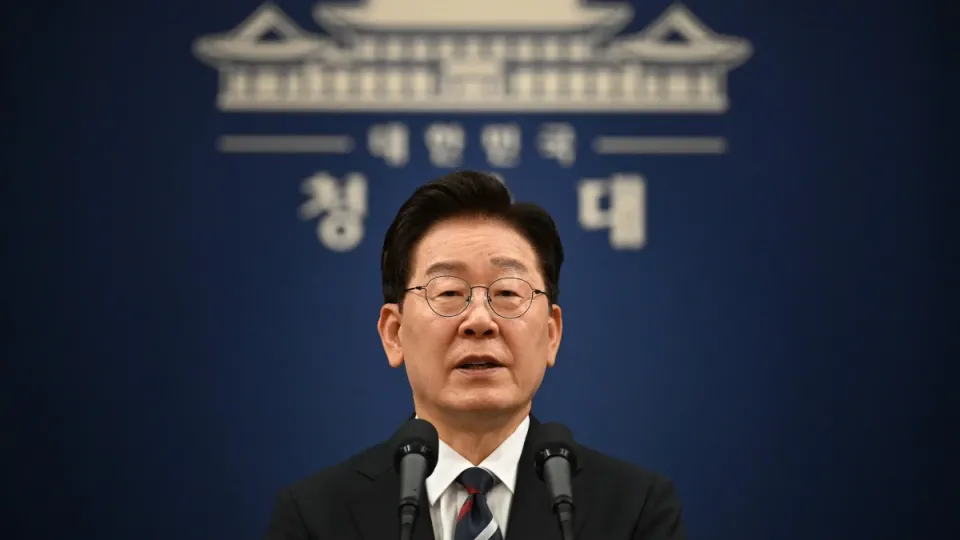
Visiting the Marine Corps’ Yeonpyeong Unit, Lee said South Korea’s military must adapt to both demographic challenges and the rapid evolution of military technology.
“Our military will need to undergo significant changes, particularly by rearming itself with advanced science and technology,” Lee said.
Lee emphasized the need to transform the role of service members from conscripts into professional personnel capable of operating sophisticated weapons systems.
“As I have promised on several occasions, we will minimize the number of conscripts and create a system in which people can choose military service as their profession through recruitment,” Lee told troops during a luncheon meeting.
The president also reaffirmed his commitment to raising defense spending.
“As we pledged, we have decided to increase defense spending to 3.5 percent of gross domestic product, which means we will have to spend substantially more on national defense than we do now,” Lee said.
“That spending should not become wasteful expenditure. Instead, it should be used to strengthen the capabilities of our military personnel and to create new opportunities and hope for young people.”
Lee further underscored the importance of peace backed by military strength.
“Far more important is winning without fighting. There is an even more important stage: creating a situation in which there is no need to fight at all. That is peace,” Lee said. “Peace is both the goal and the strongest foundation of security.”
Lee reiterated that his administration would undertake a broad overhaul of the armed forces.
“We will comprehensively transform the Republic of Korea’s armed forces and military into a future-oriented force and strengthen your capabilities so that it can be reborn as a powerful military that the nation can proudly present to the world,” Lee said, referring to South Korea by its official name.
The trip marked Lee’s first visit to Yeonpyeongdo since taking office. The island, located near the de facto maritime border known as the Northern Limit Line, was shelled by North Korea in 2010 in one of the deadliest attacks on South Korean territory since the Korean War.
During the visit, Lee inspected a range of Marine Corps weapons systems, including K1E1 tanks, Spike precision-guided missiles, Bigung guided rockets, Chunmoo multiple rocket launchers and K9A1 self-propelled howitzers.
Lee later climbed aboard a K9A1 howitzer for a closer look at the artillery system deployed on the island.
He also listened to troops’ requests on issues ranging from transportation costs associated with serving on the island to housing, medical services, recreational facilities and leave policies.
Lee’s visit also included a stop at a firing range, where Lee watched troops conduct live-fire drills with K1A1, K2C1 and K15 weapons before taking part in the exercise himself.
Wearing a bulletproof vest and helmet, Lee fired 10 rounds from a K2C1 assault rifle and hit the target with all 10 shots. Lee also fired a K15 machine gun loaded with live ammunition.
Later that day, Lee visited the Yeonpyeong Peace Observatory, where he received a briefing on illicit fishing activities by Chinese vessels south of the NLL, the security situation in the area and nearby North Korean-held islands.
When National Security Adviser Wi Sung-lac explained that policing Chinese fishing vessels near the NLL was difficult because pursuit operations could trigger tensions with North Korea and risk crossing the maritime boundary, Lee expressed concern.
“We should not allow Chinese vessels to enter boundary areas and provoke disputes,” Lee said.
Lee instructed Wi to explore possible solutions, saying, “Let’s discuss how to address this.
“It doesn’t seem like something we can simply leave unattended. Isn’t this too much, happening in broad daylight?”