

May 11, 2026
SEOUL – A Samsung Electronics engineer once saw his “core talent” contract as proof that the company wanted him to stay.
The extra pay helped. The label mattered because it suggested that Samsung knew which engineers were hard to replace and would treat them that way.
That belief has since been strained.
“Watching how Samsung has handled the bonus fight lately, I’ve lost a lot of affection for the company,” said the employee, who asked not to be named because he is not authorized to speak publicly. “Now I’m asking around whether I can realistically move to SK hynix, and whether Samsung would try to block me all the way.”
His special contract bars him from joining a company in the same industry for two years after leaving Samsung, he explained. The restriction is not limited to chip rivals, but includes firms such as Apple and Google. At his CL3-grade contract, Samsung had offered around 50 million won ($34,200) over two years in retention pay. This year, the offer was 80 million won over three years, partly in stock.
“What I used to accept gratefully now feels like a slave contract,” he said.
His case covers only a small slice of Samsung’s workforce, but it helps explain why the dispute is not being felt inside the company as a simple argument over a fatter check.
In recent weeks, Samsung’s union has been demanding 15 percent of operating profit for bonuses and the removal of the cap. Samsung posted 57.2 trillion won in operating profit in the first quarter, with nearly 90 percent generated by its semiconductor business. Market consensus projects full-year operating profit at around 340 trillion won.
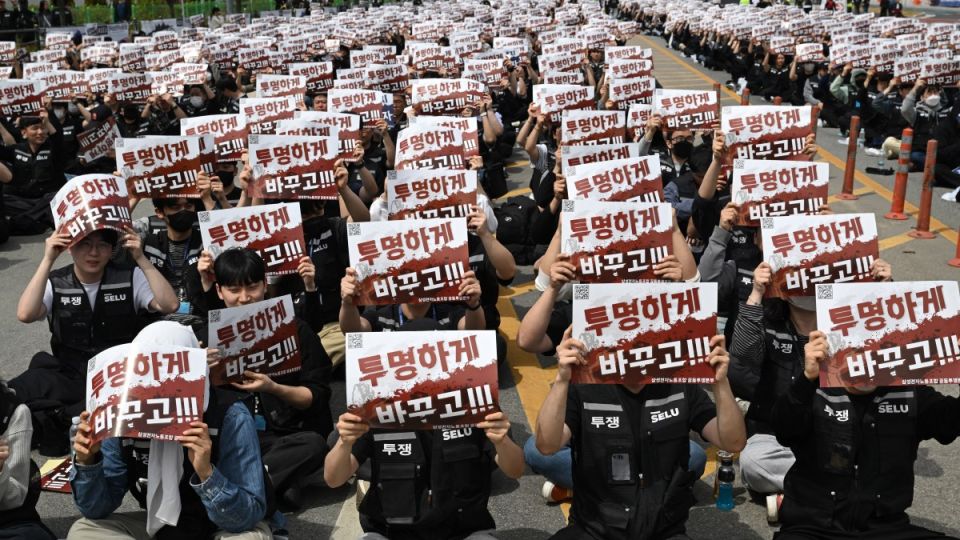
On April 23, nearly 40,000 workers gathered near Samsung’s Pyeongtaek chip complex in Gyeonggi Province, a crowd equal to nearly one-third of the company’s domestic workforce. If talks fail, the union has warned of an 18-day strike to begin May 21.
Outside Samsung, many Koreans see the numbers first. Local reports say the union demand could create a bonus pool of more than 40 trillion won, with some memory division employees potentially receiving hundreds of millions of won each.
Employees interviewed by The Korea Herald described something less tidy than a pay dispute: Engineers who once waited for Samsung to fix things are now asking whether waiting still makes sense.
“I work in what I consider the core of the core of Samsung’s memory business,” said a Ph.D.-level researcher in advanced DRAM process development, who was also hired under a core talent arrangement. “Even here, more than 80 percent have joined the union.”
For years, he said, many colleagues stayed with retention pay and smaller incentives, hoping the company would change. After watching recent negotiations, “many people around me are either considering SK hynix or preparing for a move,” he said.
Another researcher at Samsung’s semiconductor research center said the union’s growth would have been hard to imagine inside Samsung only a few years ago. Many engineers, especially younger ones, had long been wary of organized labor and politically affiliated unions.
“This was not a group that naturally ran toward unions,” he said. “Many younger engineers were skeptical of unions, even hostile to them.”
Over time, he said, many researchers concluded they had too little leverage on their own. Research staff have been offered bonuses at about 70 percent of the memory division’s level despite working on core chip technology. In some cases, bachelor’s- and master’s-level researchers at the semiconductor research center received less in bonuses than memory division employees without university degrees, with gaps sometimes reaching tens of millions of won.
“If we speak separately, there are too few of us,” the researcher said. “We can be ignored.”
An employee involved in high bandwidth memory mass production emphasized a different point. Samsung’s chip profits were “not made by a few star developers,” but by development, production, equipment, quality and yield teams moving together.
What employees want, he argued, is “a reasonable, consistent formula for everyone that we can all trust,” not another temporary payout.
The comparison Samsung employees keep returning to is SK hynix. Its uncapped 10 percent profit-linked bonus has become the standard many now want Samsung to match. The shift is striking because SK hynix spent years in Samsung’s shadow, not as the benchmark for Samsung engineers to point to.
But the SK hynix model does not fit Samsung neatly.
SK hynix largely produces memory chips, while Samsung runs other major foundry and device units. More than 2,500 members recently left Samsung’s largest union, with many objecting to what they saw as memory-centered demands and higher dues for a fight that offered little to device-side employees.
“From the outside, it may look like all of Samsung Electronics is moving as one,” another employee said. “Inside, it feels much more lopsided on memory.”
Oh Gye-taek, head of the labor relations research division at the Korea Labor Institute, said Korean workers and Korean companies are moving at different speeds.
“Employees are moving toward an American-style job market, switching jobs or bargaining hard for better pay, while companies still run on Japanese-style expectations of loyalty,” Oh said. “That gap is where the conflict comes from.”
At Samsung, the mismatch cuts deeper because the company has never been just another employer in Korea. Working there has long carried the pride of belonging to the country’s export champion. Losing engineers to SK hynix — or watching SK hynix become the more attractive employer — bruises that identity.
“People ask why we don’t just leave for SK hynix,” one Samsung employee said. “But many of us still have affection for Samsung. It is not that we want to leave. We want the company to be worth staying for.”