

May 19, 2026
DHAKA – In a typical Boro season, the villages of Nikli upazila in Kishoreganj carry the sweet aroma of ripened paddy. This year, the air in the haor area is heavy with the musty smell of grain.
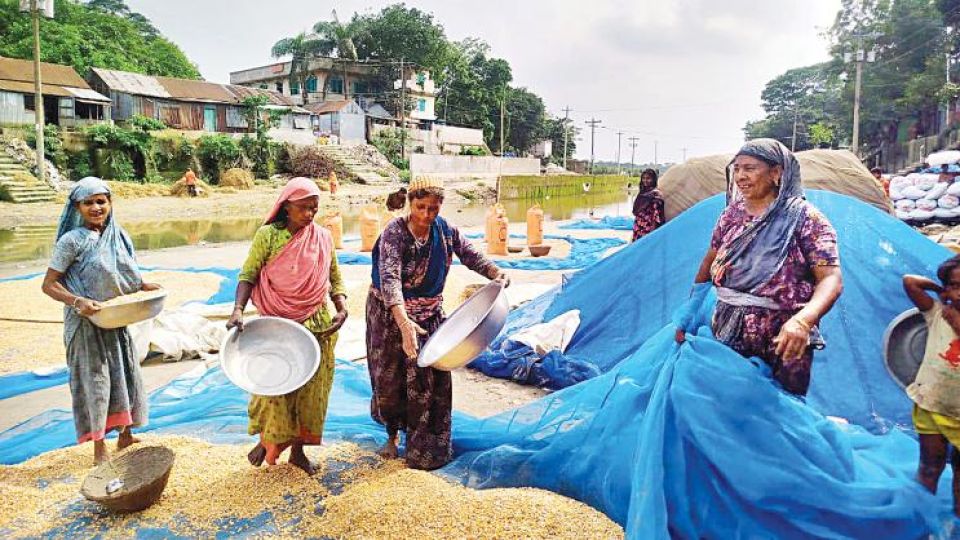
Wet paddy lay spread out along roadsides and in yards as families raced to salvage crops from fields submerged due to untimely rains. While men were busy harvesting or working as labourers, women had to take the full burden of drying and saving the grain.
They moved across roadside drying spots, turning paddy with their feet. At the first sign of heavy clouds, they rushed to gather and cover it with plastic sheets.
In this process, their clothes stayed damp for hours, yet they pressed on, determined to save the harvest that sustains their families.
“I wake up around 5:00am every day, finish cooking, clean the cowshed, feed the poultry, and send my daughters to school. Then I come here and work all day,” Nasima Begum, a farmer from Shahpur village, told this correspondent who visited over a dozen villages in Nikli on May 5 and 6.
“I dry paddy after threshing it, then parboil it and dry it again. Even when men rest, our work continues,” she said while drying paddy by the roadside.
Nadira Bibi, a 35-year-old farmer who was working nearby, said, “Except for planting and harvesting crops, everything is done by women here — irrigation, fertiliser application, weeding, threshing, drying, parboiling and storing of grain.”
Men work five to six hours in the field, but women work from dawn till late at night, she added.
In the haor region, where most of the farming is done on leased or sharecropped land, women take on gruelling labour to cut costs and avoid hiring workers. Yet their contribution remains largely unrecognised, leaving many excluded from farmer lists and government support.
Officials at the Nikli Upazila Agriculture Office said 20,762 of the 21,800 households in 128 villages of the upazila depend on farming, and only a few women were listed as farmers.
“There is no accurate count of how many women are actively involved in farming here. Women are usually listed as farmers only if they are widowed, divorced, or if no male family member’s national identity [NID] card is available,” said Abdus Samad, agriculture officer of Nikli.
He also said none of the three agriculture-related committees in Nikli includes women farmers.
Samad pointed out that 1,635 of 4,260 local farmers affected by recent rain-induced losses were listed for assistance as of May 5, with women making up roughly 10 percent of the total.
In Kishoreganj and six other haor districts, untimely rains and flashfloods destroyed 2.13 lakh tonnes of crops on 49,073 hectares of land between April 26 and May 4, affecting at least 2.36 lakh farmers. The loss was estimated at Tk 1,047 crore, show the agriculture ministry data.
EXCLUSION OF WOMEN
Many women are left out of not only farmer lists but also government programmes, including Farmers’ Cards aimed at providing farmers with access to agricultural inputs at fair prices as well as government subsidies and incentives.
Data from the Agriculture Information Service (AIS) shows that in the pre-pilot phase of the programme, most recipients of Farmers’ Cards are men, as women accounted for only 15.05 percent of the 22,061 farmers surveyed across 11 upazilas in 10 districts.
The figures are in sharp contrast with the findings of the Labour Force Survey (LFS) 2024 by Bangladesh Bureau of Statistics (BBS).
According to the survey, women outnumber men in agricultural labour nationwide. It recorded 17.25 million women engaged in agriculture, compared to 13.62 million men.
Contacted, AIS Director Mohammad Mashiur Rahman said government support is mainly targeted at field crop production.
“Male farmers get priority as almost all inputs — fertiliser, seeds and pesticides — for field crops are managed by men… Very few women work independently in fields without relying on a male family member,” he said.
Economists say this “dependency” masks a vast but uncompensated labour force.
Sayema Haque Bidisha, a professor of economics at Dhaka University, said, “Women are included in labour statistics but are rarely recognised as farmers or workers. Their labour is treated as a domestic responsibility rather than an economic activity.”
LFS 2024 data shows 3.01 million women work as unpaid family labourers across Bangladesh.
According to the BBS Household Production Satellite Account, unpaid household and care work contributed Tk 6.7 trillion — nearly 19 percent of GDP — in 2021, with women accounting for 85 percent of the contribution to that invisible economy.
Several years ago, the Department of Agricultural Extension (DAE) took up a programme to create a comprehensive digital database of both male and female farmers across the country.
However, it was abandoned in 2023 due to bureaucratic challenges, said Md Azam Uddin, former director of the Integration of Farmers’ Information in Agriculture Portal Programme at the DAE.
The department had collected data on 11.21 million farmers, of whom 45 percent were women.
Unlike traditional manual records that focus solely on the male head of a household, the database used NID-based registration to document individual family members involved in agricultural labour, including seed preservation and livestock rearing.
When contacted, DAE Director General Md Abdur Rahim said formal recognition of women’s role in agriculture cannot be achieved overnight due to deep-rooted social and structural barriers.
“However, we are working on it, and women’s participation is now mandated across all ongoing projects [in the agriculture sector],” he said.
WAGE DISPARITY
Following the untimely rains at the end of April, the demand for workers in Nikli to harvest crops surged. Male workers were offered around Tk 2,000 each per day for the job.
In contrast, for an entire day’s work, women workers got less than half of what male harvesters earned for a shorter workday in the field.
In Singpur union, 65-year-old Panch Tola Bibi said she earned Tk 1,000 a day for drying wet maize though the work required gruelling labour.
Experts say the wage gap reflects a deeper structural undervaluation of women’s agricultural labour, extending beyond income to issues of recognition and institutional inclusion.
Professor Bidisha said the most urgent step towards equity is official recognition of these women as farmers.
She stressed the need for replacing manual farming tools with modern machinery and making the financing mechanisms more flexible for female farmers.
“Our agriculture should not remain this labour-intensive for women. If modern machinery is introduced, women will be spared this gruelling physical labour.”
NGO INITIATIVES
To provide assistance to female farmers, Manusher Jonno Foundation (MJF) is implementing a project titled “Community-Based Resilience, Women Empowerment and Action (CREA)” with support from the Embassy of Sweden, covering haor, char, coastal and hill areas across 13 districts, including Kishoreganj.
Since 2022, the project has been helping 1,260 women farmers in Nikli mitigate climate risks such as flash floods by introducing short-duration rice varieties, climate-smart integrated homestead gardening, collective disaster preparedness, and weather-based agricultural planning.
MJF Executive Director Shaheen Anam said that although macro-level government studies now officially calculate the enormous contribution of women’s unpaid care work to the national GDP, these acknowledgments must urgently reach local-level institutions and be reflected in official government documents at the upazila level.
“Women have been involved in productive agricultural work, which remains invisible. They should be given recognition and included in local-level policy interventions.”
She also stressed the need for investment in infrastructure such as water supply, sanitation, childcare and technology to reduce their care burden and enable them to become active, recognised players in the economy.
Banasree Mitra Neogi, director of Rights and Governance Programmes at the MJF, said landless women farmers in the haor region face heightened climate vulnerability, because the devaluation of their labour excludes them from land ownership, official farmer recognition, and disaster compensation.
“To build resilience, Farmers’ Cards are also needed for women engaged in sharecropping, livestock rearing, seed preservation, and post-harvest work.
“They must be included in local agriculture committees and disaster response systems to address wage discrimination, improve access to credit, and reduce climate-related vulnerability,” she added.