


January 7, 2026
JAKARTA – Clients often approach Antonius Richard, founder of Jakarta-based architecture studio RAD+ar, to design “sustainable” establishments. He would respond back with a simple question: “What do you think about sustainability?” More often than not, the exchange reveals a gap between the ambition and a clear understanding of what that entails.
Established in 2017, RAD+ar (Research Artistic Design + architecture) is a firm known for its climate-responsive design approach in urban settings. The award-winning studio builds prototypes in real conditions, treating climate, shade, wind, solar orientation and humidity as fundamental design tools, and shares its work as part of a broader creative and research practice.
“We are actively shifting the narrative that sustainability must be expensive because it’s not true,” says Antonius. “When we talk about sustainability, it’s often less about design and more about enforcement; how to be more inclusive, how to be more generous to society.”
One of the studio’s talked-about projects is the Chicken Hero Pavilion. Installed as a temporary installation at Urban Forest in South Jakarta, the hilly structure, built using reclaimed bamboo for its green roof, aimed to address Indonesia’s waste problem through the idea of backyard poultry farming.
“The project went viral,” Antonius recalls. “It wasn’t about a chicken coop. It was about showing developers and policymakers that change can happen in small ways and doesn’t have to look ‘sexy.’ At the same time, visual appeal matters, which is why we presented it aesthetically, to prove a point.”
RAD+ar is part of a new generation of practitioners in Indonesia that are expanding the country’s design identity and narrative beyond established frameworks.
Today, sustainability is no longer treated as an afterthought but as a conscious process embedded from the outset. Material exploration is increasingly tested rather than proposed, while collaborations across disciplines are actively pursued.
Even as tropical design and craftsmanship remain central to Indonesian practice, today’s practitioners are responding to a shifting discourse, shaped by a fast-moving industry, environmental urgency and new ways audiences encounter design and space.
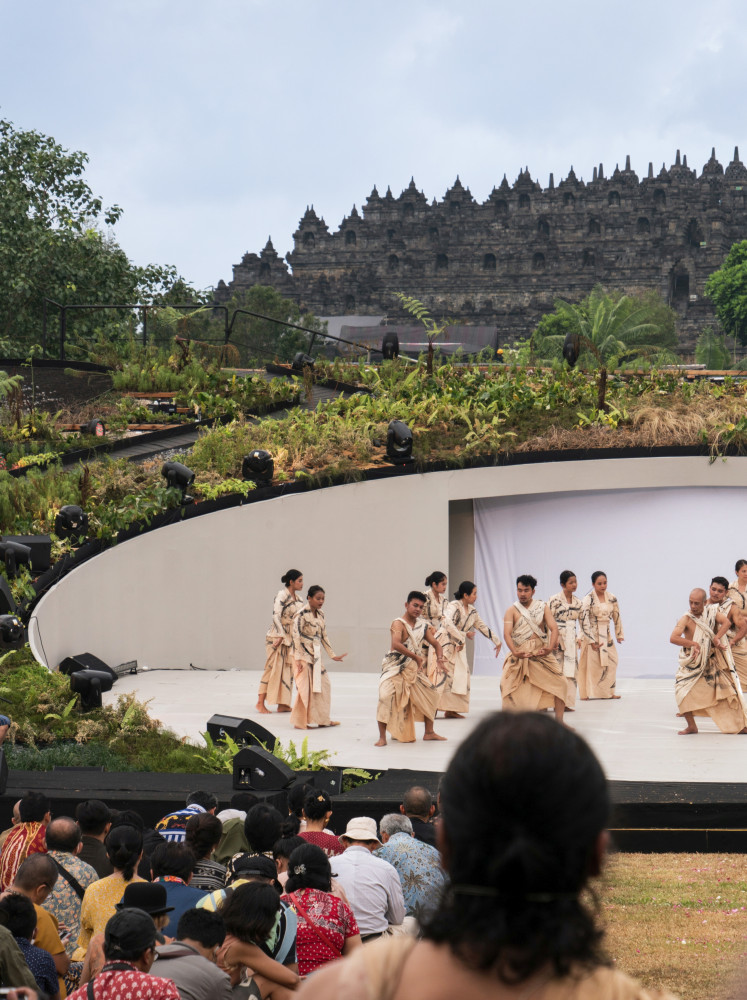
At Festival Indonesia Bertutur 2022 in Borobudur, Central Java, a blurred spatial boundary between stage and audience reflects a growing design trend that dissolves hierarchy and invites collective participation. PHOTO: COLLECTED/THE JAKARTA POST
Playful with impact
These shifts are visible in the rise of concept-driven retail and cultural spaces. Among the studios pushing these boundaries is Fffaaarrr, an architecture practice founded by Fauzia Evanindya, Andro Kaliandi and Azalia Maritza, known for its playful approach to design, process and material selection.
One of its notable projects is Pillar, a multi-label fashion store at Plaza Indonesia in Central Jakarta. Conceived as a flexible platform, the space was designed to host events, activations and installations while accommodating emerging designers.
“We saw it as a blank canvas,” says Andro. “A space where each brand could explore its identity without being boxed in by the space.” Fauzia adds, “Personally, we feel Pillar helped set the tone for many retail spaces that followed in Indonesia.”
The studio’s flexibility and exploration of architectural typology are evident in its diverse work, ranging from the Spring/Summer 2026 fashion show set for Sapto Djojokartiko to a stage design for the Festival Indonesia Bertutur in Borobudur Temple in Central Java, where the absence of physical distance between stage and audience became a defining gesture.
On questions of Indonesian design identity, the trio believes that craftsmanship and tropicality will always remain relevant, even as distinctions around style and influence may blur over time in an increasingly algorithm-driven era. “What matters is staying receptive and being open to experimentation in the process,” says Fauzia.
Azalia further adds that cross-disciplinary collaboration has become central to contemporary practice. “As the environment changes, so do the ways designers work and access opportunities.”
Material exploration
In the realm of furniture and product design, wood has long been a shorthand for Indonesia’s design dictionary. Format, a production studio specializing in metal-based solutions, is charting a different path.
Founded by Diaz Hensuk in collaboration with longtime steel manufacturer, Alba Unggul Metal, in 2023, Format’s creations are intentionally modular. Its systems, from shelving units to cabinets and tables, can be reconfigured to suit changing needs, offering a practical response to shrinking living spaces.
“We chose modularity to address a pressing issue,” says Diaz. “How do we design products that make sense for today’s homes, where space is increasingly limited?”
Jakarta’s housing problem underscores the challenge. Earlier this year, the Public Housing and Settlements Ministry floated a controversial proposal to reduce the minimum size of subsidized homes. After a strong public reaction, the proposal was ultimately withdrawn, but the debate continues to call attention to the city’s population density and intense competition for space.
“We wanted to see how we could respond to that challenge. We looked to many references to see how they address shrinking spaces and create modular products that are adaptable.”
Format’s signature Plus System, recently awarded the Good Design Award 2025, exemplifies this approach. Made entirely of metal, it features a 150 mm grid with plus-shaped joints that enable multiple configurations. The studio has applied it across scales, from creating a merchandise display at ADGI Design Week to a kitchen installation at Bintaro Design District.
“The next challenge,” Diaz reflects, “is helping the public see design as a way of life, not just a commodity. Design should be inclusive and impactful.”
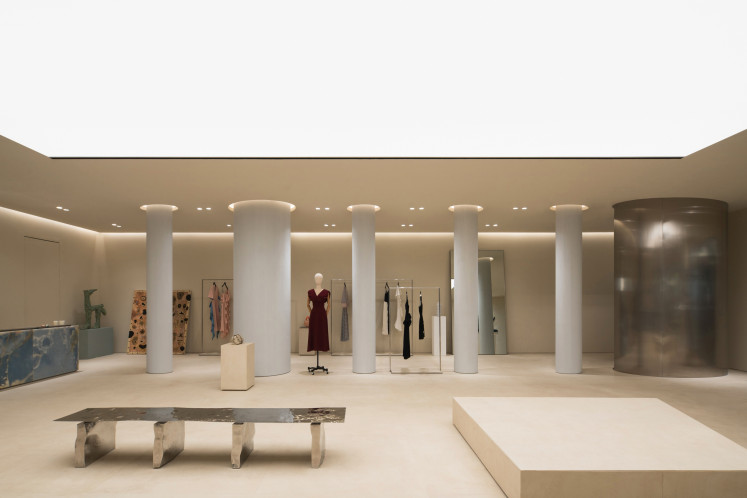
Pillar, a multi-label fashion store at Plaza Indonesia designed by Fffaaarrr, is conceived as a flexible platform, able to shift seamlessly between retail space, event venue, and installation site. PHOTO: COLLECTED/THE JAKARTA POST
Changing perception
Indonesia’s design industry is also being shaped by platforms that amplify regional practices, ranging government-backed festivals to grassroots initiatives that stage open calls, open studios and public programs.
One such platform is Jia Curated, a design and art festival based in Bali held annually since 2022.
Last year’s August edition, held at an abandoned theme park, marked a significant expansion in scale and network. Nearly 200 Indonesian and international brands participated, alongside site-specific installations by names such as Andra Matin and Studio Lianggono, each championing the use of local, reclaimed materials.
“Our goal is to support the local design sector by providing visibility and opportunities for cultural and business exchange, allowing Indonesia to be a real contender on the global stage,” says co-founder Budiman Ong, also the light designer behind Ong Cen Kuang.
As Jia Curated continues to grow, Budiman remains clear-eyed about the broader condition of Indonesian design, which he believes is still in a developing phase. While Asia offers a pool of projects, markets and opportunities, there is a mindset he hopes to shift.
“Indonesia is still perceived as a manufacturing country,” he says. “One challenge is shifting that mindset by connecting creative talent with local manufacturers.” He notes that change is underway, as designers increasingly draw from Indonesia’s cultural heritage while creating work that resonates beyond function.
Looking ahead, Budiman sees Indonesian design becoming more craft-focused, with greater attention to collectible and limited-edition works. He also anticipates stronger emphasis on sustainable material solutions. “There are already studios spearheading this,” adds Budiman.