

July 2, 2026
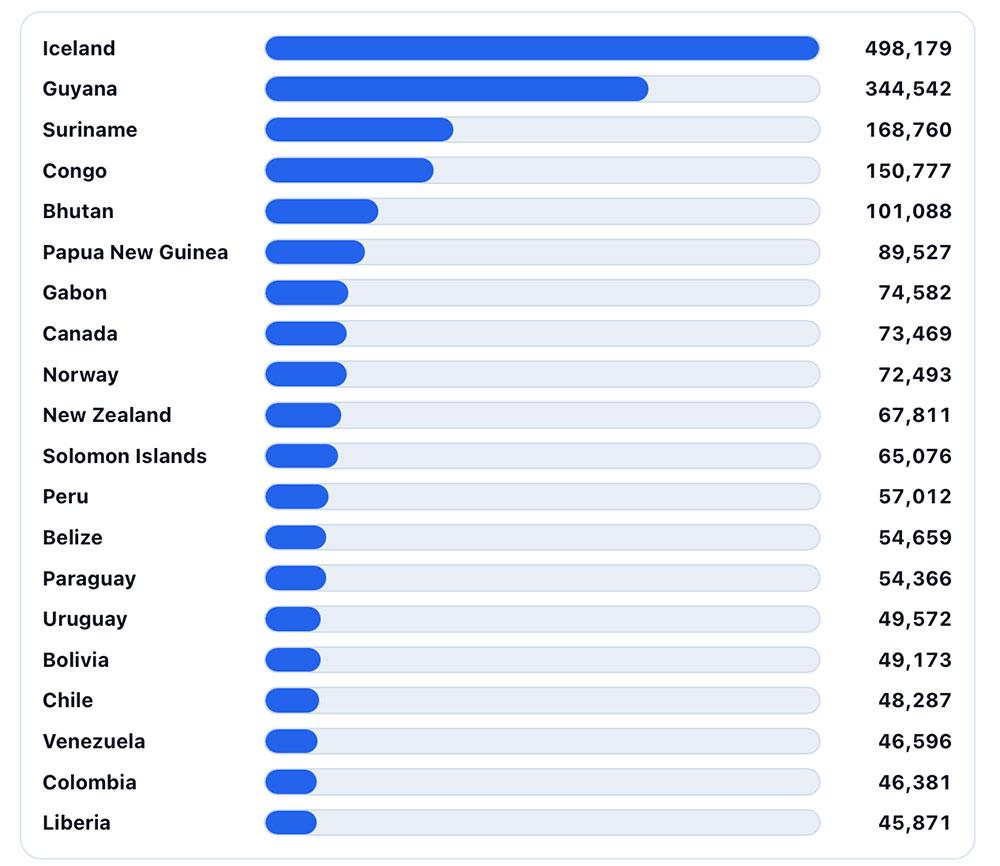
THIMPHU – Bhutan has been ranked as the only Asian country in the global Top 10 of a recent freshwater resources per capita ranking published by StatRanker.org, placing it fifth worldwide in a dataset that highlights extreme disparities in access to renewable water resources across countries.
The report ranks 100 countries based on renewable freshwater availability per person per year, measured in cubic metres per capita.
Iceland tops the list with 498,179 m³ per person per year, followed by Guyana (344,542), Suriname (168,760), and the Republic of the Congo (150,777).
Bhutan’s fifth position places it ahead of Papua New Guinea, Gabon, Canada, Norway, and New Zealand, which complete the Top 10.
The figures are based on long-term hydrological averages rather than short-term fluctuations such as droughts, rainfall anomalies, or reservoir changes.
The methodology defines freshwater resources per capita as total renewable freshwater, derived from rivers, lakes, groundwater, and transboundary inflows, divided by population size.
However, the report stresses that this indicator reflects natural endowment rather than actual water security. It notes that infrastructure quality, pollution levels, seasonal variability, distribution systems, and governance structures ultimately determine real-world access to safe drinking water.
While Bhutan’s ranking reflects strong hydrological abundance relative to its population, the domestic reality presents a contrasting picture marked by persistent water quality challenges.
A nationwide assessment cited in the 2025 edition of the Journal of Water and Health by the Royal Centre for Disease Control (RCDC) finds that drinking water quality in Bhutan has not improved over the past eight years, despite continued investment in infrastructure and monitoring systems.
The National Health Survey indicates that 99.7 percent of Bhutanese have access to improved drinking water sources, but service quality and safety remain inconsistent.
The RCDC study covered all 20 dzongkhags and analysed data from 31 urban and 242 rural drinking water systems, drawing samples through urban and rural health centres, primary health centres, and sub-posts.
Microbial contamination
The assessment found that only 52.8 percent of urban water samples met national microbial standards, with eastern Bhutan showing the lowest compliance levels.
Trashiyangtse, Trashigang, Lhuentse, Samdrupjongkhar, Mongar, Punakha, Wangdue and Zhemgang recorded average microbial compliance rates of about 50 per cent, indicating widespread contamination across major urban centres.
The study also found serious gaps in disinfection systems, with only 11.9 percent of 7,094 samples meeting national and international residual chlorine standards, pointing to weak chlorination across distribution networks.
Turbidity levels showed partial improvement, with 95.2 percent of samples meeting national standards.
However, compliance dropped to 67.3 percent when measured against WHO guideline values across more than 10,972 samples. pH levels were relatively stable, with 96.3 percent compliance across 11,086 samples and an average pH of 7.2, though Wangdue recorded a significantly lower compliance rate of 66 percent.
Out of 1,715 rural samples analysed, 70.1 percent met national microbial standards, despite minimal treatment infrastructure. Only Dagana recorded compliance below 50 percent.
Rural systems also showed 88.3 percent turbidity compliance under national standards, although this declined to 47.6 percent under WHO guidelines.
Microplastic contamination
The highest concentration was recorded in stream water at 5.12 microgrammes per litre, followed by groundwater at 2.70 µg/L and river water at 2.69 µg/L. Treated municipal tap water contained 1.05 µg/L, while bottled water recorded 0.78 µg/L.
Polyethylene terephthalate (PET), commonly associated with plastic bottles, accounted for 52.5 percent of detected particles, making it the dominant polymer type. Materials linked to pipes and construction infrastructure contributed 14.6 percent, while synthetic rubber from tyres and artificial turf accounted for 14.3 percent.
Chief Executive Officer of Mawongpa Water Solutions and a water sector expert, Sonam Dorji, said Bhutan’s water investments remain fragmented and overly focused on low-cost interventions that undermine long-term sustainability.
“The use of effective technological solutions has often been overshadowed by short-term investment considerations. The government is not being serious about the health and future of the nation,” he said.
He said that the absence of home-based water testing services, despite consumers’ dependence on treated systems, is a major concern for all, even in the context of adequate water availability.
Moreover, he raised concerns over chlorine management practices, rooftop storage contamination, biofilm formation in distribution networks, infrastructure maintenance gaps, and the absence of household-level monitoring systems.
Health Minister Tandin Wangchuk said that, according to the WHO, there is currently no internationally established numerical safety limit or regulatory standard for microplastics in drinking water.
“Bhutan’s immediate priority remains microbial contamination, particularly E. coli, and ensuring safe water treatment systems,” Lyonpo said.
He said that the Drinking Water Quality Standard 2025 has been introduced to strengthen regulatory oversight. “Under the 13th Plan, we aim to increase the proportion of people using safely managed drinking water from 70.3 per cent in 2023 to 90 percent,” he added.
Pema Thekcho, assistant engineer at Thimphu Thromde, confirmed that no microplastic testing has yet been conducted in tap water due to a lack of technical expertise.
“Upstream sources are generally considered less exposed to anthropogenic contamination, and although treatment plants reduce microplastic levels, complete removal cannot be guaranteed,” said Pema Thekcho.
Over the past eight years, Thimphu Thromde has constructed five treatment plants under the Design-Build-Operate-Transfer model through public-private partnerships, while two older plants at Motithang and Jungshina are scheduled for upgrades.
However, RCDC deputy chief laboratory officer Pema Chophel said no formal stakeholder sensitisation or regulatory measures have followed the microplastics findings.
He said that Bhutan currently lacks a standardised national protocol for microplastic detection, monitoring, or reporting, warning that the system risks becoming “data-rich but information-poor,” where data is collected but not translated into policy or operational action.