

June 23, 2026
BANDAR SERI BEGAWAN – Over the past few years, Brunei Darussalam has made steady and meaningful progress in strengthening its national radiation safety and nuclear security infrastructure. This progress reflects the strong collective commitment and collaboration among all relevant stakeholders to ensure that the nation’s regulatory system remains robust, responsive, and fit for purpose.
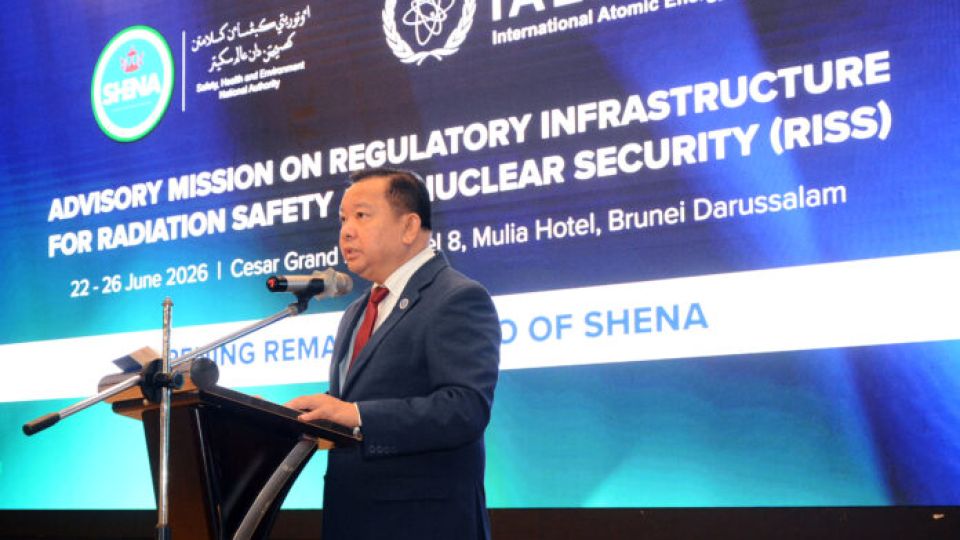
This was said by Chief Executive Officer of the Safety, Health and Environment National Authority (SHENA) Haji Muhsin bin Haji Ahmad in his welcoming remarks at the opening of the International Atomic Energy Agency (IAEA) Advisory Mission on Regulatory Infrastructure for Radiation Safety and Nuclear Security (RISS).
Among the key milestones achieved, he outlined Brunei Darussalam’s “political commitment to the IAEA Code of Conduct on the Safety and Security of Radioactive Sources, together with its supplementary guidance, in October 2024”, marking an important step in aligning the national framework with internationally recognised guidance.
Building on this commitment, he shared, “Brunei Darussalam commissioned its first Early Warning Environmental Radiation Monitoring System and launched the Radiation Dosimetry Service Laboratory in April 2025. These capabilities have since been further strengthened through dedicated air and water monitoring systems and the establishment of a Radiation Sampling and Analysis Laboratory in collaboration with Universiti Teknologi Brunei, which commenced operations in February 2026.”
At the regional level, he added, “Brunei Darussalam has also enhanced its engagement by participating in the Asian Nuclear Safety Network (ANSN), which provides valuable platforms for technical cooperation, knowledge sharing, and capacity building with regional partners.”
Radiation safety and nuclear security, he iterated, “require clear governance, well-defined roles and responsibilities, and strong coordination across the government and stakeholders. In this regard, the establishment of the National Working Committee on Radiation and Nuclear Matters (JKRN) in 2024, under the National Committee on Chemical, Biological, Radiological, Nuclear and Explosives, serves as an important mechanism to strengthen national coordination.
“The committee provides a dedicated platform to enhance policy alignment, facilitate inter-agency collaboration, and support a more integrated and coherent national approach to addressing current and emerging challenges.”
Through coordinated efforts, he said, “Brunei Darussalam continues to strengthen its national preparedness, emergency response capabilities, and resilience in line with evolving risks and national priorities.”
He also expressed, “As we move forward, it is important that we take the opportunity to reflect on our current position and identify areas where our regulatory framework can be further strengthened to remain relevant, responsive and sustainable. Such reflection is best achieved through constructive engagement, objective assessment, and international
cooperation.”
The IAEA Advisory Mission on Regulatory Infrastructure for Radiation Safety and Nuclear Security (RISS) in the country marks a significant milestone in Brunei Darussalam’s ongoing efforts to strengthen its national regulatory framework for radiation safety and nuclear security.
The opening ceremony was attended by SHENA senior officials, representatives from government agencies, and members of the IAEA RISS team.
The five-day mission, from June 22-26, 2026, brings together international experts from the IAEA and national stakeholders to review and provide expert advice on Brunei Darussalam’s regulatory infrastructure for radiation safety and the security of radioactive materials.
The RISS mission serves as an advisory and benchmarking exercise conducted against internationally recognised standards and guidance, including IAEA safety standards and the Code of Conduct on the Safety and Security of Radioactive Sources. The mission’s findings will support Brunei Darussalam in further strengthening and aligning its regulatory framework with international best practices, while identifying opportunities for continuous improvements.
Throughout the mission, the IAEA RISS team conducted a seminar on radiation safety and the security of radioactive materials, engaged in technical discussions with relevant national agencies, and made site visits to facilities involved in radiation safety and related technical services. The mission will conclude with the presentation of a preliminary report outlining key observations, recommendations, and a proposed action plan.