

February 3, 2026
BANDAR SERI BEGAWAN – Brunei Darussalam and South Korea enjoy a longstanding and friendly relation, underpinned by growing economic cooperation. This partnership is further strengthened under the ASEAN-Korea Free Trade Agreement, which provides an important framework to facilitate trade, reduce barriers and enhance market access between our economies.
The current trade between Brunei Darussalam and South Korea provides a positive foundation upon which both countries can further strengthen and expand economic cooperation in priority areas of mutual interest.
Permanent Secretary at the Ministry of Finance and Economy Dr Hajah May Fae’zah binti Haji Ahmad Ariffin underscored the longstanding and friendly relation between Brunei Darussalam and South Korea in her keynote address at the ASEAN-Korea Trade Facilitation Mission in Bandar Seri Begawan.
The permanent secretary described, “The ASEAN-Korea Trade Facilitation Mission is both timely and practical, providing an important platform for Brunei companies to meet with the Korean importers and explore opportunities for collaboration. Brunei Darussalam’s support for this mission reflects our broader approach to economic development – one that goes beyond promotion alone. Our focus is on connecting local enterprises to international demand, strengthening trade linkages, and ensuring that global engagement contributes to sustainable growth.”
Secretary-General of the ASEAN-Korea Centre Kim Jae-shin shared, “While bilateral trade exchange between Brunei and Korea has been relatively modest compared to other ASEAN Member States (ninth in 2025), Brunei’s economy remains robust than ever. Alongside a strong performance in traditional oil and gas industries, it is notable that trade in emerging agri-food sectors are contributing to a projected growth of two per cent in 2026.”
“With the second-highest gross domestic product per capita in ASEAN and strong macroeconomic stability Brunei offers ample opportunities for Korean companies across diverse sectors, many of which are present today. Reflecting this potential, the bilateral trade has increased by 32 per cent over the past three years after the pandemic, and is set to increase more,” said the secretary-general.
Chairwoman of the Korea Importers Association (KOIMA) Youn Young-mi highlighted, “Brunei has long been a reliable partner for Korea, particularly in the energy sector, contributing to Korea’s energy security and forming a strong foundation for bilateral trust.
Building on this foundation, our two countries are now exploring new areas of cooperation as Brunei actively advances its economic diversification agenda.”
She outlined, “Opportunities are emerging in sectors such as food processing, halal industries, logistics, downstream manufacturing, and other value-added industries.These areas align well with the growing demand in the Korean market for high-quality, safe, and sustainable products, as well as for stable and trustworthy supply chains.”
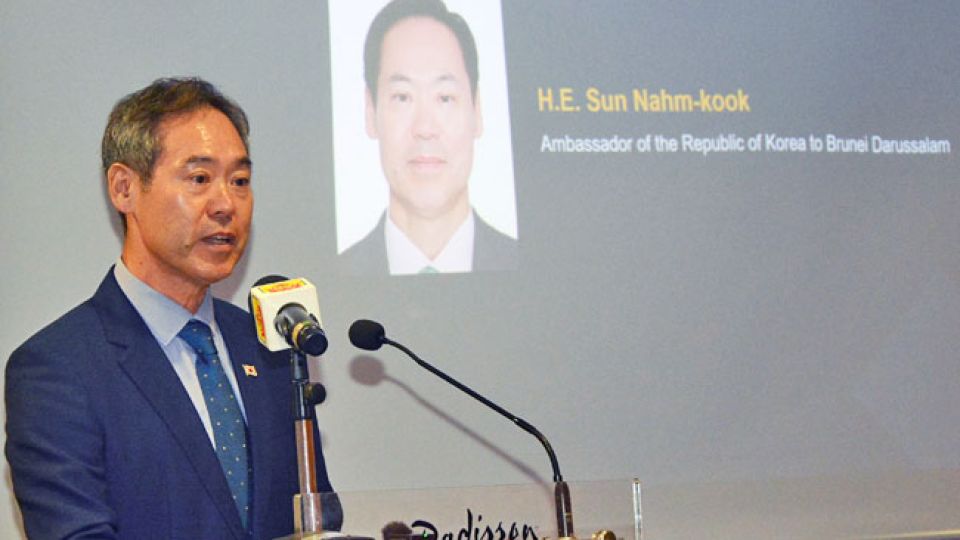
Meanwhile, Ambassador of Korea to Brunei Darussalam Sun Nahmkook welcoming participants to the ASEAN-Korea Trade Facilitation Mission, thanked the Ministry of Finance and Economy, Brunei Economic Development Board (BEDB), ASEAN-Korea Centre, Korea Importers Association for organising the event.
The mission has created direct opportunities for Bruneian micro, small and medium enterprises (MSMEs) to engage with Korean importers, gain market insights and explore pathways to expand beyond the limited domestic market.
The mission was organised by the ASEAN-Korea Centre (AKC) in collaboration with the Korea Importers Association (KOIMA), and with the support from the BEDB. Through this platform, Bruneian MSMEs were connected to international buyers and exposed to Korea’s import requirements, consumer preferences, and regulatory environment-key considerations for enterprises seeking to enter or scale within export markets.
The ASEAN-Korea Trade Facilitation Mission focused on identifying new trade and investment opportunities between ASEAN Member States and South Korea, fostering sustainable and mutually beneficial economic partnerships, and addressing information and access gaps that often limit MSME participation in international trade.
For Bruneian enterprises, the mission served as a practical entry point into regional value chains by facilitating dialogue, business matching, and relationship-building with potential overseas partners.
Although a modest market, Brunei Darussalam was highlighted during the mission as a high-income, stable, and reliable trade partner, backed by solid economic fundamentals and a clear plan to diversify its economy. – James Kon