

March 16, 2026
SEOUL – South Korea’s three major mobile carriers are racing to fortify their networks ahead of what is shaping up to be one of the country’s largest live events in recent memory: the long-awaited BTS comeback concert in the heart of Seoul.
The show, titled “BTS The Comeback Live: Arirang,” is scheduled for 8 p.m. on March 21 at Gwanghwamun Square. Police estimate that upwards of 260,000 people will flood the area, with fans expected to begin gathering a full day in advance.
The concert marks the group’s first full-member performance in roughly three years and nine months, following the start of a hiatus to fulfill their mandatory military service.
With hundreds of thousands of attendees expected to simultaneously upload photos and videos, livestream the event, and share the moment across social media, all three carriers have mobilized special response plans that combine traditional infrastructure buildouts with AI-driven traffic management.
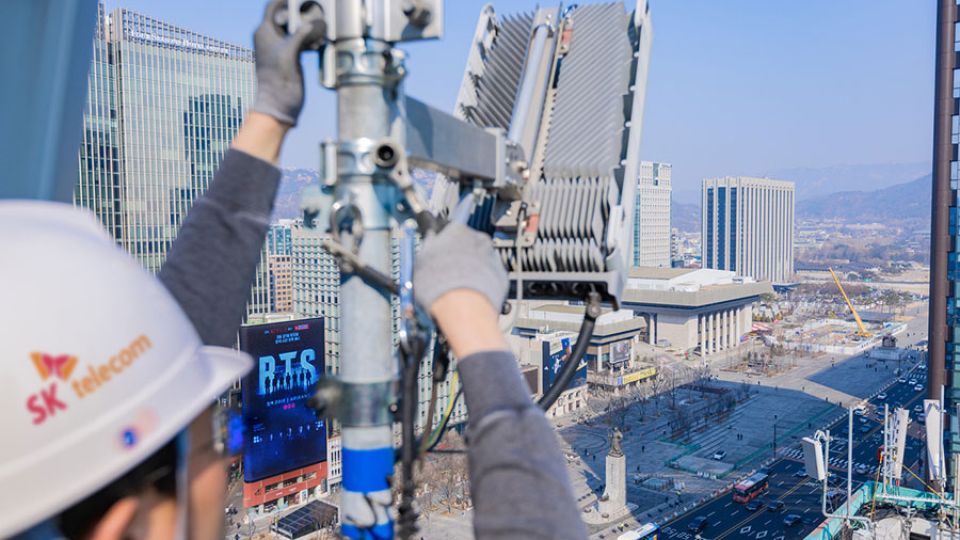
SK Telecom said it will deploy its newly developed AI-based network operations system, A-One (Access All-in-One), for the first time at the concert. The system uses coverage analysis to recommend optimal placement of temporary equipment, draws on historical event data to forecast traffic volumes, and integrates AI-agent-based monitoring to fine-tune network quality in real time.
SKT has divided the Gwanghwamun and Seoul City Hall area into three distinct zones based on crowd density and expected usage patterns:
- Zone 1 covers the main venue along the eight-lane Sejong-daero boulevard between Gwanghwamun and City Hall, where 22,000 ticketed attendees will be seated.
- Zone 2 encompasses the surrounding streets, ticket booths and merchandise areas, where nonticketed fans will gather.
- Zone 3 includes outer side streets likely to see heavy foot traffic and congestion.
The carrier has also installed mobile base stations and temporary relay equipment near the stage, ticket booths, and merchandise zones, and optimized coverage for roaming users and subway stations near the venue.
KT has positioned six mobile base stations across the Gwanghwamun and City Hall plaza area, along with 79 newly built wireless base stations and 14 new Wi-Fi access points. On the day of the concert, the company’s network control center in Gwacheon will operate under an emergency footing, with around 80 personnel, including some 40 on-site engineers, monitoring bidirectional traffic in real time.
The carrier will also activate W-SDN (Wireless Software Defined Network), an AI-based solution that detects early signs of base station overload and automatically redistributes traffic within one minute.
KT said it has also significantly expanded its backbone network capacity to handle the surge in high-definition streaming traffic from both domestic and international viewers tuning in to the global live broadcast.
LG Uplus is deploying mobile base stations and temporary repeaters at more than ten locations around the venue. The carrier’s autonomous network technology pre-configures operating parameters for nearby cells before the event and automatically adjusts base station output and connection settings during the concert to redistribute traffic when any single cell becomes overloaded.
LG Uplus will staff an on-site operations team to monitor equipment and network quality, backed by an emergency response unit at the company’s Magok network operations center.