

July 1, 2026
BEIJING – China and the European Union are set to hold intensive trade talks over the next three months, seeking to contain growing tensions after weeks of sharp rhetoric between the world’s second- and third-largest economies.
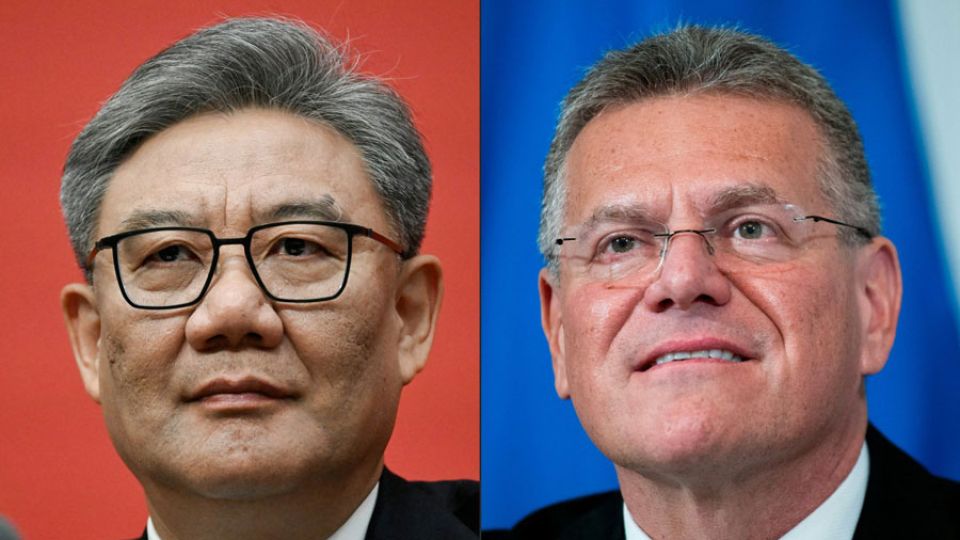
In their first joint statement since 2019, both sides agreed to establish a new trade and investment consultation mechanism aimed at institutionalising dialogue to manage growing disputes, after Chinese Commerce Minister Wang Wentao met EU Trade Commissioner Maros Sefcovic in Brussels on June 29.
Analysts said the move reflects a pragmatic recognition that deep-seated disagreements over industrial overcapacity, market access, export controls and economic security are not likely to be resolved any time soon, making sustained dialogue increasingly important.
The talks come at a time when both Beijing and Brussels see value in maintaining stable ties with each other amid growing uncertainty over US trade and security policies under President Donald Trump.
Beijing is seeking to prevent Brussels from drifting further into the US camp, while the EU is trying to manage its economic dependence on China without abandoning its de-risking strategy.
Under the mechanism, four working groups will focus on trade and investment balance, export controls, intellectual property rights and World Trade Organization reform, according to the joint statement released in the early hours of June 30 (Beijing time).
Wang and Sefcovic have mandated officials to engage in the four work streams and agreed to meet again at the ministerial level in autumn, the joint statement said.
Wang Yiwei, a former Chinese diplomat who is Europe expert at Renmin University, said that the mechanism was a pragmatic outcome as it allows both sides to “seek common ground” and “exchange space for time” – a Chinese expression meaning to create room to manage immediate tensions while waiting for more favourable conditions to resolve deeper disagreements.
Successive rounds of negotiations will be needed both for geopolitically sensitive issues such as export controls covering semiconductors, precision equipment, artificial intelligence and dual-use technologies, and for disputes over industrial overcapacity, anti-dumping and anti-subsidy investigations, and tariff barriers, which reflect fundamentally competing economic interests, he said.
“The interests involved are highly zero-sum in nature… Both sides cannot reach a once-and-for-all agreement,” he said.
The broader backdrop is Trump’s tariffs on China and technology restrictions that have continuously pressured the EU to align with the US, said Wang.
The EU wants to avoid becoming subordinate to the US or being dragged into a China-US confrontation, which is why it has opted for limited de-risking rather than outright decoupling, he said.
Speaking to reporters after the meeting, Sefcovic said that both sides had “a clear mandate and an ambitious timeline to deliver tangible results” before the ministerial-level meeting in Beijing, which he said will be in October.
The October meeting will take place shortly after Chinese President Xi Jinping’s possible visit to the US in September and around the time of the next EU leaders’ summit on Oct 15. It also coincides with the expiry of a one-year suspension of Chinese export controls on critical minerals.
Sefcovic said the priority in the coming months would be addressing several longstanding disputes, particularly the widening trade imbalance, as the EU grapples with a surge in Chinese exports, including electric vehicles (EVs).
China’s trade surplus with the EU reached €360.6 billion (S$532 billion) in 2025, up 15 per cent from 2024, and expanded by another 10 per cent in the first four months of 2026.
All 27 EU member states share concerns over the widening trade imbalance, but they differ over how to respond to China. Germany, for example, has traditionally preferred dialogue with China and opposed EU tariffs on Chinese EVs in October 2024. But its automotive, chemical and clean-tech sectors are now under severe pressure from Chinese rivals.
China’s Commerce Ministry, in a separate statement released on June 30, said Commerce Minister Wang had raised concerns over two proposed EU measures that could further restrict Chinese companies’ access to the European market.
One is the draft Cybersecurity Act, which would tighten cybersecurity requirements for products and digital infrastructure, and the other is the proposed Industrial Accelerator Act, aimed at strengthening Europe’s industrial competitiveness and resilience in strategic sectors.
The meeting came days after sharp rhetoric from Beijing, which had warned that it would retaliate against any new EU trade curbs.
On June 27, a post from Yuyantantian, a WeChat account linked to Chinese state broadcaster CCTV, said that if the EU insists on treating negotiations as a mere formality, China is “capable of handling a further deterioration in economic and trade ties with the EU, even to the point of a freeze”.
“China does not want it to come to that, but it is not afraid to do so either,” it said.
Renmin University’s Wang said that from Beijing’s perspective, negotiations had remained unequal for a long time, during which the EU continued to call for high-level dialogue while simultaneously launching trade investigations.
“China has now clearly abandoned the previous approach of seeking to ease tensions through unilateral compromise and will no longer tolerate an unbalanced pattern of negotiating while competing,” he said.
Future market-opening measures would have to be matched by equivalent commitments from Europe rather than unilateral concessions by China, he said.
Beijing would also deepen engagement with core economies such as Germany and France, while making use of differences within the bloc, rather than treating the EU as a single actor, said Wang.
“At the same time, China will accelerate diversification of its industrial supply chains, reduce dependence on the European market, and strengthen its resilience so as to lessen the impact of a freeze in economic and trade relations,” said Wang.
Claus Soong, an analyst in the foreign relations team at German think-tank Merics, said that the consultation mechanism highlighted Beijing’s efforts to keep Europe engaged at a time when access to the US market has become increasingly difficult for Chinese exporters.
Both Europe and China have leverage over each other, but they also remain economically interdependent, he said.
“Politically, Beijing is in a position to seize the momentum to improve relations with Europe, as scepticism grows over whether the US can still be relied upon as an ally,” he said.