

January 22, 2026
CHONGQING – China’s economic influence in Central Asia has grown as it overtook Russia to become the region’s largest trading partner, but this does not necessarily put both superpowers in direct competition to woo their neighbours, analysts said.
That is because Central Asia – an inland region that sits west of China and south of Russia – imports different products from both its neighbours and works with them in separate ways, they added.
Dr Zhou Mi, senior research fellow at the Chinese Academy of International Trade and Economic Cooperation, told The Straits Times that “exports from Russia and China to Central Asia help the region’s growth in different ways, with both countries having the space to carve out their own niches”.
He pointed out that “China’s exports, including tech products, are suitable for Central Asia’s current growth stage and can satisfy the region’s demand to grow its energy, automobile and logistics sectors”.
He added: “Working with China also makes a lot of sense for Central Asia because of China’s large domestic market and purchasing power.”
Professor Wang Yiwei at Beijing’s Renmin University told ST that “Central Asia’s growing economy would mean that countries in the bloc would seek more varied products for its growth”.
“Central Asia, being an inland region, is also likely to turn to China, the world’s factory and one of its closest neighbours, for imports to help with its growth,” he added.
Prof Wang said that China’s trade relationship with Central Asia is complementary, given that China imports oil and natural gas as well as agricultural produce from Central Asia for its own economic growth.
On Jan 18, China’s Commerce Ministry announced that the world’s second-largest economy has emerged in 2025 for the first time as the top trading partner for all Central Asian countries.
The announcement came after Tajikistan revealed in 2025 that China has now become its largest trade partner.
The five countries in Central Asia are Kyrgyzstan, Tajikistan, Turkmenistan, Uzbekistan and Kazakhstan, the region’s largest economy.
They gained independence after the collapse of the Soviet Union in 1991, and are considered to be middle-income economies, though development levels vary across the region.
China’s Commerce Ministry also said on Jan 18 that two-way trade between China and Central Asia hit US$106.3 billion (S$136.5 billion) in 2025 – an increase of 12 per cent from 2024.
The figures also showed that the latest growth rate had doubled from the 6 per cent recorded in 2024, with trade growth between China and Central Asia having expanded for five straight years.
Chinese exports to the region, including electric vehicles, lithium batteries and photovoltaic products, have expanded steadily, the authorities said.
Meanwhile, imports from Central Asia grew 14 per cent to US$35.1 billion, with products and resources such as chemicals, steel and agriculture.
Trade turnover between Russia and Central Asia reportedly exceeded US$45 billion in 2024.
The European Bank for Reconstruction and Development estimated that Central Asia’s economy will grow 5.2 per cent in 2026 – higher than the World Bank’s prediction of 2.6 per cent for global growth – reflecting a growing demand for imports and markets for its exports.
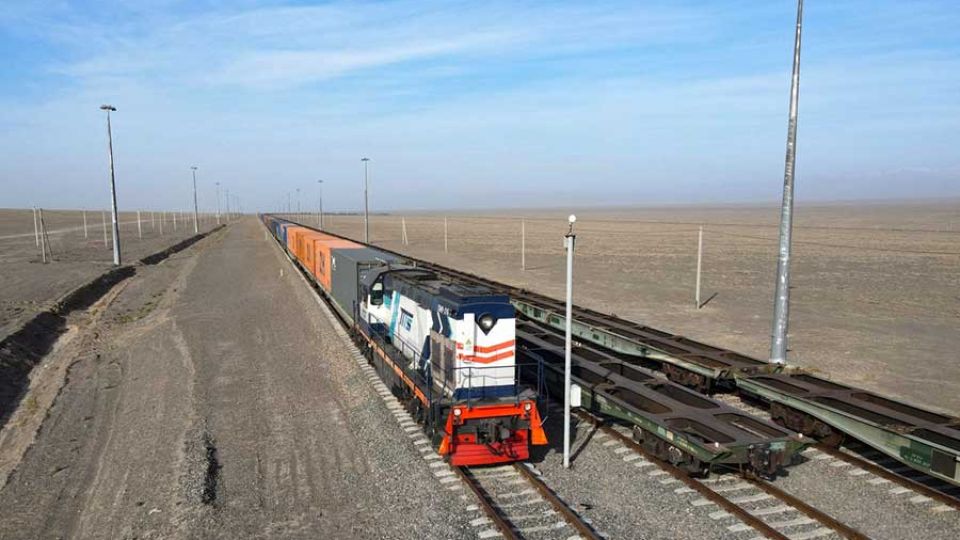
The authorities in China also credited the Belt and Road Initiative (BRI) with being the driving force for the robust trade between Central Asia and Asia.
The BRI is China’s global trade and connectivity project launched in 2013 by Chinese President Xi Jinping, linking a reported 150 countries together by sea and rail links.
Prof Wang pointed to the BRI’s China-Europe Railway Express, which passes from Chongqing in south-western China, to European hubs in Britain, Germany and Spain, as a key push for growth in Central Asia.
Professor of economics Bala Ramasamy at the China Europe International Business School said: “China offers a wider variety of goods to Central Asia, especially high-tech products. Russia does not come to mind when it comes to machinery, technological advancements or green development.”
In 2025, China’s top three trading partners – when groupings are included – were ASEAN, the European Union and the US, according to market research firm Export Import Data, while another research firm, Seair Exim Solutions, reported that Russia’s main trading partners include China, the Netherlands and Germany.
Geopolitical uncertainty has been increasing for countries in Central Asia – long considered Russia’s backyard – especially with
Russian President Vladimir Putin’s invasion of Ukraine in 2022, resulting in sanctions from major countries in the West, particularly those in Europe.
Central Asia primarily imports petrol, diesel and liquefied petroleum gas as well as arms and military equipment from Russia, according to a report by US think-tank Caspian Policy Center.
Turning to China is one way that Central Asia can protect itself better from the possibility of secondary sanctions on those who work with Russia, analysts said.
“Russia’s influence in its neighbouring countries has been on the decline, particularly after what has happened to Ukraine,” Prof Wang said.
“So the pace of economic integration between Russia and Central Asia has slowed down accordingly,” he added.
Policy institute Chatham House said in a 2025 report that Russia has been “making particularly significant inroads into the energy sectors of Kazakhstan and Uzbekistan as it attempts to find new markets for its exports as a consequence of sanctions (since 2022)”.
“Despite such ties, Russia’s leadership still worries that Central Asia is moving too far out of Moscow’s orbit” amid a growing trend in the grouping to step up engagement with other European countries, the US and China, the report added.
Local media in Central Asia also reported in October 2025, during the latest Central Asia-Russia summit, that Mr Putin had criticised the slow pace of regional integration and called for increased trade between Russia and Central Asia.
He had reportedly compared Russia’s trade with Belarus, which has exceeded US$50 billion, with Central Asia, despite the former’s far smaller population of about 10 million.
Prof Ramasamy said “Russia traditionally exports resources” so to that extent, its offerings to other countries remain limited.
Russia’s top three exports are crude petroleum, refined petroleum and petroleum gas, according to 2023 data from the Observatory of Economic Complexity, an open-source data site.
Looking ahead, countries in Central Asia can continue working closer with Russia on resource industries while deepening cooperation with China in areas such as agricultural produce, handicrafts and light industries, Dr Zhou said.