

January 22, 2026
MANILA – China will move to hasten negotiations with Southeast Asian nations to finally adopt a long-delayed Code of Conduct (COC) governing the disputed areas of the South China Sea.
According to Chinese Ambassador to Manila Jing Quan, Beijing is banking on the Philippines, which chairs the Association of Southeast Asian Nations (Asean) this year, in concluding the COC negotiations that began only in 2018. That’s 16 years after the two parties signed a 2002 declaration to adopt a binding framework that will ensure peace and stability in the highly contested waterway.
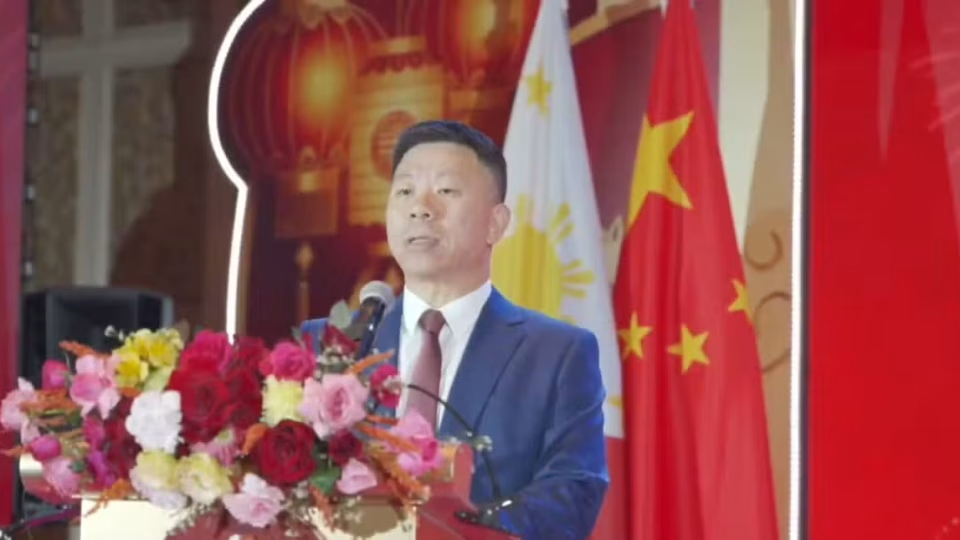
“This year, the Philippines is chairing the Asean. Both sides hope to accelerate negotiations on the (COC) in the South China Sea. To this end, consultations are becoming more frequent and more intensive,” the new Chinese envoy said in a speech at an event on Tuesday night with members of the media.
This is the first time in the past few years that a Chinese diplomat expressed optimism on the COC.
Jing formally assumed the Manila post in December last year, succeeding Huang Xilian who had served a nearly six-year tenure.
READ: West PH Sea: Hontiveros calls for action as Chinese embassy targets Tarriela
Slow progress
In October 2024, during the 27th Asean-China Summit in Laos, President Ferdinand Marcos Jr. called on the member states of Asean to fast-track the COC to push for meaningful progress amid China’s continued aggression and harassment in Philippine waters.
Progress had been slow in passing the COC and claimant countries have not arrived at a solution to any of the dispute, with coercive and provocative acts racked up into serious tensions.
In the case of the Philippines, the 2002 Declaration on the Conduct of Parties in the South China Sea (DOC) did not stop China from seizing control of Ayungin (Second Thomas) Shoal in 2012 after a tense standoff with the Philippine Navy.
The Philippines in 2013 brought an arbitral case against China before the Permanent Court of Arbitration in The Hague, the Netherlands.
In 2016, the international tribunal upheld the Philippines’ sovereign rights to fish and exploit resources within its 370-kilometer exclusive economic zone (EEZ) and rejected China’s sweeping claims over practically the entire South China Sea.
Beijing, however, has refused to acknowledge the ruling, claiming it has sufficient historical and jurisprudential basis.
Apart from the Philippines, Asean members Vietnam, Malaysia and Brunei also have overlapping claims over the South China Sea.
The Philippines want the COC to be consistent with the United Nations Convention on the Law of the Sea and must also affirm the 2016 award on South China Sea arbitration.
Easing tensions
The new Chinese envoy also told the media during an event Tuesday night that Manila and Beijing are holding talks to come up with a “roadmap” that hopes to ease tensions in the West Philippine Sea (WPS) that have lingered since the Chinese takeover of Panatag (Scarborough) Shoal.
Jing disclosed this as he urged for continued dialogue over tense confrontations between the Chinese and Filipinos in various parts of the waterway that are well within the Philippines’ 370-km EEZ.
“The best option is to sit down for talks and solutions in a diplomatic way. At present, the diplomats on the two sides are working toward this goal, and have already reached preliminary consensus on a roadmap for the next stage [of] dialogue and negotiation,” Jing stressed.
The maritime conflict in the South China Sea is among the issues that the Chinese envoy wants to see stabilized under his watch so as not to jeopardize bilateral relations between the two nations.
“The South China Sea issue is only one portion of China-Philippines relations. We still need to have the bigger picture in mind,” he said, then quoted President Marcos about not allowing “differences to define our relationship.”
The Chinese ambassador highlighted the trade ties between the two countries, with China consistently a top source of imports for the Philippines and buyer of agricultural products, such as durian, mango and banana from Manila.
At an international import expo in China last year alone, import deals with durian exporters from Davao City reached $36.6 million, he noted.
Calls for DFA action
Jing’s remarks came days after Commodore Jay Tarriela, spokesperson of the Philippine Coast Guard (PCG) for the WPS, and Chinese Embassy deputy spokesperson Guo Wei continued to publicly trade barbs over the use of altered images of Chinese President Xi Jinping in the former’s public engagements.
Guo warned Philippine officials, specifically Tarriela, to “immediately stop making provocations and stop confusing right and wrong, or they would pay the price for what they did.”
In a joint statement, the Liberal Party and the Akbayan Party called the warning a reckless escalation and said it required a “firm response” from the Department of Foreign Affairs (DFA) considering that it involved threats by a foreign embassy against specific government officials.
“No state has the authority to threaten officials of another sovereign country for speaking publicly about verified developments within their own maritime domain,” the parties pointed out. “Truth-telling does not escalate tensions; China’s illegal incursions, aggressive maneuvers and open threats do.”
‘Bad guest’
Sen. Risa Hontiveros has also called the Chinese Embassy in Manila a “bad guest,” citing its failure to show respect to officials in its host country.
In a Kapihan sa Senado on Wednesday, Hontiveros reiterated her appeal for the DFA to immediately act on the embassy’s public attack against government officials defending the Philippine position on the WPS dispute.
The DFA on Wednesday issued a statement stressing that “differences between states are best addressed through established diplomatic channels rather than public exchanges.”