

April 28, 2026
SEOUL – Chinese automakers are rapidly shedding their reputation as budget electric vehicle producers, unveiling high-performance, software-driven models at the country’s premiere auto show, while foreign rivals rush to localize their strategies to remain relevant in the world’s largest automotive market.
At the Auto China 2026 trade show, Chinese manufacturers are showcasing breakthroughs in battery technology, autonomous driving, artificial intelligence and in-car digital systems, reflecting a strategic move by Chinese makers toward the premium segment to target wider global audience following a prolonged price competition in China that has squeezed profit margins.
Held under the theme “Future of Intelligence,” the biennial show opened Friday in Beijing and runs through May 4. Spanning roughly 380,000 square meters — equivalent to about 50 soccer fields — the event features more than 1,400 vehicles, including upward of 180 world premieres, according to organizers.
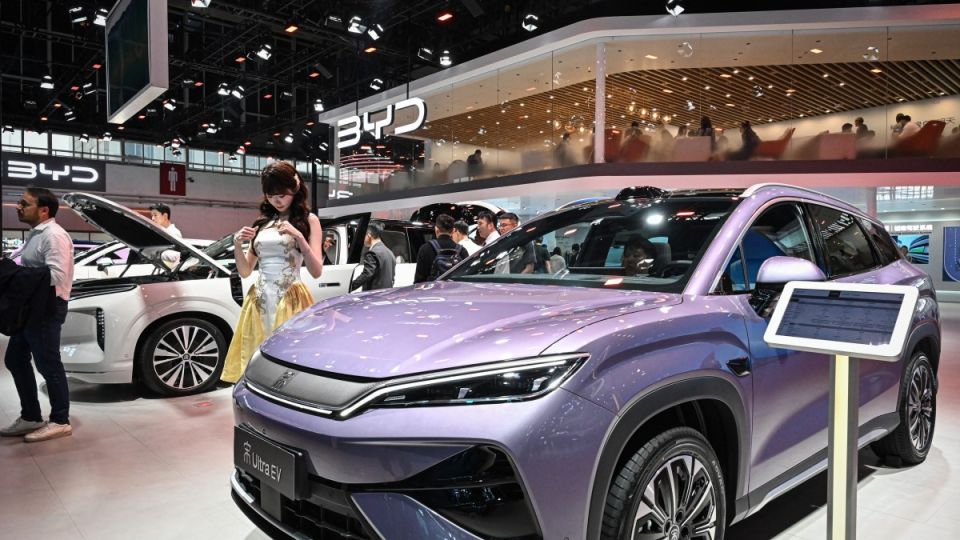
Leading Chinese carmakers, including BYD and Geely, used the world’s largest auto show to unveil vehicles that emphasize performance, intelligence and luxury.
BYD’s premium off-road brand Fang Cheng Bao went beyond rugged SUVs, introducing its first sedan, the S-series, along with a two-door convertible supercar Formula X. The carbon-fiber supercar produces a whopping 1,000 horsepower. It is set for production by 2027, according to the company.
BYD’s luxury unit Denza — begun as a joint venture with Mercedes-Benz before the German carmaker exited in 2024 — stole the show with its Denza Z, a production-ready hypercar to take on the Porsche 911. The model delivers over 1,000 horsepower, capable of sprinting from zero to 100 kilometers per hour in under two seconds.
Chinese carmakers are also pushing boundaries by weaving advanced AI software and autonomous driving systems into their EVs.
Xpeng presented its new SUV GX, a Range Rover-style six-seater that brings together the company’s most advanced autonomous driving technology, which could support highly automated Level 4 capabilities. Xpeng also showcased its flying car, the “Land Aircraft Carrier” at the auto show, with plans to begin full-scale production in 2027.
Not only the carmakers, tech giants like Xiaomi and Huawei are flexing their muscles in the heated car race. Xiaomi showcased its Vision GT electric supercar concept, built for Gran Turismo, which CEO Lei Jun introduced himself.
Huawei, which entered the car market through partnerships with car manufacturers, expanded its presence across multiple brands at the auto show. Beyond its tie-up with the Aito brand through Seres Group — where it showcased its flagship SUV models and announced its push into overseas market — Huawei’s technology has also found its way into vehicles from Audi and Toyota.
China’s top battery-makers also staged a technology showdown. The world’s largest battery-maker CATL highlighted its third-generation lithium iron phosphate battery, Shenxing, capable of charging from 10 percent to 98 percent in just 6 minutes and 27 seconds, approaching the refueling time of gasoline vehicles.
“The new Shenxing is expected to be produced by end of this year,” said a CATL official.
BYD, seeking to close the gap with CATL, drew crowds with a live demonstration showcasing battery performance under in the extreme cold.
The company set up a see-through chamber at its booth, placing vehicles like Denza’s Z9 GT and Fang Cheng Bao’s Tai3 inside at temperatures dropping below minus 30 degrees Celsius and demonstrating their ability to achieve a full charge in about 12 minutes.
As Chinese automakers set their sights on global markets with premium offerings, legacy foreign brands are firing back by unveiling China-specific models — dubbed “For China” — backed by deep localization strategies aimed at winning over Chinese consumers.
China’s total vehicle sales reached about 30.05 million units last year, the highest on record, with domestic brands accounting for 69.5 percent of the market, according to the China Association of Automobile Manufacturers. Homegrown players like BYD, Geely and Chery have tightened their grip on the market — particularly in the electric and hybrid segments — squeezing out foreign carmakers in the process.
Global automakers such as Volkswagen Group, Mercedes-Benz and BMW, which once enjoyed dominance in the internal combustion era, are now pushing localization as a core strategy in a market where EVs already account for more than half of new car sales.
Under its “In China, for China” strategy, Volkswagen Group announced its plans to launch around 30 electrified models in the country by 2027, rising to 50 by 2030.
“Starting in 2026, we will launch a new vehicle on average every two weeks,” said the chair and CEO of Volkswagen Group China. “This is the Volkswagen Group’s largest-ever electric mobility offensive in China.”
At the show, Volkswagen launched various models, including the premiere of its “ID. Unyx 09,” an electric sedan developed with Xpeng.
Volkswagen Group’s luxury marque Audi is pursuing a dual-brand strategy in China, deploying a separate “AUDI” identity in all capitals — dropping its signature four-ring emblem — to appeal to younger consumers. The Audi brand, established through a partnership with SAIC Motor, premiered the fully electric E7X at the show, marking the second production model from the marque since its launch in 2024.
Mercedes-Benz unveiled a China-exclusive electric GLC L SUV as well as three other vehicles for the market. The German carmaker also highlighted its collaboration with Chinese autonomous driving startup Momenta, which will enable Level 2 urban driving in its upcoming models such as the CLA, GLS and S-Class in China.
BMW is also doubling down on its China push, unveiling two China-tailored EV models — the iX3 Long Wheelbase and i3 Long Wheelbase — alongside the new 7 series, all made their world premieres at the Beijing auto show.
South Korean carmaker Hyundai Motor is also “tripling down” in the Chinese market, according to its CEO Jose Munoz. Under its “In China, For China, To Global” market strategy, it unveiled its China-specific Ioniq V in partnership with local companies including Momenta and CATL.