

June 24, 2026
TELUK INTAN – Following the hit release in Malaysia and Singapore of ‘Dear You’ (Love Letters to Grandma), a film depicting the stories of Teochew-speaking Chinese immigrants making a living in Southeast Asia, the letters featured in the movie evoke memories of sending letters and cash.
To this day, some Malaysian Chinese families still keep those letters to remember their ancestors’ deep love for their hometown.
After early Chinese ancestors migrated here from China, they sent remittances back to their native villages aside from writing letters home.
Relatives in China referred to these letters from Nanyang or overseas as Qiaopi (侨批) – letters sent back by overseas Chinese.
Pi (批) is the Teochew or Hokkien word for a letter.
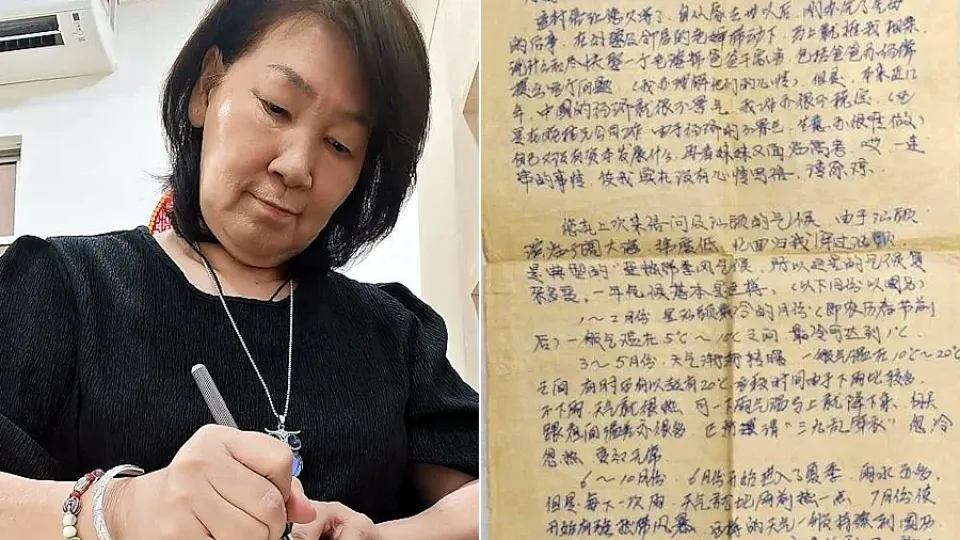
Tan Ing Ting, from Sungai Burong in Bagan Datuk, Perak, and her cousin still keep a collection of those letters sent by their relatives in Chaoshan, China, decades ago.
After watching the movie, Tan shared in an interview with Sin Chew Daily that she remembers the practice vividly, as she used to write letters for her late grandfather.
“My grandpa came from Chaoshan at the age of 19 and settled down in Sungai Burong.
“After he earned some money here, he would start finding ways to send letters to his relatives back in China, while also sending money to financially support them,” she said.
She added that according to her aunt, her grandfather would often go to “Ah Lin” on “Gangqian Street” (now Jalan Wah Keng Jooi) in Teluk Intan to have his letters written and money remitted.
“It took more than a month for a letter to reach China. By the time our relatives received the letter and money, it would be more than three months before we would receive their replies from the letter agent,” said Tan.
Tan said when she started secondary school, her grandfather, finding the cost of hiring a professional letter-writer too high, asked her eldest sister to write the letters.
Later on, this task was passed down to herself.
The contents of the letters were almost always the same: sharing daily life updates, assuring the family in China that they were doing well and not to worry, while stating the amount of money enclosed.
“In his later years, to save on fees, my grandfather would just slip RM10 in cash directly into the envelope.
“Our relatives could exchange the cash for Renminbi to use in China.
“The Ringgit exchange rate was high back then, so a small amount of Malaysian currency could be exchanged for a substantial amount of Renminbi.”
Recalling that her grandfather was always worried they might take the RM10 note out of the letter, so he would closely watch them seal the envelope before feeling at ease to send it off.
Tan said her family continued to stay in touch with their relatives in China until mobile phones became available in the market.
They gradually transitioned to communicating via WeChat, and the letters faded into history.
Since 2013, the letters with money, known as money letters by the Unesco Memory of the World Register, for their immense historical value.
Local merchants recalled that a woman used to set up a table at Jalan Wah Keng Jooi to write such letters for the community.
Now elderly, she has since moved to Ipoh to live with her children.
“Due to changing times, no one needed to write letters back to China anymore, and the letter-writing stall subsequently closed down.
“But many older Teluk Intan residents, especially the merchants along Jalan Wah Keng Jooi, still remember it.”
Goh Thien Wah, president of Heng Ann Association Melaka, wrote on Facebook that the signages of old shops like Poh Teck & Co, Tay Miang Guan & Co Ltd located at Jalan Kampung Pantai in Melaka containing the words “letters and remittances” in Chinese are proof of Chinese migrants sending money through these shops based on trust, before banks came into existence.
“These are traces of history and form a collective memory of Chinese Malaysians,” he said.
Various Teochew clan associations in Klang, Penang, Negeri Sembilan, Johor and other states have sponsored the movie, inviting members to watch it for free since it started screening in Malaysia on June 18.
Besides Teochew clan associations, the Chan Clan Ancestral Hall in Kuala Lumpur also invited 200 people to watch the movie in conjunction with its 130th anniversary as the movie featured the history of early Chinese immigrants in Malaysia.
The Chiang Chuan Association in Muar has announced setting up a station to collect such letters as part of its effort to preserve history.
The letters collected would be exhibited in a public display in future.
In just five days of its release in Malaysia, sales of the movie have surpassed RM5.8 million so far.
In Singapore, all eight additional screenings of the movie in Teochew dialect sold out on Golden Village’s website within one and a half hours on June 22.
GV had previously screened eight sessions of ‘Dear You’ in Teochew between June 18 and 21 where all 4,800 tickets were sold out within two hours of their launch on June 16.
It was reported that ‘Dear You’ was produced with just US$2 million (RM8.3 million), and the movie became a massive-box office earning over 1.8 billion yuan (RM1.1 billion) in China.