

January 6, 2026
DHAKA – Dense fog that set in late December continues to persist, dragging down daytime temperatures and driving up cold-related illnesses. Daily life across Dhaka and the northern districts has slowed to a crawl, with children, the elderly, and low-income families bearing the brunt of the chill.
According to the Directorate General of Health Services (DGHS), 48 people have died of cold-related diseases across the country since November.
Currently, a mild cold wave is sweeping across Rajshahi division and the districts of Dinajpur, Jashore, Chuadanga, and Kushtia.
Climate scientist Rashed Chowdhury, adjunct faculty at Arizona State University, said Bangladesh’s cold spell is part of a wider global climate pattern rather than a local anomaly.
“La Niña is cooling not only Bangladesh but also the regional climate,” he explained, adding that the polar jet stream is pushing cold air farther south.
“Large parts of the Northern Hemisphere, including regions of the United States and Canada, are also experiencing colder-than-normal winters,” he added.
The Bangladesh Meteorological Department (BMD), in its monthly forecast, has already warned of two to three cold waves in January, one of which could be “severe”, with temperatures dropping as low as 4°C.
Bazlur Rashid, senior meteorologist at the BMD, said the dense fog is not clearing due to a lack of westerly winds and rainfall. “The situation will not improve until the fog lifts. People will feel colder as foggy conditions block sunlight,” he noted.
Around this time of year, Dhaka’s daytime temperature usually hovers near 28°C. Yesterday, however, it was just 19°C due to heavy fog.
BMD recorded the day’s lowest temperature at 8.4°C in Ishwardi, Pabna, while the highest was 26.7°C in Teknaf, Cox’s Bazar. In Dhaka, the maximum was 19.7°C and the minimum 13.2°C.
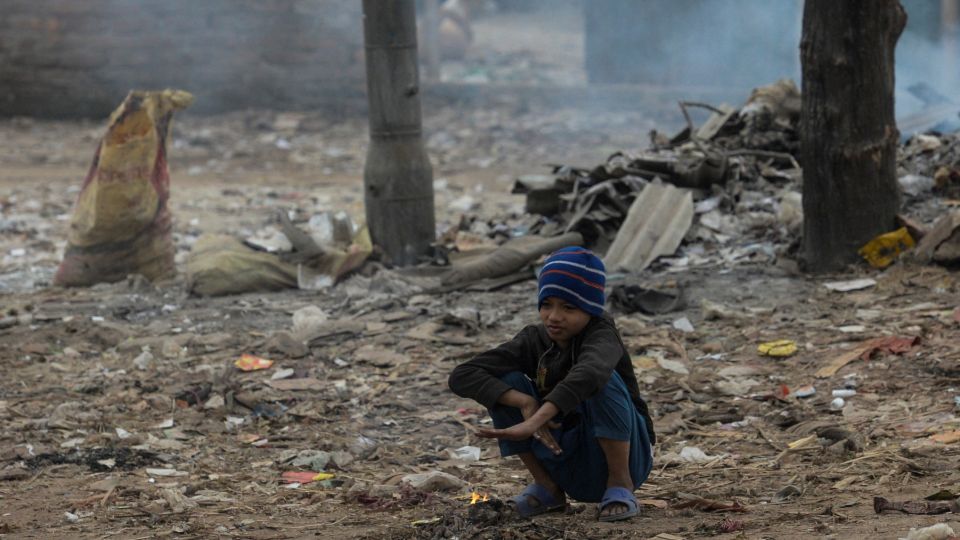
Local correspondents reported that the sun was absent in Ishwardi and adjoining areas throughout the day. The severe cold has disrupted lives and livelihoods, with many residents venturing outdoors only for emergencies. In Pabna, day labourers and homeless people were seen burning wood along roadsides to keep warm.
“I usually earn Tk 400–500 by pedalling from dawn to noon. Today, I made only Tk 150,” said Abdul Latif, a rickshaw puller in Ishwardi municipality.
He added that despite burning scrap paper to warm himself, his hands felt “frozen” and he struggled to steer his rickshaw.
COLD-RELATED ILLNESSES
As the cold wave sweeps parts of the country, the number of patients suffering from cold-related illnesses has risen sharply, particularly among children and the elderly.
DGHS data show hospital admissions for acute respiratory infections (ARI) continue to climb: 1,102 patients were admitted in the 24 hours until 8:00am yesterday, compared to 1,031 on Sunday and 632 on December 27.
Meanwhile, 2,220 patients were hospitalised with diarrhoea in the same 24-hour period, down from 2,332 on Sunday and 2,676 on December 29.
Since November 1, hospitals have admitted 1.02 lakh patients—30,657 with ARI and 71,406 with diarrhoea. Forty-eight people have died during this period.
Prof Mahbubul Hoque, director of Shishu Hospital, said 30–40 percent of patients at the hospital’s outpatient department are suffering from cold-related illnesses. “Every day, some 1,000 to 1,400 people seek treatment at the outpatient department. Some, mainly with respiratory issues, require admission.”
He warned that severe cold and dense fog are especially harmful to children and the elderly. “If possible, they should stay indoors, wear masks, and cover their heads when outside. For common colds, guardians can use nasal drops and certain antihistamines. In cases of breathing problems, patients must be taken to hospital. Antibiotics should not be used without a doctor’s consultation.”
Meanwhile, the advisory committee on law and order yesterday urged authorities to take steps to ensure road safety amid the cold wave.
Drivers have been asked to remain cautious, as foggy conditions on highways have significantly reduced visibility.
Transport owners and workers have been directed to enforce safe driving practices during this period.