

July 3, 2026
JAKARTA – The planned amendment to the 2014 Copyright Law offers a mixed bag for journalists and press institutions in Indonesia.
On the positive side, the bill, which is set to be deliberated by the House of Representatives, recognizes journalistic works as copyrighted works—the first formal recognition of its kind in the country. This places journalism on an equal footing with other creative and intellectual works.
Amid mounting pressures from failing business models and an increasingly restrictive government that have constrained both the press and civil society, the amendment seeks to safeguard the economic rights of journalists and media organizations as the producers and owners of journalistic works, including news content.
Article 30 of the bill, for example, stipulates that digital platforms must compensate producers of journalistic works if they derive direct or indirect profits from using such content through activities including aggregation, curation, republication, or advertising.
These provisions are a welcome development after a series of legal setbacks for news publishers in their pursuit of fair compensation from digital platforms. The most significant setback came with the Agreement of Reciprocal Trade (ART) between Indonesia and the United States, signed by President Prabowo Subianto and US President Donald Trump.
The agreement stipulates that Indonesia may not require US digital service providers—including Google, Meta and X—to support Indonesian news organizations through paid licensing, user data sharing or revenue-sharing arrangements.
This provision runs counter to the 2024 Publishers’ Rights Regulation (Presidential Regulation No. 32/2024), which requires digital platforms to compensate news publishers for using their content. If the copyright amendment is enacted, it would provide journalists and media organizations with stronger legal standing in their dealings with digital platforms.
The downside, however, is that the bill also opens the door to the potential criminalization of journalists and content creators. Article 55 stipulates that digital portraits of public figures may only be used for educational, cultural or commemorative purposes and must not be digitally altered in ways that “go against the subject’s dignity.”
The Press Legal Aid Institute (LBH Pers) has warned that the broad definition of a “public figure portrait” could expose journalists and editorial illustrators to lawsuits for using photographs or visual archives in caricatures or satirical illustrations intended to express criticism.
LBH Pers has also criticized Articles 132, 138 and 139, which impose criminal penalties on individuals or corporations whose works are deemed to violate “morality, religion, decency, public order, or national defense and security interests.”
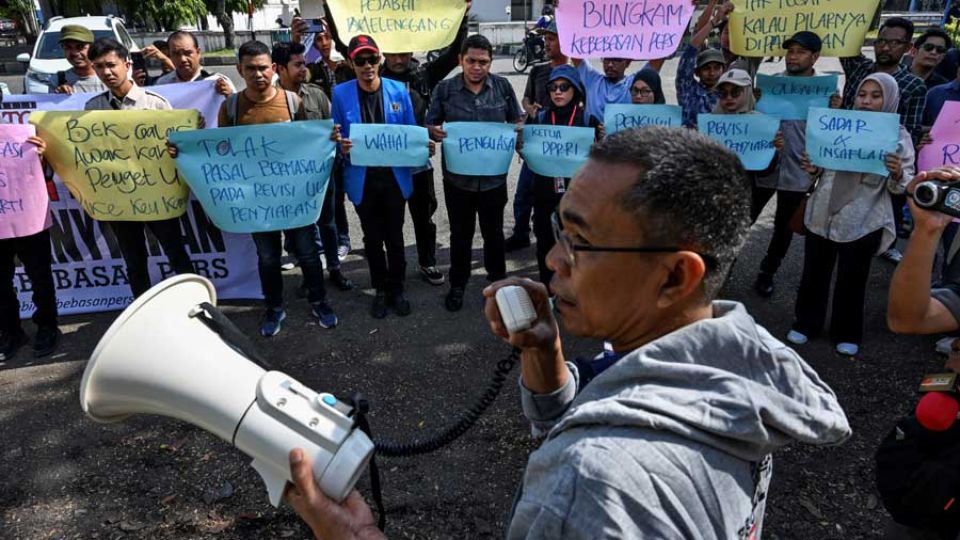
Today, Indonesia’s press faces a dual challenge: growing pressure on press freedom and the urgent need for economic sustainability.
If President Prabowo and his administration truly see themselves as defenders of democracy, they should seize the copyright amendment as an opportunity to strengthen legal protections for journalists and media organizations—not weaken them.
The government must stop introducing legal provisions that intimidate the press and further erode press freedom. Indonesia already has the 1999 Press Law and the Journalistic Code of Ethics to ensure that journalists and media organizations operate within clear legal and ethical boundaries.
Instead, the government should focus on helping journalists and media organizations rebuild sustainable business models that enable Indonesian journalism to remain financially viable while continuing to serve democracy and the public interest. This can be achieved by establishing regulations that create a more level playing field between news publishers and digital platforms.
Without a free and sustainable press, governments lose an essential democratic safeguard—one that holds power accountable and keeps leaders grounded in the realities and aspirations of the people.