

June 23, 2026
TOKYO – This is the second installment in a series of articles taking an in-depth look at the demographic challenges in Japan.
“Check left and right. Check behind. All clear.”
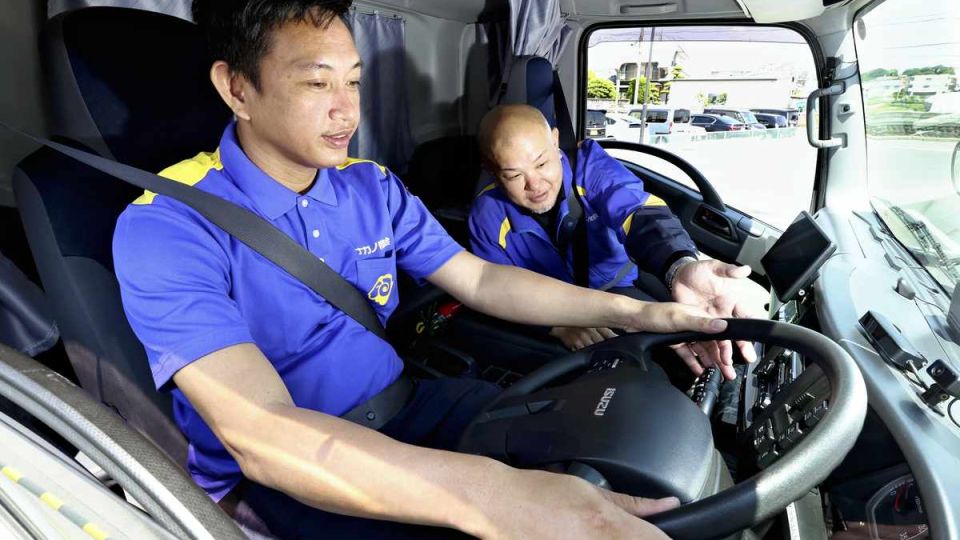
In mid-May, three Vietnamese men in their 20s and 30s were undergoing training to become truck drivers at a base of Tokyo-based logistics company Nakano Shokai Co. in Atsugi, Kanagawa Prefecture.
The men arrived in Japan at the end of January and were granted a five-year residence status under the Specified Skilled Worker (SSW) program. They have already obtained Japanese driver’s licenses and are currently learning Japanese traffic rules and culture. They are scheduled to begin working in inter-company logistics using medium-sized trucks in the Kanto region by the end of this year.
Nakano Shokai is a subsidiary of Yamato Holdings Co., the parent company of major parcel delivery firm Yamato Transport Co. It employs around 700 drivers. While the company is not currently facing a driver shortage, Yusuke Takada, its managing director, has expressed a strong sense of urgency, saying, “Unless we hire foreign drivers, we’ll inevitably see a decline in our transport capacity in the future.”
The trend of hiring foreign drivers for logistics is spreading throughout the industry.
Starting in 2027, Yamato HD plans to hire up to 500 Vietnamese drivers nationwide over a five-year period. Logistics giant SBS Holdings, Inc., meanwhile, plans to have foreign nationals make up about 30% of its drivers — approximately 1,800 people — within 10 years.
The trend is driven by a projected decline in the number of drivers due to Japan’s aging population and low birth rate. According to the Internal Affairs and Communications Ministry’s Labor Force Survey, driver numbers in the road freight transport industry have remained flat. On the other hand, the proportion of drivers aged 50 and over has been rising year by year, reaching 47% in 2025. Among younger drivers, those in their teens account for just 1%, and those in their 20s for only 10%, deepening concerns that a driver shortage will grow as the aging workforce moves into retirement.
Meanwhile, as online shopping continues to spread, the volume of parcels has been increasing annually, with delivery handling more and more each year. In fiscal 2024, the figure stood at 5.03 billion parcels, but some estimates suggest it will exceed 6 billion by fiscal 2030. An industry insider said, “If we include parcels delivered via online retailers’ own delivery networks, the total has already surpassed 6 billion.”
On the front lines, a sense of operational strain is intensifying. Last December, Yamato Transport, the market leader in parcel delivery, and Sagawa Express Co., in second place, experienced delivery delays as they struggled to handle a surge in packages during the year-end shopping season.
Logistics is a critical infrastructure that supports the economy and society, and public-private partnerships have begun to form to address the crises looming in the future.
As a critical solution to overcome the crisis, the central government and over 100 companies have formed a council to explore the concept of Autoflow Road, a system that involves running carts loaded with small parcels 24 hours a day in dedicated spaces on expressways or underground. Tests will begin on a section of the Shin-Tomei Expressway by fiscal 2027 to evaluate the costs and identify challenges.
The industry also has high expectations for autonomous truck driving technology. Since March of last year, the Land, Infrastructure, Transport and Tourism Ministry and Central Nippon Expressway Co., among others, have been conducting tests on a section of the Shin-Tomei Expressway in Shizuoka Prefecture in collaboration with private companies. These tests, which take place on weekday nights under specific conditions, aim to achieve Level 4, fully autonomous driving.
“‘Fast delivery anytime’ is not a matter of course,” said Jun Oishi, a senior consultant at Nomura Research Institute, Ltd., who specializes in logistics issues. “To maintain the convenience of logistics, efforts are needed and involve not only logistics companies but also shippers and consumers.”