

December 4, 2025
SEOUL – President Lee Jae Myung on Wednesday thanked the people for their part in resisting the martial law declared by previous President Yoon Suk Yeol, but added that the work toward reconciliation that started on Dec. 3, 2024, was incomplete and must continue.
In a special address to the public, Lee expressed gratitude to the people who bore the brunt of that winter night of martial law.
The president also proposed to designate Dec. 3 as “People’s Sovereignty Day” to commemorate the role the people played in resisting and overturning Yoon’s martial law. Lee said the people who peacefully overcame the crisis “deserve to win the Nobel Peace Prize.”
He explained that such moves are meant to “honor the great courage and actions of our people.”
Calling the public’s resistance of martial law a “revolution of light,” he said that restorative changes remain incomplete, calling for the people involved in the imposition of martial law to be swiftly brought to justice.
“The truth-finding efforts regarding the insurrection are ongoing. Investigations and trials of those involved in the rebellion, as well as those responsible for it, are still underway,” Lee said in his statement.
“Strict punishment of those involved in the coup will be just the beginning. The atrocities of destroying the constitutional order and even plotting a war for personal ambition must be brought to justice.”
However, Lee also said it is important to refrain from haste in such efforts. Lee told the presidential press corps after his public statement, “The treatment must be executed completely, even if it’s a bit of a long and tiring process.”
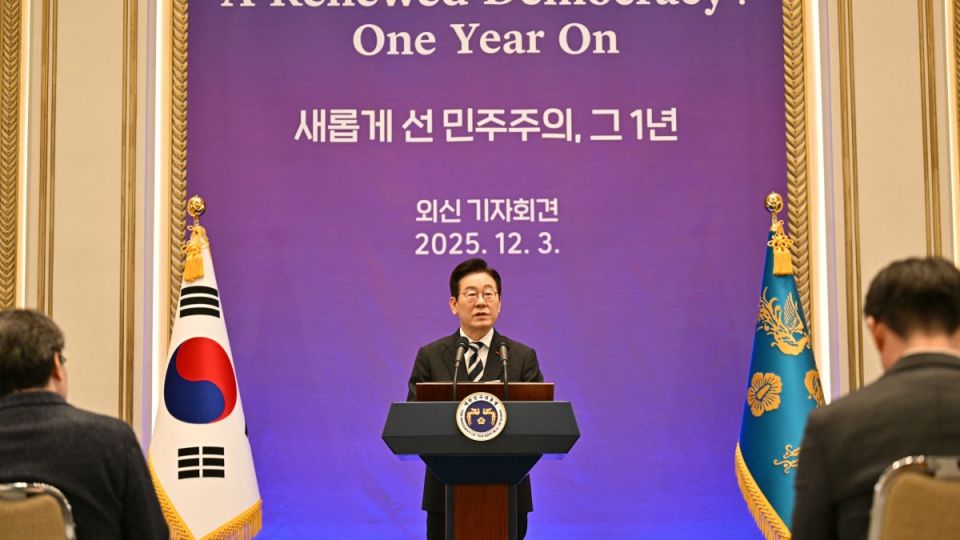
In a news conference with foreign media after the address, Lee continued to highlight the role of the people, and touted that “K-democracy” could serve as a guiding light for aspiring democracies around the world.
“I hope that South Korean citizens’ beautiful and peaceful revolution and its restoration of democracy will become an example in world history,” Lee said at a news conference held at the former presidential compound of Cheong Wa Dae in Seoul.
“I also extend my gratitude and support to the people and leaders across the world fighting for democracy, and I hope you have hope.”
At the time of Yoon’s martial law declaration, Lee served in the parliament as the opposition leader. Recalling the moment he began livestreaming his entrance to the National Assembly before climbing over a wall to circumvent a police blockade, Lee said the people’s engagement was key to overturning the martial law imposition.
“I broadcast myself (via YouTube) rushing to the scene, as I believed that the coup could only be stopped if people were present there,” Lee said.
Lee asked more people to come to the National Assembly in the broadcast, and said Wednesday he was impressed when people did come to resist armed soldiers with just their bare hands.
In the end, Lee was one of the 190 lawmakers who made their way inside the parliament, despite armed forces deployed there, and unanimously passed a resolution to lift Yoon’s martial law declaration at around 1 a.m. the next morning.
“While the National Assembly exercised its power to nullify martial law, the real power to do so came from the people,” Lee said.
Yoon’s martial law, declared at 10:20 p.m. on Dec. 3, 2024, was short-lived, as the National Assembly passed a resolution to lift it less than three hours later. Yoon officially revoked the martial law six hours after its declaration, was impeached within two weeks and was formally removed from office four months later.
Asked about the uniqueness of South Korea’s democracy during the news conference, Lee said it stems from the South Korean people’s unique trait of “not turning a blind eye to someone else’s business and taking direct actions in a peaceful manner.”
Lee also stressed that such a trait has been repeatedly demonstrated in South Korea’s modern history, which had been plagued by decades of autocratic leadership and the suppression of democratic movements.
“This is probably unprecedented in world history, as far as I know, that power has been overthrown by the bloodless, peaceful actions of the people, and this has happened twice in less than a decade,” Lee said, referring also to the 2016 candlelight vigils that ousted President Park Geun-hye.
“To many citizens and leaders in the world fighting for democracy, look at South Korea. Isn’t it a reality?”
Later Wednesday, Lee hosted a lunch with representatives of the highest constitutional institutions to commemorate democratic movements to overcome martial law crisis. Attending the lunch were National Assembly Speaker Rep. Woo Won-shik, Supreme Court Chief Justice Jo Hee-de, Constitutional Court President Kim Sang-hwan, Prime Minister Kim Min-seok and National Election Commission Chair Rho Tae-ak.
According to Lee Kyu-youn, senior presidential secretary for public relations and communication, Woo gave Lee a commemorative plaque made with wooden debris collected from the National Assembly building after last year’s martial law was lifted.