

September 10, 2025
DHAKA – The Dhaka University Central Students’ Union (Ducsu) election returned to the campus in style, marking a significant rise in turnout and a renewed sense of democratic engagement among students.
The Ducsu election returning officer last night said the turnout was around 78.36 percent, significantly higher than that of previous polls.
The highest turnout was recorded at Surya Sen Hall, with 88 percent, followed by Sheikh Mujibur Rahman Hall at 87 percent and Kabi Jasimuddin Hall at 86 percent.
Bangladesh-Kuwait Maitree Hall witnessed 68.39 percent turnout and Sheikh Fazilatunnesa Mujib Hall saw 67.08 percent turnout, the lowest rate.
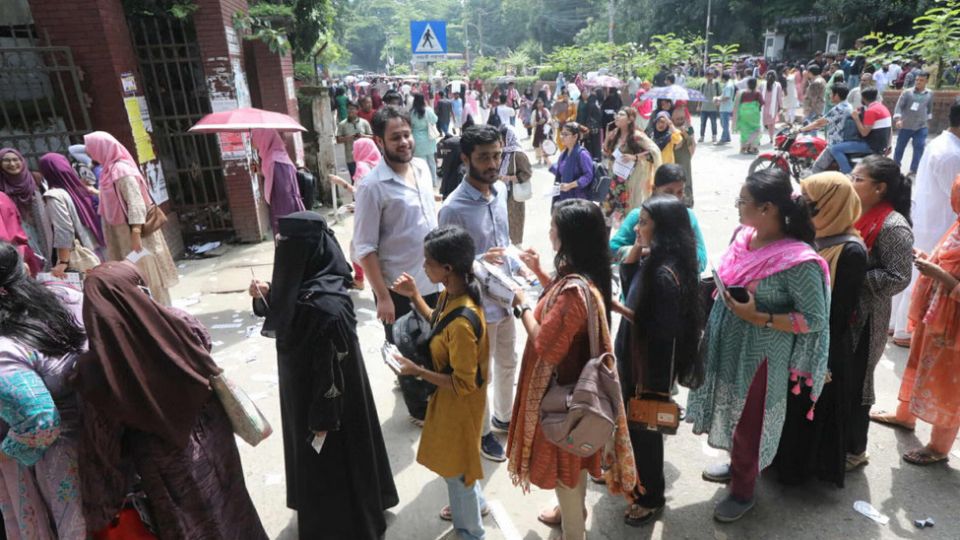
From early morning, the university campus came alive with the hum of student voices, queues forming at polling centres, and a palpable sense of history in motion.
For many, especially first-time voters, the day was more than just a ballot — it was a rite of passage into civic participation.
Historians and former candidates who ran elections from 1979 to 2019 observed that voter turnout in yesterday’s Ducsu election was significantly higher than in previous years.
Mahmudur Rahman Manna, president of Nagorik Oikya and twice-elected vice-president in the 1979 and 1980 Ducsu polls, estimated that the turnout during his time was around 60 percent.
Professor MM Akash, who lost as a general secretary candidate from a leftist-backed panel in the 1982 election, recalled that voter participation back then had exceeded 50 percent.
Public health expert Mohammad Mushtuq Husain, elected general secretary in 1989, who later lost as a VP candidate in 1990, said that turnout in both elections hovered around 60 percent.
Speaking to The Daily Star, Mohammed Hannan, author of several books on the history of student movements, described student participation in yesterday’s Ducsu polls as highly encouraging, reflecting their strong preference for a democratic campus environment.
He noted that the timing of the election — just a year after the July uprising led by students against an authoritarian regime — served as a source of inspiration for many to cast their votes. He also highlighted the remarkable role of women in that mass movement, which he believes contributed to the surge in voter turnout.
Hannan further recalled that voter participation was notably high in the first-ever Ducsu election held in 1972, shortly after the Liberation War, although he could not immediately recall the exact turnout figure.
Ducsu was formed in 1922, just a year after Dhaka University’s founding, and its mission was to promote cultural activities and foster cooperation among students across dormitories.
Over time, it became one of the most powerful and historically influential student bodies in the country, often termed as a launching pad for future national leaders.
Its five student representatives in the 105-member Dhaka University Senate play a crucial role in the democratic selection of the vice-chancellor, who also serves as Ducsu’s ex-officio president.
The election process itself has undergone transformation.
Before 1972, Ducsu leaders were elected indirectly — first through hall union elections, with VP and GS posts rotating among halls. The 1972 election, held just after the Liberation War, marked the beginning of direct voting, allowing students to elect their central representatives directly.