

March 13, 2026
JAKARTA – When bombs from the United States-Israeli strike against Iran started falling on Tehran, 69-year-old Zulfan Lindan chose to do what many other Indonesians living in the country have yet to do: ask to be evacuated back to Jakarta.
Zulfan was among 32 Indonesians who opted to be evacuated from Iran amid the escalating US-Iran war on Iran, as the Foreign Ministry prioritizes protection of citizens in the war-torn region.
Since the first wave of strikes against Tehran on Feb. 28, Zulfan said he had seen on a nightly basis the city’s streets filled with thousands of protesters venting their anger at Washington’s unilateral actions. Missiles streaking overhead have become so normalized that locals now stop at the street to watch rather than run for cover.
The Indonesian Embassy in Tehran sent out a letter to Indonesians in the country on March 3 along with a form offering evacuation from Iran. Zulfan was among dozens of people who filled out the form, allowing him to secure a ticket home.
Two days later, Zulfan made his way to the embassy in Tehran, preparing to make his journey home while seeing “10 bombs fly over the [embassy] building, each weighing around 1 to 2 kilograms”, as he recalled his final hours in the Iranian capital during a press briefing at Soekarno-Hatta International Airport in Tangerang, Banten on Tuesday.
“The situation at the embassy was gripping,” said Zulfan, a politician of the NasDem Party. “The blasts [from the bombs] rattled all the glass in the embassy. We started considering taking shelter in the basement.”
After the blasts, Zulfan and other Indonesians spent a night at a hotel in the city before setting off just before dawn on March 6 on a nine-hour road trip to Astara, the Iranian city with a border crossing to Azerbaijan. The border has become a key exit point for people seeking to flee Iran.
The trip to the border “went very smoothly”, Zulfan said, adding that the roads were not jammed, unlike when Iran’s conflict with Israel escalated in June 2025 marked by missile and drone attacks between both countries.
The group then waited nearly five hours at Iranian immigration as various foreign nationals packed the crossing to leave the country. The Indonesian entourage finally reached the Azerbaijani capital of Baku on March 6, spending another night before flying to Jakarta via Turkey.
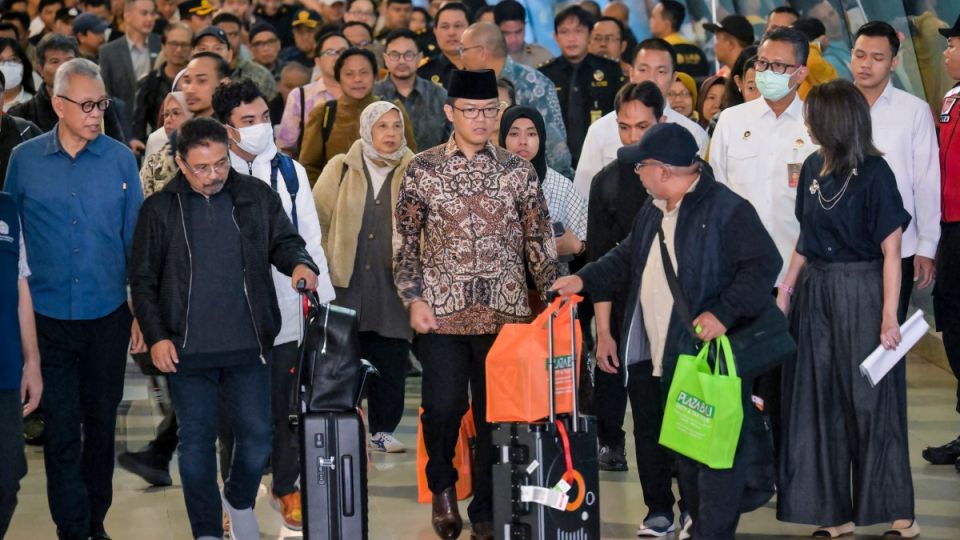
The group of 22 Indonesian evacuees from Iran finally landed in Indonesia on Tuesday, with many expressing relief and gratitude to officials who assisted their return. Meanwhile, another 10 Indonesians were expected to arrive in Jakarta on Wednesday.
Another evacuee, Tomi, a 52-year-old airline technician who had worked in Tehran for six years, said his final days in the capital were marked by constant attacks and sounds of explosions, prompting him to end his time in Iran and accept the embassy’s evacuation offer.
Upon touching down in Indonesia and reuniting with his family, Tomi expressed relief while speaking to reporters, as quoted by Tribunnews.com: “My child is here to take me home.”
Citizen protection prioritized
The first batch of Indonesians evacuated from Iran included 12 workers, 14 students, five tourists and a journalist, according to a statement issued by the Foreign Ministry on Tuesday.
After arriving in Jakarta, they will go to their respective hometowns with the assistance of regional administrations.
Welcoming the evacuees on Tuesday, Foreign Minister Sugiono stressed that the government’s priority remained centered on citizen safety amid the deteriorating security conditions in the Middle East.
“Since the conflict began, the Foreign Ministry together with Indonesian missions across the Middle East have continued coordinating closely to monitor the situation, update data on Indonesian citizens and discuss contingency measures,” Sugiono said.
A total of 329 Indonesian citizens are currently residing in Iran, according to the latest records from the Indonesian Embassy in Tehran. Most of them are students in the city of Qom, while others are primarily migrant workers.
Iran has come under sustained bombardment from the US and Israel since Feb. 28, with coordinated strikes targeting the country’s military infrastructure and senior leadership. Explosions have been reported in Tehran and other cities, with Iran launching retaliatory missile and drone attacks against US bases across the region.