

December 8, 2025
SEOUL – South Korea’s military ranks are being filled by a growing number of soldiers from mixed or foreign backgrounds, but discrimination and barriers persist, with preventative measures falling behind the reality.
The military first began conscripting sons of international marriages who held Korean citizenship following legal changes in 2010, which removed long-standing restrictions that had limited “mixed-heritage” men to wartime labor service rather than active-duty roles.
That year, the number of soldiers from mixed ethnic backgrounds stood at 51. By 2016, the number exceeded 600. In 2025, the number of such soldiers surpassed roughly 5,000 and is projected to reach approximately 9,700 by 2031, about 5 percent of all new draftees, according to the Defense Ministry and the Korea Institute for Defense Analyses.
The presence of soldiers from minority backgrounds has also expanded into higher ranks to operationally important duties.
In 2012, the Army commissioned its first mixed-heritage sergeant. In 2023, the Navy also saw a noncommissioned officer of Pakistani Korean heritage, followed in 2025 by an Army officer who renounced his Japanese nationality to serve in the Korean military. In 2015, a soldier born to a French father and Korean mother was deployed to a frontline guard post in the Demilitarized Zone — one of the most fortified areas dividing the two Koreas — for the first time.
While such soldiers help fill South Korea’s diminishing ranks and serve just as any other able-bodied Korean man, they face discrimination and barriers.
Earlier this year, the Army faced a high-profile case in which a young conscript — born in China to a Chinese father and a North Korean defector mother — attempted to jump from a barracks building after repeated bullying and discriminatory slurs from fellow soldiers.
He survived but suffered major spinal injuries. Investigations also confirmed persistent harassment and ostracism tied to his background.
Experts say the military must confront deep-rooted discriminatory sentiments within its ranks.
Choi Byung-wook, a professor of national security studies at Sangmyung University, said, “Policies and plans often remain symbolic. If the military hides too strictly behind the principle, discrimination and hatred can simply be left unattended.”
Im Tae-hoon, director of the Center for Military Human Rights Korea, stressed the need for stronger, practical support systems to help these soldiers adapt to military life.
“Soldiers from immigrant-family backgrounds typically have weaker social support networks. They need tailored adjustment measures, not just symbolic equality,” he said.
Im also called on the military to introduce stronger penalties for racist or xenophobic slurs.

Pakistani-born Arnold Javaid, a petty officer first class in the South Korean Navy who was commissioned in 2023. PHOTO: SOUTH KOREAN NAVY/THE KOREA HERALD
Even when racism and bullying by other soldiers are not an issue, recruits of multiethnic backgrounds face hurdles from day one.
The primary challenge is often language.
For these recruits, even basic tasks can become a language test. Weapon names, commands and equipment procedures — areas that require precise terminology — often cannot be accurately translated by those delivering instructions, and delivering clear explanations takes significantly longer.
Citing safety concerns and repeated cases in which soldiers could not follow instructions, an Army officer said, “If a recruit cannot communicate at all in Korean, the military should at least reconsider compulsory enlistment,” speaking on condition of anonymity.
Some Korean citizens who do not have mixed heritage but grew up overseas face similar problems.
A recent survey by the National Human Rights Commission of Korea also confirmed the seriousness of the problem. Soldiers from immigrant-family backgrounds identified language barriers as their greatest difficulty during service, at 56.3 percent, while fellow soldiers likewise viewed language issues as the top challenge at 61.1 percent.
The commission warned that recruits not fluent in Korean may be unable to perform tasks that rely heavily on spoken communication, and that assigning them to such roles could lower their confidence, weaken their sense of belonging and risk reduced combat readiness and safety incidents.
In response, the Defense Ministry launched a new adaptation program in late November for recruits with limited Korean proficiency, set to begin next year. The program includes a one-week pretraining adjustment period, one-on-one mentorship and a multilingual glossary of more than 500 military terms.
Additional measures announced by the ministry include consolidating intake centers for these recruits, strengthening support at units nationwide and distributing standardized educational materials across the force.

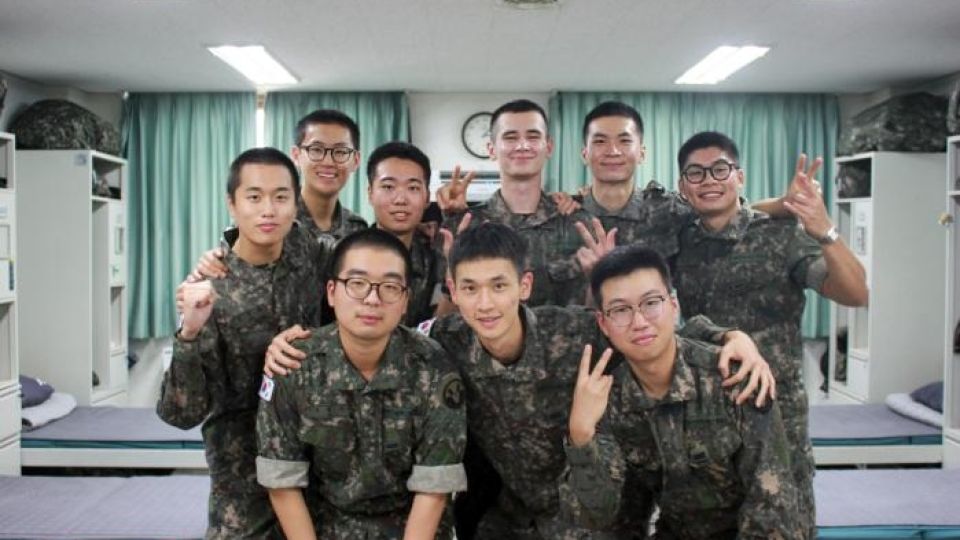
Pvts. Lee Seung-won (left), a South Korean British dual national, and Park Jae-hwan pose for a photo holding a TOEIC preparation book at their barracks in the Army’s 6th Infantry Division in October 2025. PHOTO: SOUTH KOREAN ARMY/THE KOREA HERALD
Another issue Korea needs to address is military service for naturalized citizens, according to Kang Sung-sik, an attorney and immigration law specialist at KNC Law Firm.
“While men of mixed heritage who hold Korean nationality from birth are subject to compulsory service, naturalized citizens — who actively and voluntarily chose to acquire Korean nationality — are still exempt unless they volunteer,” he said.
According to government data, South Korea sees 10,000 to 12,000 naturalizations annually, and a 2020 study by the Korea Institute for Defense Analyses estimated that about 1,000 naturalized men per year would fall under conscription criteria if applied equally.
“For naturalized citizens as well, fulfilling military service can be an opportunity to carry out the responsibilities of citizenship and gain a deeper sense of pride as true members of South Korea,” Kang added.