

June 5, 2026
MANILA – Born and raised on an orchid and flower farm in Davao City, Oscar Mejia III grew up in a world of flowers. As a little boy, he would gather blossoms from the garden and boil them in pots, curious about the scents they would create. The kitchen became his laboratory. It was there, too, amid family meals and simmering pots, that the aroma of his mother’s adobo found its way into memory.
Those scents never really left him. Because for Mejia III, fragrance has never been merely about smelling good. It is about memory. A scent can bring back a face, a place, or a feeling long thought forgotten. “My earliest memories are of home,” he shares. “Of family.”
Flower of youth
Flowers were part of everyday life. His father, who was allergic to plastic flowers, insisted on having fresh blooms around the house. He arranged them himself, filling their home with color, beauty, and fragrance. Growing up on a flower farm and in a household filled with fresh flowers, Mejia III was constantly surrounded by scent. Flowers were simply everywhere.
He picked them, played with them, gave them away as gifts, and sometimes boiled them in pots out of sheer curiosity.
Mejia III was equally fascinated by chemistry. The way ingredients transformed and reacted captivated him. It was a fascination that followed him through his years at the Philippine Science High School and later while studying chemistry at Ateneo de Manila University.
Along the way, he found mentors who nurtured his growing interest in perfumery, among them the renowned French perfumer Nicolas de Barry.
Years later, he would discover that perfume making was where science and creativity met.
Fragrances inspired by home
Much like cooking, “There is a lot of convergence between scent and aroma,” Mejia III explains. “Apart from sweet, salty, sour, bitter, and spicy, much of what we perceive as taste is actually smell.”
His first fragrance, Ginger Tea, created in 2011, was inspired by a childhood memory. As an asthmatic child, ginger tea often brought him comfort and relief. Years later, he transformed that memory into scent. “It reminds me of home,” he said simply.
That idea of home continues to inspire much of his work. When asked what the Philippines would smell like in a bottle, Mejia III smiles. It was never just one ingredient. Mountains and sea. Woodiness and greenery. The warmth of ginger. The delicate florals of sampaguita and ylang-ylang. Even Philippine salts have captured his imagination of late.
Most of all, he described it as “ginhawa.” A feeling of ease. A feeling of comfort. A feeling of coming home.
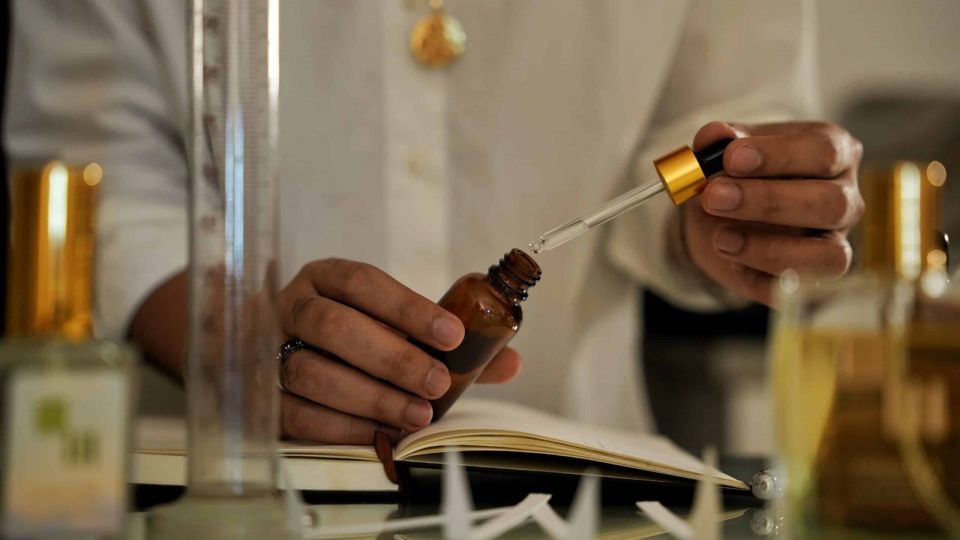
Every fragrance begins with an idea. Mejia III starts with a journal and a mood board, reflecting on what a scent represents long before he begins blending. He spoke of ylang-ylang as an example. Before thinking about ingredients, he thinks about the memories and emotions a flower evokes. Only then does he begin creating.“There is a little bit of courage involved,” he admits with a smile.
He experiments, adding a little bit of this and a little bit of that, allowing the fragrance to slowly reveal itself. More often than not, those creations are the ones eventually chosen by his clients.
Recreating a memory
For Mejia III, how a fragrance makes people feel is just as important as how it smells. One of his latest creations, Palay, was inspired by the paintings of National Artist Fernando Amorsolo for the Ayala Museum. Looking at Amorsolo’s paintings, he was less interested in the scent of rice than in the feeling those paintings leave behind.
There is no actual palay in the formulation. Instead, notes of rosemary, green tea, and olive come together to evoke abundance, simplicity, and the quiet beauty of the Philippine countryside.
For him, fragrance is not always about recreating a smell. Sometimes, it is about recreating a memory.
Today, Mejia III creates fragrances for hotels, resorts, museums, and cultural institutions, though many of his ideas still begin the same way they did when he was a boy—with curiosity.
He is currently working on a collection inspired by Philippine history—scents that explore the Pre-Colonial, Spanish, and American periods through the botanicals and aromatics that would have existed during those eras.
The project extends beyond scent. For the pre-colonial fragrance, he imagines the sound of gongs. For the Spanish period, the pealing of church bells. For the American era, the bright notes of brass instruments. History, after all, is remembered through more than scent alone.
Asked if the project was finished, he shook his head and laughed. “Pinahirapan ko ang sarili ko.”
Championing Filipino perfumery on the world stage
Mejia III has come a long way from that little boy of five, smelling ylang-ylang from the palm of his hands and boiling flowers he gathered from the garden in a pot to see what smell it would emit. Today, he creates fragrances that capture memories and stories, while proudly championing Filipino perfumery on the world stage.
Yet at heart, he remains the same boy enchanted by the magic of scent. He still loves the aroma of adobo. He still finds wonder in flowers. And he still believes that the world becomes a better place with a hint of fragrance.
How to make your own ginhawa in a bottle
Bright, warm, and unmistakably Filipino, this DIY cologne by Oscar Mejia III combines calamansi, pandan, ginger, cacao, and coconut into a fragrance that evokes sunshine, countryside memories, and the comforting feeling of “ginhawa.”
Ingredients
- Calamansi peels from 5 to 6 fruits
- 20g fresh ginger, sliced thinly
- 3 to 4 pandan leaves, chopped
- 10g toasted pinipig
- 10g cacao nibs or crushed tablea
- 10g coconut flakes, lightly toasted
- Crushed black pepper
- Cinnamon extract
- 200 ml vodka or perfumer’s alcohol
Procedures
- Place each ingredient in separate jars. Cover with alcohol. Macerate for 2 to 4 weeks.
- Filter each tincture.
- Blend the tinctures as follows: 35% calamansi peel tincture, 20% pandan tincture, 15% ginger tincture, 10% cacao tincture, 10% toasted coconut tincture, 8% pinipig tincture, 2% black pepper tincture, 1 drop of cinnamon extract.
- Opening is bright, like that sunny Filipino smile. Then deepens into a blend that takes you to the countryside. Finishes with warm comforting notes, reminiscent of Oscar’s signature ginhawa.