

November 4, 2025
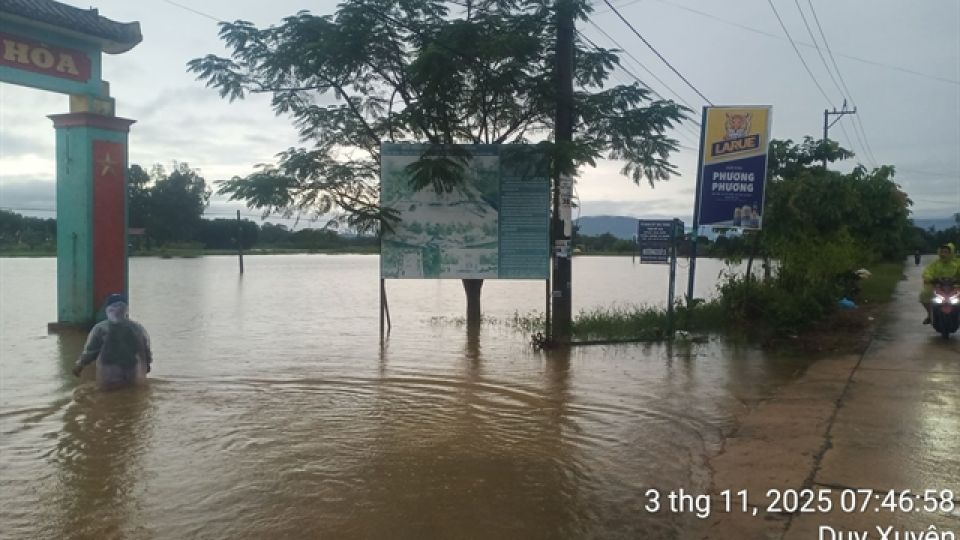
DA NANG – After two days of easing rain and receding floods, water levels on the Bồ, Hương, and Vu Gia–Thu Bồn rivers began rising again on the night of November 2, causing renewed flooding in residential areas of Huế City and Đà Nẵng City.
Heavy rain continued overnight and into the early hours of November 3, with rainfall totals reaching 141mm in Quảng Trị Province, 220mm at Bạch Mã Peak (Huế City), and 301mm in Đà Nẵng City.
In Đà Nẵng City, at 4am, the Vu Gia River at Ái Nghĩa stood 0.33 metres above Level 3, a sharp rise of 1.72 metres from the previous morning, while the Thu Bồn River at Hội An Ward was 0.06 metres above Level 3, up 0.8 metres from Sunday afternoon.
According to the National Centre for Hydro-Meteorological Forecasting, from November 3 to 4, areas from southern Quảng Trị to Đà Nẵng are expected to receive 200–300mm of rain, with some locations exceeding 600mm. Rainfall intensity could exceed 200mm within three hours, posing a high risk of flash floods and landslides.
Flooding risks remain high in low-lying and riverside areas, as well as densely populated urban zones from Hà Tĩnh Province to Quảng Ngãi Province. There is also an elevated risk of landslides and flash floods across 211 communes and wards from Hà Tĩnh Province to Lâm Đồng Province.
According to the Department of Dyke Management and Natural Disaster Prevention, as of 6pm on November 2, floods in central Việt Nam had left 36 people dead, five missing and 60 injured. A total of 94 houses were destroyed, 12,600 remained inundated, and more than 7,200 hectares of rice and crops were damaged. Approximately 43,500 livestock and poultry were reported dead.
At the same time, 50 locations along national highways remained blocked due to landslides and flooding, while over 11 kilometres of canals and 20 kilometres of river and coastal embankments had suffered erosion.