

January 6, 2026
JAKARTA – Inflation in 2025 reached the highest level in three years, spurred by increasing prices for various food commodities but also for gold, as the precious metal reached record highs in a world marked by uncertainty.
Statistics Indonesia (BPS) official Pudji Ismartini revealed in a press conference on Monday that annual consumer price index (CPI) reached 2.92 percent in December, marking a sharp rise from the 2.72 percent year-on-year increase registered a month prior.
She said the reading was “the highest” full-year figure since 2022.
In 2022, inflation spiked to an unusually high 5.51 percent, partly due to an increase in government-set prices of subsidized fuels, which increased transportation and logistics costs.
The latest number is also higher than inflation was in 2021 (1.87 percent), 2023 (2.61 percent) and 2024 (1.57 percent).
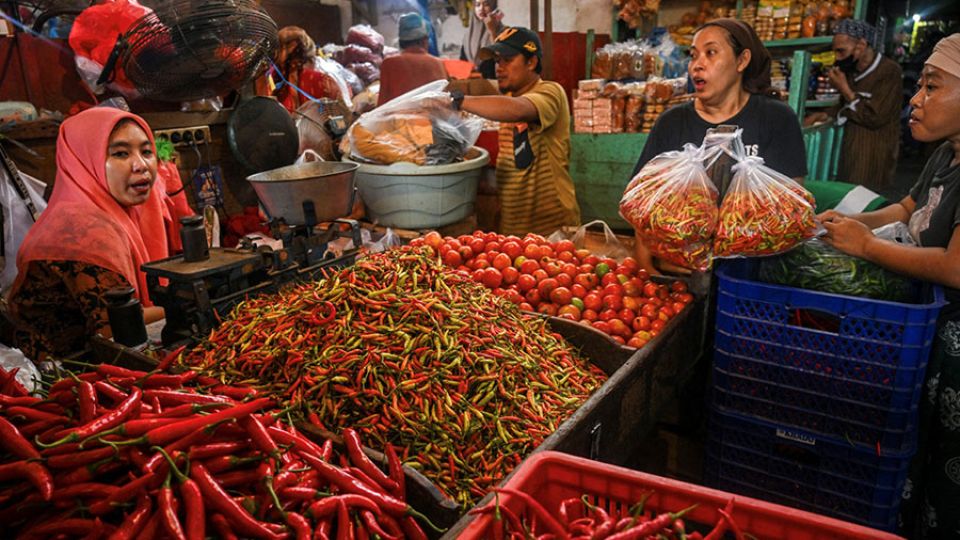
One of the driving forces behind last year’s higher inflation were commodities belonging to the volatile foods component, which recorded inflation of 6.21 percent yoy. The main commodities pushing inflation in the group were chili pepper, fresh fish, bird’s eye chili and rice, which together made up 0.63 percentage point of the year’s inflation figure.
Prices in the food, beverages and tobacco commodity group ended the year 4.58 percent higher and were the leading cause behind the higher headline inflation reading.
However, in terms of single commodities, none contributed more than gold to last year’s inflation, as the precious metal single-handedly accounted for 0.79 percentage points of the overall 2.92 percent inflation figure.
Pudji revealed that gold was the main driver of month-to-month CPI growth in 11 out of 12 months in 2025, meaning its price rose almost consistently throughout the year.
Gold is universally perceived as a safe haven asset particularly sought after during uncertain times, and 2025 was among the most uncertain years in recent memory due to ongoing geopolitical conflicts and global trade disruption.
Israel’s war in Gaza and other conflicts in the Middle East featured prominently through much of 2025, while the war between Russia and Ukraine continued without a clear resolution, despite efforts by the United States to broker a peace deal.
However, the most significant source of economic uncertainty last year, according to many analysts, was a seismic shift in the global trade landscape brought about by steep increases in US import tariffs soon after US President Donald Trump took office for a second term in January.
It was difficult to keep track of the tariffs imposed by Washington, with varying rates applied to exports from different countries and the Trump administration pursuing a push-and-pull strategy in bilateral tariff negotiations, creating prolonged uncertainty for exporters worldwide, including Indonesian companies.
With these uncertainties in mind, many investors saw gold as their best bet, while many central banks also piled up on the precious metal, partly driven by a desire to reduce dependence on the US dollar.
The precious metal rose almost 70 percent in the global market throughout last year, touching an all-time high of US$4,794 per troy ounce in late December, according to Trading Economics.
BPS includes the commodity’s price increase in the core inflation component, which was logged at 2.38 percent yoy in 2025 and made up more than half of last year’s headline inflation.
Permata Bank chief economist Josua Pardede wrote in an analysis on Monday that “persistent global uncertainty” might keep gold prices on an upward trend this year, putting “upward pressure on imported inflation, although gains are expected to be more modest than in 2025”.
He forecast that inflation would remain above 2.5 percent this year, owing to the government’s pro-growth stance, but remain below 3 percent, well within Bank Indonesia (BI) target range of 2.5 plus/minus 1 percent, which would allow BI to “maintain an accommodative policy stance over the medium to long term”.
“While BI has signaled a pro-stability bias in the near term, this is likely temporary and should ease as global pressures subside and capital inflows return. This supports the case for further BI-Rate cuts in 2026, although the room for easing has narrowed in the near term amid rupiah depreciation pressures,” said Josua, projecting just 25 basis point cut to the benchmark interest rate this year.
He noted that external inflation risks had moderated as pressure from trade wars and geopolitical developments had eased somewhat from its peak in the first half of 2025. Josua argued that food demand would be “relatively firm” this year on account of the government’s free nutritious meals program, which created “upside risks” to volatile food inflation.
Bank Danamon economist Hosianna Evalita Situmorang wrote in an analysis on Monday that disruption from “persistent tropical cyclones” was expected to last until April and would likely suppress chili and shallot output, adding upside risk to food inflation.