

December 8, 2025
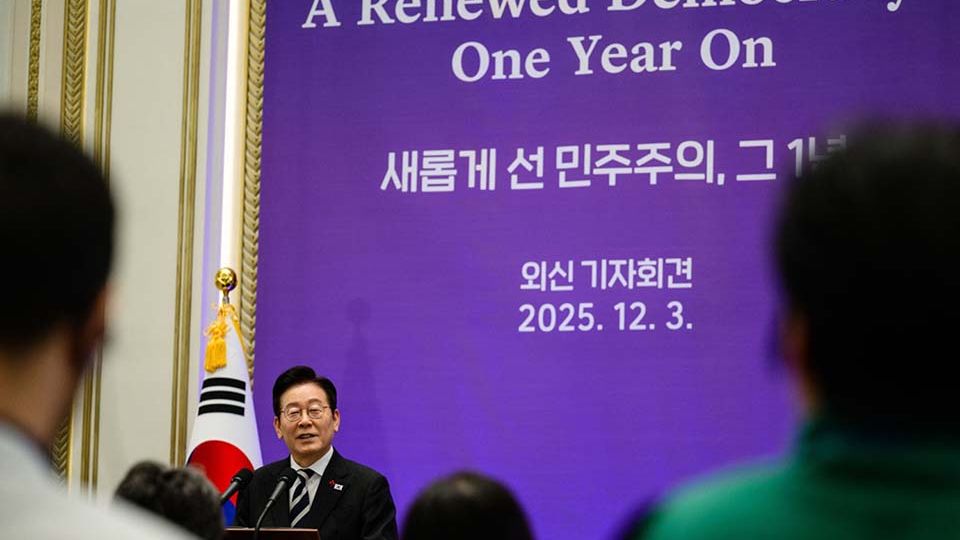
SEOUL – On the first anniversary of former President Yoon Suk Yeol’s Dec. 3 martial law declaration, President Lee Jae Myung did something unprecedented. On Wednesday, he held an 80-minute press conference exclusively for foreign media. For the first time in recent South Korean memory, only foreign correspondents were invited to a presidential press event.
Under the theme “A Renewed Democracy: One Year On,” Lee used the occasion to underscore the resilience of Korean democracy — its ability to rise above the political turmoil that culminated in last year’s martial law declaration. Korea’s democratic journey, he noted, is now a “model case for world history.”
Lee’s reason for convening a foreign-media-only press conference is not difficult to grasp. He wanted the world to understand that Korea’s democracy is functioning again. But beyond that, the event was an unmistakable gesture of gratitude toward foreign journalists who helped safeguard Korean democracy not only over the past year, but throughout the country’s modern history.
During the conference, he thanked foreign reporters for swiftly and accurately portraying the Korean people’s resistance to the political crisis. Yet his appreciation stretched back decades — to the years when Korea’s domestic press was silenced, and foreign media provided the only reliable window into the reality of authoritarian rule.
During the darkest years of military rule, domestic media operated under tight restrictions. Censorship was rampant, and journalists were routinely harassed or punished for stories deemed critical of the regime. Except for a few exceptionally courageous reporters, most had no choice but to remain silent under draconian press controls. By contrast, foreign correspondents enjoyed comparatively greater freedom because military rulers wished to avoid diplomatic friction — especially with Washington, which was highly critical of Seoul’s suppression of the press.
The contrast was stark during the 1980 Gwangju Democratic Uprising. Domestic journalists were largely denied access to the city, which was tightly sealed off by the military. A few pro-government outlets were allowed in, but their reports were heavily censored and often distorted. Some portrayed peaceful pro-democracy demonstrators as violent mobs threatening public order. In Wednesday’s press conference, President Lee even admitted that he once believed this narrative — because that was what local media had reported.
Foreign journalists, however, were able to document the Gwangju crackdown more freely and thus more accurately. They entered Gwangju at great personal risk and documented the military’s brutal crackdown against peaceful pro-democracy protesters that resulted in hundreds of casualties. They succeeded — despite censorship and threats — in transmitting their powerful stories and images to audiences worldwide. These impactful accounts galvanized global outrage and helped shift international opinion decisively against Korea’s authoritarian regime.
This global pressure had real consequences. The US government, influenced partly by foreign media coverage, placed substantial pressure on Seoul to protect human rights and move toward democracy.
Former President Kim Dae-jung, initially sentenced to death by a military court for allegedly instigating the Gwangju Democratic Uprising, was later pardoned in significant part due to Washington’s intervention. Other pro-democracy figures, including former President Kim Young-sam, also received sustained coverage that helped maintain momentum for democratic change.
Foreign media again played a vital role when Kim Dae-jung returned to Korea in 1985 after years of self-imposed exile in the United States. There were widespread fears he might face physical harm at Gimpo International Airport, echoing the assassination of Philippine dissident Benigno Aquino at Manila International Airport two years earlier.
To deter any attack, US politicians and journalists boarded the same flight and accompanied Kim down the steps. Newsweek later covered the episode in a story titled “A Stormy Homecoming.” Such articles helped fuel the People Power movement and ultimately contributed to the military’s June 1987 Democratic Declaration, where many democratic reforms, including a direct presidential election and the autonomy of local governments, were announced.
As Korean media liberalized and flourished, the role of foreign media naturally became less central — and at times even counterproductive. During the 1997-98 Asian financial crisis, many foreign media outlets sharply criticized Seoul’s economic management and predicted imminent national default. Some of their claims were exaggerated or unsupported, yet foreign investors believed them and withdrew capital en masse, worsening the financial crisis and forcing Korea to seek an emergency International Monetary Fund bailout.
Even with such episodes, foreign media have, on balance, been beneficial to Korea. Beyond their contributions to democratization, foreign journalists helped introduce Korean pop culture to global audiences. Their portrayals of Korea’s dynamic cultural and social landscape have been instrumental in elevating the country’s soft power. More recently, their coverage of Korea’s technological and industrial competitiveness has reinforced its economic reputation.
Seen in this broader historical context, Lee’s exclusive press conference for foreign media on Wednesday does not seem unusual at all. It reflects Korea’s recognition of how deeply foreign journalists have shaped its modern journey — documenting its darkest moments, amplifying its democratic struggles, and eventually helping usher the country onto the global stage as a confident, resilient democracy.
Lee Byung-jong is a former Seoul correspondent for Newsweek, The Associated Press and Bloomberg News. He is a professor at the School of Global Service at Sookmyung Women’s University in Seoul. The views expressed here are the writer’s own. — Ed.