

January 22, 2026
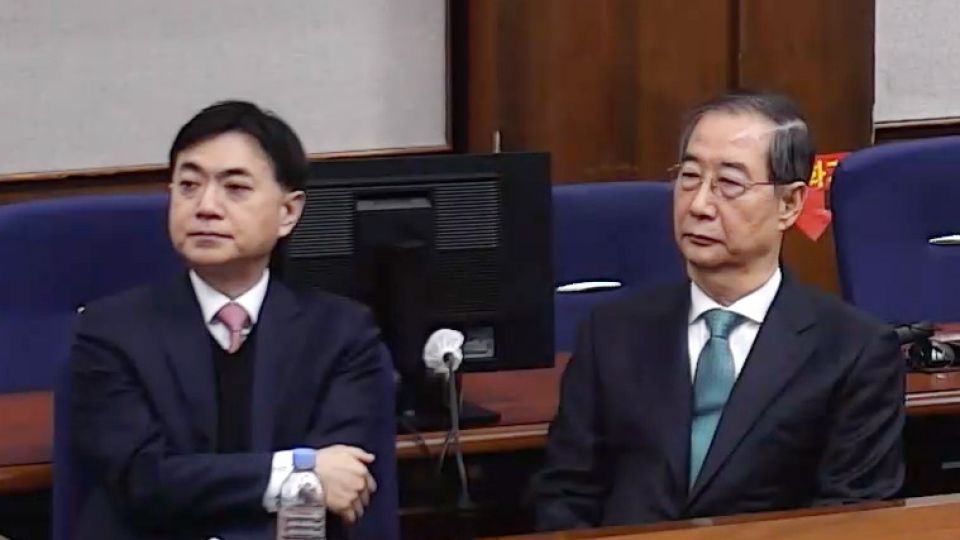
SEOUL – The Seoul Central District Court on Wednesday sentenced former Prime Minister Han Duck-soo to 23 years in prison, finding him guilty of playing a key role in an insurrection by aiding former President Yoon Suk Yeol’s failed attempt to impose martial law on Dec. 3, 2024.
Han was immediately taken into custody in the courtroom following the sentencing.
“As prime minister, the defendant bore a duty to uncover the truth behind the insurrection,” presiding Judge Lee Jin-gwan said while reading the verdict. “Instead, he fabricated and later destroyed a martial law decree after the fact, and gave false testimony before the Constitutional Court to protect himself.”
Special Counsel Cho Eun-suk had sought a 15-year prison term, arguing that Han played a key role before and after the declaration of martial law. It is rare for a court to impose a sentence exceeding the prosecution’s request.
Wednesday’s ruling marks the first conviction of a former Cabinet member in connection with Yoon’s 2024 martial law crisis and the first judicial determination that the declaration of martial law constituted an insurrection.
Court officially labels crisis ‘12.3 insurrection’
With Han’s sentencing, the court explicitly characterized Yoon’s Dec. 3 martial law declaration as an insurrection.
“The act of proclaiming an unconstitutional and unlawful decree following the declaration of martial law on Dec. 3, and mobilizing military and police forces to occupy the National Assembly, the National Election Commission and other institutions, constitutes an act of insurrection as defined under Article 87 of the Criminal Act,” Judge Lee said. “I will henceforth refer to it as the ‘12.3 insurrection.'”
Under Article 87 of the Criminal Act, insurrection is defined as an act of rioting to exclude state authority or disrupt the constitutional order in all or part of the territory of South Korea.
The court said the decree bypassed constitutional procedures and effectively suspended core democratic institutions, including the National Assembly and the multiparty system.
Judge Lee further defined “rioting” as acts such as assault, intimidation or other conduct that induces fear, adding that Yoon’s actions caused serious disturbance within specific parts of the country.
‘Principal role’ in insurrection
Han was initially charged with abetting an insurrection, but the special counsel amended the indictment in October 2025, at the court’s request, to include charges of playing a principal role in an insurrection.
The court found that Han ultimately helped the declaration appear to have procedural legitimacy, despite claiming he sought to restrain the president.
Specifically, the court cited Han’s role in convening a Cabinet meeting to create the appearance of deliberation, collecting ministers’ signatures to meet formal requirements, failing in his duty as prime minister and vice chair of the Cabinet to ensure democratic procedures, and discussing the potential shutdown of utilities at certain media outlets with then Interior Minister Lee Sang-min.
Despite being one of the first to review a draft decree that included provisions banning political activity and controlling the press, the court said he gathered ministers to secure a quorum and encouraged signatures to formalize the decree.
Han had argued that he convened ministers to dissuade Yoon from declaring martial law. The court rejected this claim, noting that Han failed to clearly express opposition even as other ministers voiced objections.
Perjury and forged official documents
The court also found Han guilty of forging an official document after ordering the creation of a new martial law decree on Dec. 6 — three days after the declaration — in an attempt to legitimize the move retroactively.
Prosecutors said Han later ordered the document destroyed, constituting illegal destruction of an official record.
The court further found that documents Han received from the presidential office were not simply discarded but rather disposed of separately.
Han was also convicted of perjury for falsely testifying during Yoon’s impeachment trial that he had no prior knowledge of the decree and had not received any related documents.
The court dismissed Han’s claim that memory lapses explained his testimony.
Court underscores deterrence
Before delivering the sentence, the court emphasized the gravity of the crisis, warning that historically, successful coups have led to dictatorships or prolonged civil conflict.
The judges also noted that the absence of casualties and the swift lifting of martial law were due to citizens’ courage, lawmakers’ prompt action and the restraint of some military and police officers — not the intent of those who declared it.
The courtroom filled with audible gasps as the verdict was read.
Han, who had been smiling and quietly speaking with his lawyers before the ruling, appeared visibly shaken.
“I humbly accept the court’s decision,” he said in a trembling voice.