

April 9, 2026
JOHOR BAHRU – What began as a simple act of kindness ended up making history.
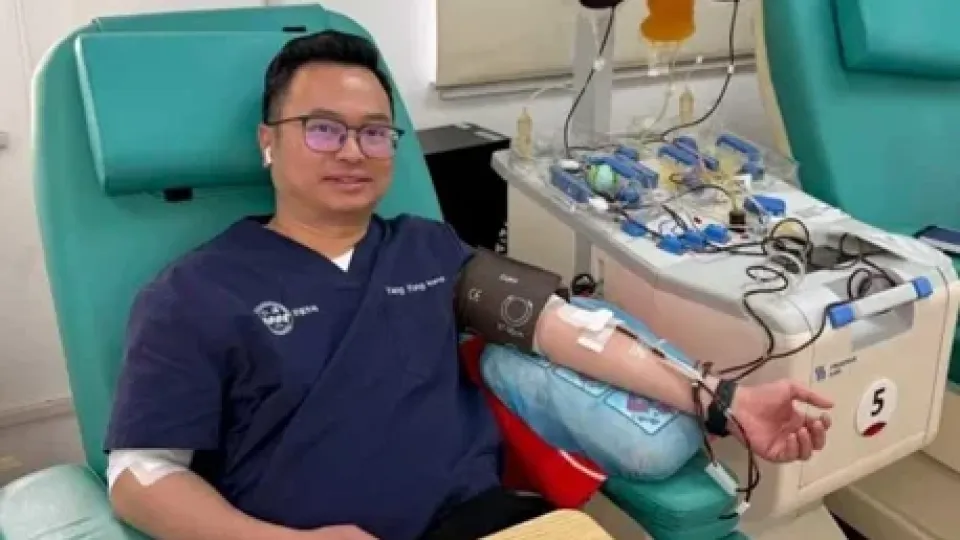
For Dr Yong June Kong, a stem cell donation didn’t just save a young life—it broke a 10-year legal stalemate, paving the way for him to become the first foreign doctor officially licensed to practice in China.
Dr Yong, from Johor Bahru, also known as Yang Yongkang in China, recently gained media attention as the physician for Nur Ayura Medina, a three-year-old Malaysian girl with biliary atresia who travelled to China for a life-saving liver transplant.
However, his own journey—from a “trainee” with no legal status to being personally commended by Chinese President Xi Jinping—is equally remarkable.
Dr Yong, who has been living in China for more than 20 years, was interviewed by Sin Chew Daily to share his journey of becoming the first foreigner to practice medicine in China.
The frustration of a “statusless” doctor
Born in Johor Bahru where he studied in Foon Yew 1 primary school then SMK Taman Tun Aminah, Skudai and completed form six in SMK Sultan Ismail, Dr Yong’s dream of becoming a doctor was sparked at age 10 after watching his grandfather suffer through illness.
(It was reported that born in 1977, Dr Yong completed his study in biomedical science at Universiti Kebangsaan Malaysia in 2001 but regulatory limitations prevented him from practicing medicine).
Suggested by his grand uncle who is a doctor, Dr Yong started from zero in China.
In 2001, he pursued a degree in medicine at Tianjin Medical University for five years.
He received a scholarship to pursue a master’s degree from 2006 to 2009 at Tongji University and was working at Shanghai East Hospital, receiving the standardised training by pursuing clinical research and surgical practice.
However, he hit a “systemic vacuum.” Before 2014, there was no mechanism for foreigners to register as licensed doctors in China.
Despite completing a master’s degree and having passed the qualifying examinations to be a doctor, Dr Yong was unable to practice medicine.
“I spent five years as a ‘trainee.’ I couldn’t perform surgeries independently or write prescriptions. I had no official status and no clear future,” Yong recalled.
He reconsidered the option of returning home and start the journey of becoming a doctor again in Malaysia.
“If I were to remain in China, I still could perform surgeries. If I were to return home, I have to spend another four to five years to start again,’’ he said.
The turning point came from a forgotten gesture.
During his university years, Dr Yong had registered as a regular blood donor.
In one of the blood donation venues he saw an advertisement about seeking voluntary donors for stem cell and he signed up.
In 2011, he received a call: he was a match for a child in Anhui suffering from a life-threatening condition.
The odds of a non-relative match are roughly one in a million. Without hesitation, Dr Yong donated his hematopoietic stem cells, becoming the first foreigner in China to do so.
His selfless act reached the highest levels of government. During a state visit to Malaysia in 2013, President of China Xi Jinping publicly mentioned him:
“We will not forget the Malaysian, Yong June Kong, who donated stem cells to save the life of a child in Anhui…”
This recognition catalysed a policy shift.
In March 2014, the Shanghai Health Bureau and the National Ministry of Health of China issued a formal document allowing qualified foreigners to register and practice medicine.
Dr Yong became the first recipient of this license.
Another reason for him to remain in China is that he has become a son-in-law in Shanghai, marrying a local woman and they have a daughter.
A vision for Malaysia-China medical exchange
Now a specialist in paediatrics liver transplantation at Renji Hospital—inspired by his mentor Dr. Xia Qiang’s philosophy of “teaching a man to fish”—Dr. Yong remains deeply connected to his roots.
Whenever he is in Malaysia, he works with the Malaysia Biliary Atresia Association to provide pre- and post-operative consultations for Malaysian families.
He facilitates exchange programmes for Malaysian doctors and nurses to observe medical procedures in Shanghai.
As an “Ambassador of Love” for the China Marrow Donor Programme and a recipient of several awards, Dr Yong said the awards served as a reminder for him to continue pursuing his dream.
As for Malaysian students who are keen to study medicine in China, he advised them to have good command of Chinese and be prepared to undergo long period of training.
“The bar is rising. Top hospitals now require PhDs and rigorous standardised training,‘’ he said.
More Liver transplant saves Malaysian toddler’s life in Shanghai by Johor-born surgeon