


December 8, 2025
ISLAMABAD -Travelling the Indus from Kalabagh to Makhad Sharif is to witness Pakistan’s past, present, and imperilled future flowing side by side.
The journey began the moment we veered onto the newly built Hakla-D.I. Khan Motorway, leaving Islamabad for a landscape that felt almost primordial.
Within minutes, the view changed: rolling mountains unfurled on either side and gorges plunged unexpectedly beside us, at times intercepted by small mountain streams. We were bound for Kalabagh (about two hours from Islamabad) for a boat journey along the mighty Indus.
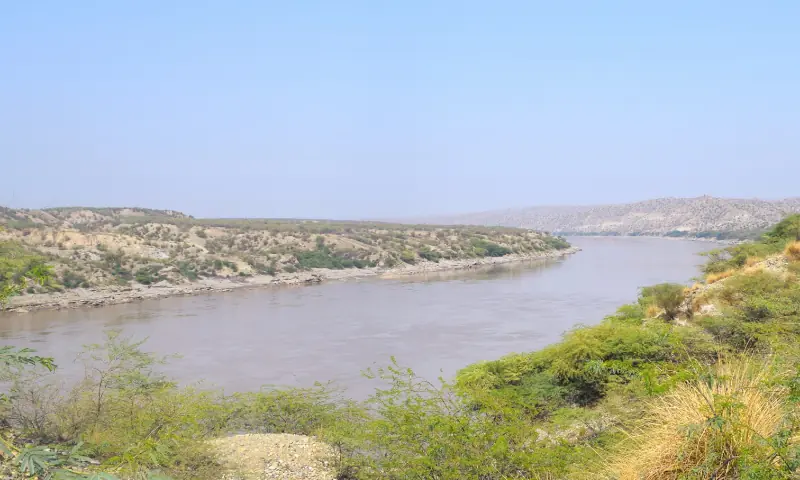
On the banks of the Indus River. PHOTO: DAWN
At Tarap, we took a short detour to visit a centuries-old baoli — a traditional Indian stepwell once used for drinking water and everyday domestic needs. This one was impressively well preserved, and the tourism department is now working to restore it, along with several other baolis across Punjab. From there, we drove to a beautifully kept farmhouse overlooking fruit orchards and the River Soan, where we paused for tea. With miles still ahead of us, we eventually tore ourselves away, promising to return one day to spend a night there under a star-studded, smog free sky.

Left: The baoli and the mosque Right: The baoli — stairs leading to the well. PHOTO: DAWN
One of the unintended pleasures of travelling through Pakistan’s hinterland is encountering colonial-era buildings in the most unexpected places: a quaint, decrepit dak bungalow (a government-run rest house in British India); a quiet, small railway station where trains no longer stop; or a Glasgow-manufactured iron girder railway bridge standing steadfast over a stream for more than a century. As we left, we again drove through Potohar’s backyard, the sun setting as we crossed the Soan River, which originates in the Murree Hills before merging with the mighty Indus — but more on the Soan in a bit.
We reached Kalabagh by evening and checked in, delighted, to the renowned Bohr Bangla on the Indus, only to discover we were being placed in an annexe rather than the historic bungalow itself, contrary to what had been stated on the online booking site. After a brief protest and an unyielding management, we shifted to an Irrigation Department dak bungalow next door. It was a typical government rest house but comfortable enough for three friends on the road. We ended our day with tea on the floating barge outside, watching the vast river drift by as the lights from the 19th-century Kalabagh Bridge shimmered across its dark waters.
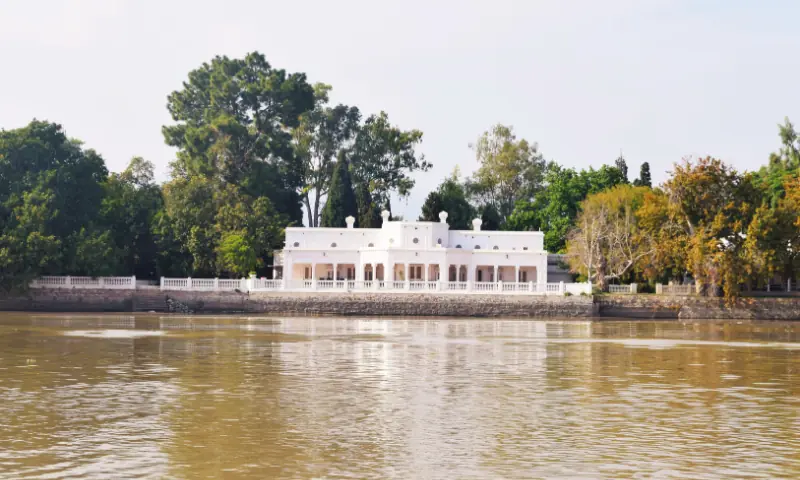
The historical Bohr Bangla at Kalabagh. PHOTO: DAWN
The journey upstream
The next morning, a boat arrived from the Punjab Tourism Department’s facility on the eastern bank of the river. A guide and a pilot accompanied it.
We set off around 10am, heading about two hours upstream toward our destination: Makhad Sharif, a small, historic town on the Indus in District Attock.
As we pulled away, we captured some striking photographs of Bohr Bangla and the tiered steps of Kalabagh — a town known for its salt mines, its tillay wali chappal (ornamental shoes), and, of course, the legendary Nawab of Kalabagh. On our left was Kalabagh town; on our right, the tourism facility and the historic Mari Indus railway station slid past. Soon we crossed the Kalabagh Bridge and passed a restaurant-cum-hotel recently opened by a local entrepreneur.
To our right rose a massive mound marking the ancient town of Mari Indus. At its summit stood abandoned Hindu temples, their silhouettes stark against the sky, while below lay the river port that once bustled with trade.
That era has long faded with the advent of railways, roads, and faster means of transport. As we crossed Mari Indus, the locally famed village of Kukran Wala appeared on our left (perhaps the only village in Punjab situated west of the Indus, reachable only by passing through Khyber Pakhtunkhwa).
Beyond Kukran Wala, the landscape grew quieter. The river narrowed, funnelling us into a gorge, with Punjab on one side and KP on the other. About 30 minutes into our journey, the remains of rusting cables and weathered structures came into view along the bank. This was the proposed site of the hotly contested Kalabagh Dam — a project that was debated for decades but ultimately never built.
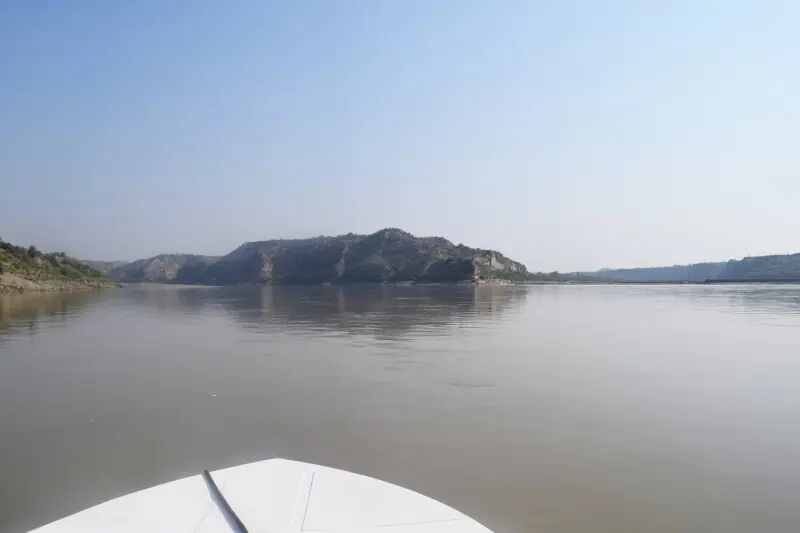
Soan River on the right merges with Indus River on the left. PHOTO: DAWN
We were marvelling at the raw wilderness when a foul stench hit our noses. Our guide explained that we were approaching the point where the Soan River meets the Indus, and that the Soan, carrying all the sewage from Rawalpindi, makes this section of the river particularly odorous.
All we could do was silently hope for some sense to prevail. After all, whenever humans tamper with nature, it often strikes back, as the recent floods along the Soan had painfully shown. But expecting better judgement seemed optimistic at best.
We pressed on and soon crossed the magnificent confluence of the Soan and Indus. The merging of the two rivers was a spectacle to behold, etched permanently in my memory. Beyond the intersection, the water grew clearer, and the gorge deepened. At times, the cliffs seemed barely a couple of hundred metres apart, hinting at the immense depth of the river below.
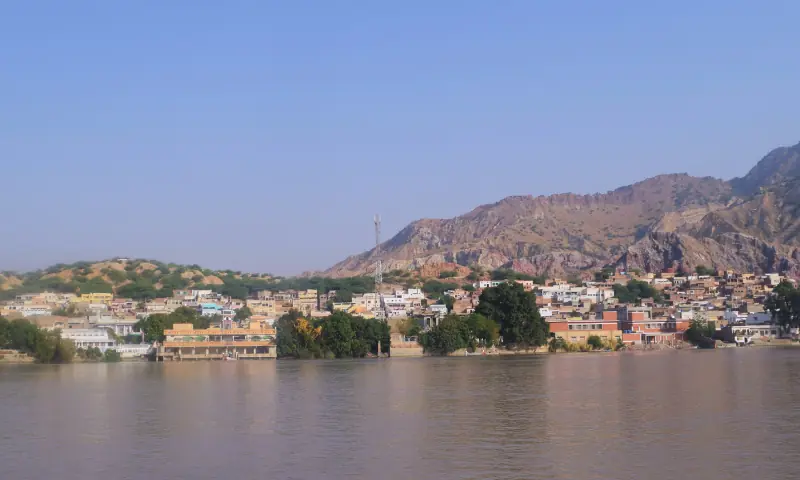
Kalabagh town on the river. PHOTO: DAWN
Along the way, we passed a few fishing huts under construction by the tourism department. Whether they would ever be actively used remained a question; building infrastructure is one thing, running it successfully is another. I sincerely hoped for their success.
Further along, we spotted multiple excavators along the riverbanks (mostly on the KP side) digging for gold, apparently all illegal. Judging by the number of operations, it seemed like a surprisingly profitable venture.
Eventually, we stopped at a private hut belonging to a friend near Makhad Sharif. We sat under a sprawling banyan tree, sipping tea and watching the Indus flow past. In such moments, the concepts of time and space dissolve. You feel part of another world, moving at its own pace. far removed from phones, emails, and the constant buzz of the internet.

The revered shrine of the Pirs of Makhad. PHOTO: DAWN
Gold mining along the riverbank
We strolled along the riverbank and learned about the gold mining process from a group of young boys working manually with simple tools: fine steel meshes and a few pans.
By sifting river soil through the mesh, they could gather tiny golden specks, which they then separated into raw gold using mercury. The yield from such manual operations is minimal, unlike those using excavators and mechanised equipment to extract gold from the riverbed. I believe the government should permit these small-scale manual operations to support local livelihoods, while banning commercial excavation except for licensed government operators.
Resuming our journey to Makhad Sharif, we arrived at the historic town’s banks about two hours later. An elaborate ancient Hindu temple graces the riverbank, but it awaits attention from the Archaeology Department to explore its historical significance. We wandered through the bazaar, alive with local crafts and, of course, the famous Makhadi halwa, celebrated for its unique flavour and now available as far afield as Peshawar, Mianwali, and Rawalpindi.
We visited a library maintained by a local religious leader, which claims to be the largest in the Potohar region, before paying our respects at the shrines of the saints for whom Makhad Sharif is named.
The shrines are majestic, adorned with intricate blue tile work, and even the surrounding graveyards narrate the town’s ancient history. During the annual urs, Makhad comes alive with thousands of disciples, who are provided free boarding and lodging, reminiscent of the arrangements at Kartarpur. Finally, we rested and enjoyed tea at a friend’s house before beginning our journey back to Kalabagh.
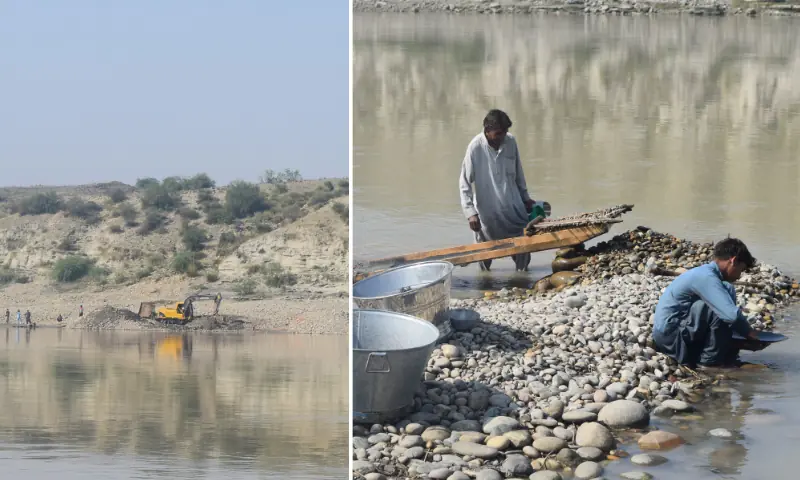
Left: Rich gold diggers of the Indus Right: Poor gold diggers of the Indus. PHOTO: DAWN
The return journey was faster as it was with the flow of the river. The sun was setting and the whole gorge and Indus before us was glowing. The wilderness was awe inspiring but in less than two hours, we reached Kalabagh. The sunset afforded us some great photography, but it also made one feel that the sun has probably set over an otherwise historic town by the river.
This relatively small corridor along Indus offers a glimpse into ancient Hindu heritage, colonial heritage, railways heritage, religious landmarks, a peek into the Nawabs of Kalabagh and Pirs of Makhad Sharifs’ heritage besides a breath-taking landscape. Together, this endowment makes this corridor an excellent eco-tourism site for Punjab as well as Khyber Pakhtunkhwa.
Eco-tourism potential of the Indus corridor
Reviving the Kalabagh-Indus River-Makhad Sharif corridor could begin with a comprehensive masterplan to develop the area into an ecotourism zone, supported by a dedicated tourism authority to manage and regulate activities
Introducing speed boats and water sports at Kalabagh and Makhad Sharif, alongside technical assistance to develop the towns on the model of Lahore’s Walled City, would enhance their appeal.
River-facing buildings in Kalabagh, Makhad, Mari Indus, and surrounding villages could be whitewashed or blue-washed, while robust solid waste management and strict measures to prevent untreated sewage from entering the Indus and Soan rivers would protect the fragile ecosystem.
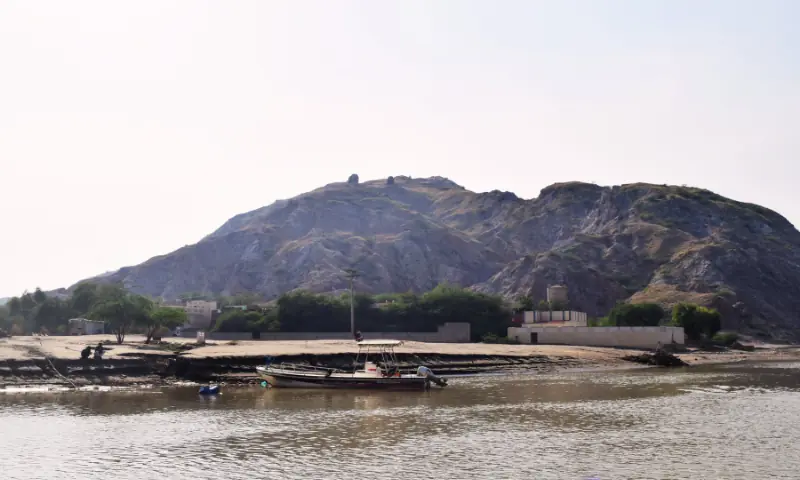
The ancient port of Mari Indus, with the temples perched at the top. PHOTO: DAWN
Cable cars across the river, revival of the Mari Indus railway, timely completion of fishing huts, and the establishment of riverfront boutique hotels by recognised chains, complemented by substantial tax and other incentives for private operators, would further energise the region.
The impact of such ecotourism initiatives on local livelihoods, heritage preservation, and economic growth cannot be overstated, offering Pakistan and Punjab a much-needed tourism destination while restoring the historic glory of these towns.