

May 8, 2026
JAKARTA – Indonesia’s economy grew at a steady 5.2 percent through 2025 and into early 2026. On paper, that is a success story. Yet in practice, millions of Indonesians aren’t buying it, because they aren’t feeling it.
Household budgets remain tight, the middle class has stopped expanding, and a quiet frustration is building between what the macroeconomic data says and what people actually experience at the market, at the fuel pump and at the end of the month.
This is not a uniquely Indonesian problem. The United States posted roughly 2 percent growth in the first quarter of 2026, yet Americans remain consumed by anxieties over housing costs, grocery bills and a softening job market.
The pattern is the same on both sides of the development spectrum: The economy grows, but the people do not prosper. What was once a temporary divergence is beginning to look structural. The transmission belt that used to carry growth into household income is slipping.
In the US, the culprit is concentration. Growth has been concentrated in capital-intensive sectors like technology, where windfalls flow overwhelmingly to asset owners rather than to workers. Meanwhile, costs for housing, health care and education have outpaced median incomes for years. Gross domestic product climbs while purchasing power of ordinary families falls.
Indonesia’s story is structurally different but arrives at the same unhappy destination. Data from Statistics Indonesia (BPS) show the middle class has stopped expanding: a striking reversal for a country that spent two decades lifting tens of millions out of poverty. Deposit data from the Deposit Insurance Corporation (LPS) reveal that savings are increasingly concentrated among higher-income groups. Growth is happening and the gains are going somewhere; they just aren’t reaching most people.
Whether you’re looking to broaden your horizons or stay informed on the latest developments, “Viewpoint” is the perfect source for anyone seeking to engage with the issues that matter most.
To understand why, it helps to look beyond GDP to a measure that receives far less attention: gross national product. GDP measures the total value of goods and services produced within a country’s borders, regardless of who owns the factors of production. GNP, however, measures the income that actually accrues to a country’s residents, capturing what flows in from abroad and subtracting what flows out. In an economy increasingly shaped by foreign investment and multinational supply chains, that gap matters enormously.
Indonesia’s recent growth has been driven substantially by downstream industrialization and resource-based activities, such as nickel processing and palm oil refining. These industries generate impressive GDP figures, but much of the return flows outward: to foreign investors who financed the infrastructure, to overseas equipment suppliers and to Chinese firms holding the technology and offtake agreements. Many of these entities do not pay domestic taxes due to tax holidays.
The value is created on Indonesian soil, but a meaningful share of the income leaves it. GDP grows, but GNP does not grow as fast. It is GNP, not GDP, that more closely approximates what Indonesian households and businesses can actually spend, save and invest.
When this gap widens, the economy looks more prosperous from the outside than it feels on the inside. Policymakers who focus exclusively on GDP risk celebrating a number that flatters the country’s productive capacity while obscuring the slower accumulation of income in the hands of its people.
The composition of growth compounds the problem. Capital-intensive industries create fewer jobs per unit of investment than labor-intensive alternatives. Consequently, robust output figures coexist with stagnant welfare for the majority of the workforce. Workers are present in the economy but are not sufficiently present in its rewards.
When growth does not translate into wages or broader employment, households cannot build assets, invest in their children’s education or absorb economic shocks. The middle class stagnates, not because the economy has failed in aggregate but because the aggregate conceals an uneven distribution of its fruits.
Against this backdrop, the government’s free nutritious meal (MBG) program deserves careful scrutiny, not as an attack on its goals but as a case study in the complexity of social spending.
Improving child nutrition is an investment with a high social return: a better-nourished generation is a more productive one. But good intentions do not automatically produce equitable distribution. The critical question is not only who receives the benefit but also who captures the economic value of delivering it.
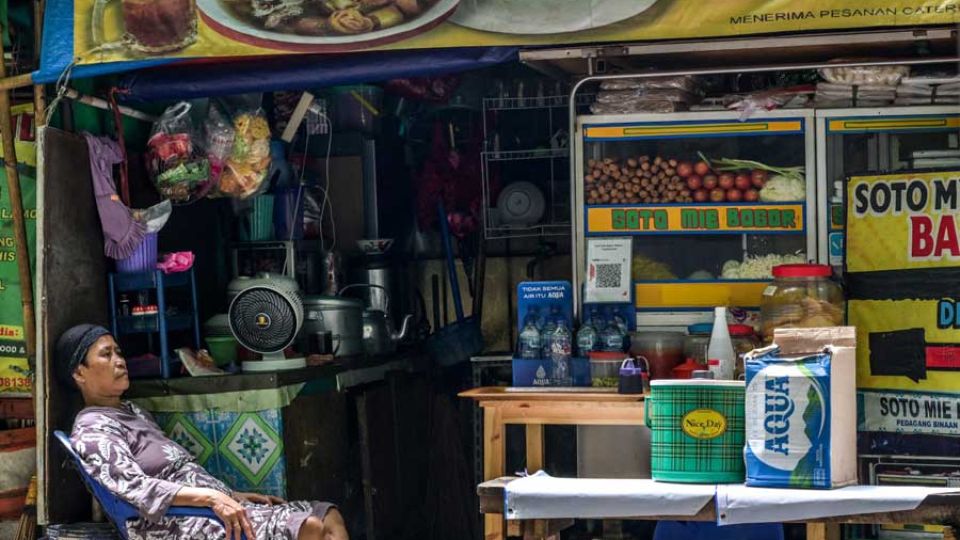
Programs of this scale often operate through centralized supply chains managed by well-capitalized firms. This creates a risk: the small food stalls and street vendors who make up the informal economy may find the government quietly hollowing out their livelihoods.
Public spending flows in, but economic rents accumulate toward the top of the supply chain rather than at the bottom. This risks becoming a form of reverse redistribution: Public money inadvertently shifts value away from the informal poor and toward the formal and better-resourced.
Even direct beneficiaries may gain less than headline figures suggest. While a subsidized meal is valuable, the substitution effect often means that if a meal simply replaces what a family would have bought, it improves nutrition without significantly freeing up disposable income. Consequently, the anticipated multiplier effect on local economies is diluted.
Compounding this are the inevitable inefficiencies of large-scale logistics, such as food waste, supply chain delays and quality inconsistencies, which cause the overall welfare impact to fall short of the program’s ambition.
This is not an indictment of the free meals program. Rather, it is an argument for designing it with a clear-eyed perspective, giving explicit attention to supply chain incidence, the displacement of informal workers and the critical difference between in-kind transfers and genuine income gains.
The uncomfortable truth is that not all growth is equal. Indonesia’s central challenge is not the quantity of growth but its quality, as well as its ownership. An economy where GDP expands while GNP lags is one in which a nation is working hard but failing to capture the proceeds.
Addressing this requires a deliberate shift in policy. It means moving away from headline GDP toward measures that capture household welfare, such as labor income shares and domestic value chains. GDP growth alone is no longer a sufficient policy goal.
Without mechanisms to ensure that what is produced on Indonesian soil stays in Indonesian hands, growth risks becoming a hollow achievement: impressive in statistics but invisible in people’s lives, and eventually to the social trust that sustains both economies and democracies.
The writer is a professor of economics at the University of Indonesia.