

March 9, 2026
THIMPHU – Despite being one of the country’s most politically influential southern dzongkhags, represented by two Cabinet ministers and the Deputy Speaker of Parliament, Samtse continues to grapple with a severe shortage of health professionals, particularly in remote areas.
The staffing crisis has left several public health centres and sub-posts either closed or operating with minimal personnel, weakening access to basic healthcare services for rural communities.
Many gewogs rely on a single health worker to manage public health centres and outreach clinics, a situation local government leaders say is increasingly unsustainable.
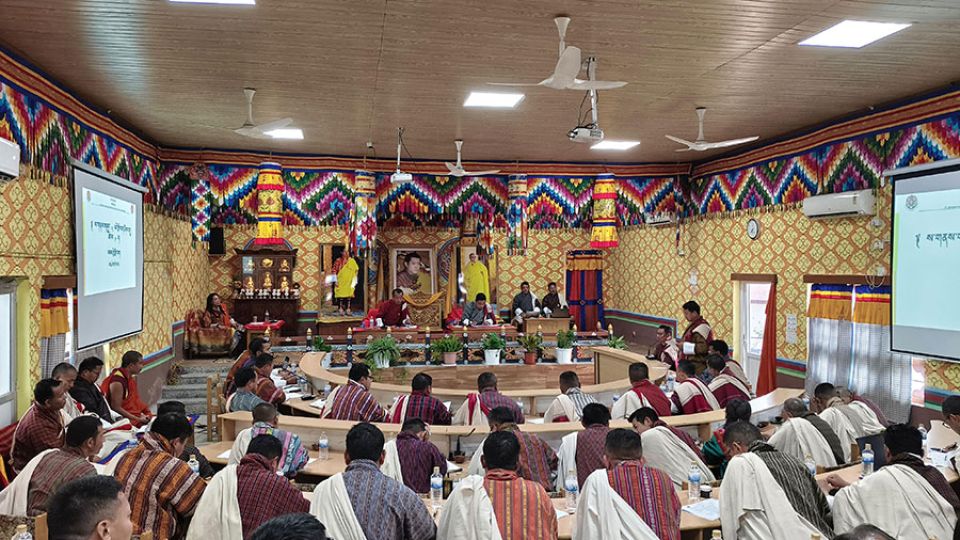
The issue dominated discussions during a recent session of the Dzongkhag Tshogdu (DT) in Samtse, where representatives warned that the lack of staff is beginning to undermine even the delivery of routine healthcare services.
Dumtoe Gup Durga Das Rai said that while civil servant attrition has affected many agencies, the shortage in the health sector has had the most direct impact on the public.
The lone public health centre (PHC) in Dumtoe has been managed by a single health assistant (HA) for about two years after the nurse resigned.
The gewog has a population of about 2,200, and its three outreach clinics (ORCs) are also being managed by the same staff.
“We have not received any replacement so far, and the workload on the lone staff has increased,” the gup said.
Similar concerns were raised in Namgaycholing, where the PHC has been requesting a female nurse since 2016. The request has remained unfulfilled for nine years.
Local leaders said the absence of a female nurse creates serious difficulties during emergencies, particularly for women seeking care.
Namgaycholing Gewog has a population of roughly 1,500 people spread across four chiwogs, comprising about 500 households and a school. The nearest hospital in Tashicholing is around 25 kilometres away.
Panbari PHC is also operating with a single staff after the Tading sub-post was closed in 2022. The lone health worker currently serves around 6,000 residents from 1,235 households, six ORCs and two schools.
“The current workload is extremely high, with around 12,800 outpatient cases a month,” said Tading Gup Yam Bahadur Ghalley.
The closure of the Tading sub-post has further affected residents in nearby villages. The sub-post earlier served about 500 people from around 150 households.
The area is also home to four mining and dredging companies, where workplace accidents are relatively common, adding further pressure on the already stretched health services.
Gup Yam Bahadur Ghalley said that although the staff from Panbari PHC manage to reach different parts of the gewog during the dry season, the situation could worsen during the monsoon.
In Norgaygang, the farthest gewog in Samtse, the closure of the Phendeygang sub-post has disrupted services for nearby chiwogs.
The gewog has requested the establishment of a new sub-post at Khababgang to offset the impact of the closure.
Tendruk is also likely to face a similar situation soon, as the two health personnel serving at the Tendruk PHC are expected to leave for further studies.
Local leaders said the situation becomes more difficult when the lone staff member managing the centres leaves the station for official duties or personal reasons, forcing facilities to remain closed for days or even weeks.
An official from the dzongkhag acknowledged the shortage, stating that the dzongkhag administration has assessed the staffing requirements and submitted requisitions to relevant authorities, including requests to reopen closed sub-posts.
The official said that compared to some other dzongkhags where even PHCs remain closed, Samtse currently has only sub-posts affected. “The situation may improve as more health workers enter the labour market.”
In cases where sub-posts are closed, mobile health services could be deployed to provide services to remote communities.