

June 17, 2026
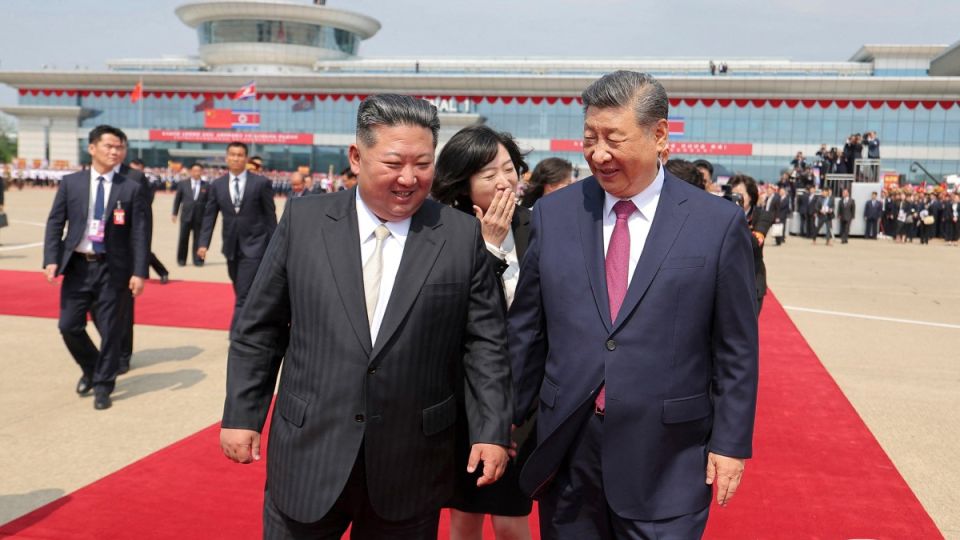
SEOUL – Chinese President Xi Jinping and North Korean leader Kim Jong-un have declared a new upgrade in relations between their two countries following Xi’s visit to Pyongyang this week. Even without the official announcement, the extraordinary welcoming ceremony organized by North Korea would be enough to mark the event as a significant milestone in the history of North Korea-China relations.
Both leaders have pledged to strengthen strategic communication, suggesting that contacts between senior leaders will become more frequent. Cooperation in political, economic and cultural fields is also likely to expand. The message from Pyongyang and Beijing is clear: Both governments want the world to see their relationship as stronger than before.
Yet an important question remains unanswered. Does this diplomatic declaration represent a genuine strategic transformation, or is it simply another chapter in a familiar cycle of rapprochement and disappointment?
Some analysts argue that Kim’s strategic position has been strengthened considerably. Others speculate that closer North Korea-China ties could pave the way for deeper trilateral cooperation among North Korea, China, and Russia. Such assessments deserve attention, but they should also be approached with caution. For decades, observers have repeatedly predicted the emergence of a powerful North Korea-China partnership capable of reshaping Northeast Asia. The trilateral cooperation scenarios have periodically appeared. Yet many of these forecasts have failed to materialize.
This does not mean that closer relations are impossible. It means only that diplomatic declarations should not automatically be interpreted as evidence of a fundamental strategic shift.
History offers several reminders. The first dates back to the early 1930s during the “Minsaengdan Incident” in Manchuria. At the time, Korean guerrillas fighting Japanese colonial rule operated within Chinese communist-led resistance forces. Local Chinese communist leaders launched an extensive campaign to identify alleged Korean spies affiliated with a pro-Japanese secret organization known as the Minsaengdan. Many Koreans were falsely accused, imprisoned, tortured or executed. Kim Il-sung himself reportedly narrowly escaped persecution. The episode left deep scars and created a lasting sense of mistrust against Chinese “comrades.”
The second occurred during the 1950-53 Korean War. After North Korea’s invasion of South Korea in 1950 led to a successful United Nations counteroffensive, China intervened militarily to save the North Korean regime. Chinese forces under Gen. Peng Dehuai assumed effective control of military operations. According to many historical accounts, Peng held a low opinion of Kim’s military capabilities and frequently treated him with little respect. For Kim, the experience was both humiliating and politically painful.
The third episode emerged in 1956 during what is commonly known as the August Faction Incident.
After Kim suppressed an internal challenge to his leadership, some of his opponents fled to China and the Soviet Union. Beijing and Moscow instantly intervened and pressured Pyongyang to reverse parts of the purge. Kim reluctantly complied but never forgot what he regarded as foreign interference in North Korea’s domestic affairs. The experience contributed to his determination to pursue greater political independence, eventually becoming one of the foundations of the Juche ideology.
The fourth episode came in 1992 when China established diplomatic relations with South Korea. For Pyongyang, the decision felt like a profound betrayal. Kim Il-sung reportedly hoped China would delay normalization long enough for Pyongyang to prepare for a new situation. Deng Xiaoping, then China’s paramount leader, declined the request.
The fifth episode remains highly relevant today.
In 2006, after North Korea conducted a series of ballistic missile launches and a nuclear test, the United Nations Security Council adopted resolutions with sanctions. China voted in favor. Beijing subsequently supported every major UN Security Council resolution imposing sanctions on North Korea over its nuclear and missile programs. To Pyongyang, Beijing proved that it could not be counted on as a true friend in times of need.
The nuclear issue remains the most important structural obstacle between the two sides.
North Korea regards its nuclear arsenal as essential for regime survival and national security. Pyongyang has repeatedly made clear that it has no intention of abandoning its nuclear weapons.
China, however, opposes nuclear proliferation and continues to support the goal of denuclearization on the Korean Peninsula as one of the recognized nuclear powers under the Nuclear Non-Proliferation Treaty.
Beijing therefore faces the difficult task of balancing its commitment to denuclearization with its desire to maintain stable relations with Pyongyang. One visible manifestation of this disagreement occurred in 2015, when North Korea abruptly canceled a scheduled performance by the Moranbong Band in Beijing. The incident reflected broader tensions over North Korea’s nuclear policy and China’s refusal to endorse it.
It would be surprising if this issue had disappeared during the latest summit. On the contrary, it almost certainly remains a source of frustration for both sides. For decades, North Korea and China have alternated between periods of tension and periods of reconciliation. Their relationship has survived because both sides continue to find strategic reasons to cooperate despite persistent disagreements. Yet those disagreements have never truly disappeared.
This is why observers should be careful not to overreact to the latest diplomatic breakthrough. The summit was important. The relationship upgrade was significant. Expanded cooperation is possible. But history suggests that declarations of strategic partnership between Pyongyang and Beijing should be evaluated with caution rather than enthusiasm.
The purpose of recalling history is not to predict failure. It is to avoid simplistic conclusions.
North Korea and China may indeed achieve a more stable and productive partnership in the future. Yet the structural barriers that have complicated their relationship for nearly a century remain very much alive.
Foreign policy begins with an accurate diagnosis. Like a physician treating a patient, policymakers cannot prescribe effective solutions if they misunderstand the underlying condition. The challenge is therefore not to celebrate or dismiss the latest summit, but to understand it clearly. Only then can governments develop sound strategies for dealing with the evolving realities of Northeast Asia.
Wang Son-taek is an adjunct professor at Sogang University. He is a former diplomatic correspondent at YTN and a former research associate at Yeosijae. The views expressed here are the writer’s own. — Ed.