

November 7, 2025
SEOUL – For Hyundai Motor Group, the road to autonomous driving has been far longer than expected. Once an early mover among legacy automakers, the company’s self-driving push has lost momentum in recent years amid technological setbacks and internal struggles.
While rivals like Tesla and Waymo have advanced their autonomous driving technology, Hyundai’s own road map — despite a high-profile investment in US joint venture Motional and the acquisition of Seoul-based startup 42dot — remains mainly in the pilot phase, with few tangible breakthroughs so far.
Now, the Korean auto giant is looking to shift gears.
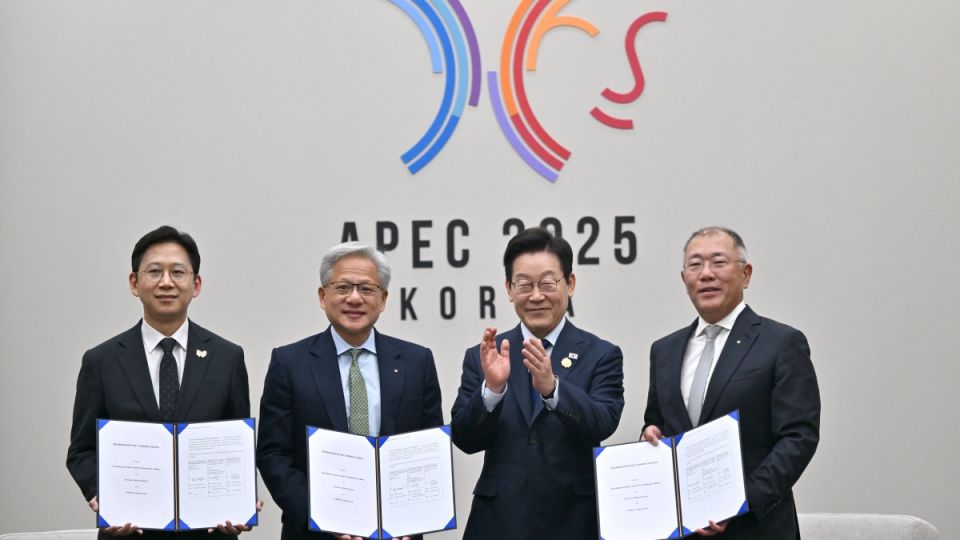
At the recent Asia-Pacific Economic Cooperation summit in Gyeongju, North Gyeongsang Province, Hyundai unveiled a sweeping partnership with Nvidia to build an artificial intelligence factory in Korea powered by the chipmaker’s 50,000 Blackwell GPUs.
The next-generation Blackwell processors will serve as the core infrastructure of Hyundai’s supercomputing hub designed to accelerate innovation in autonomous driving, digital-twin manufacturing and robotics-driven advanced production.
For autonomous driving, the GPUs will train physical AI models — AI that moves beyond digital environments and perceives, interacts and operates in the real world — through ultrafast real-world simulations, digital twins and a self-improving AI loop.
Once optimized in the AI Factory, these models will be deployed on Nvidia’s Drive AGX Thor platform inside Hyundai’s next-generation vehicles, equipping them with the built-in “physical intelligence” to perceive, predict and respond safely to complex real-world settings.
Industry watchers expect Hyundai’s tie-up with Nvidia to substantially upgrade its Level 2+ autonomous driving system, which remains in the early stages of development.
Unlike Tesla’s Full Self-Driving or Level 2+ system, which allows hands-free driving as long as drivers remain attentive, Hyundai’s current Level 2 system requires periodic contact with the steering wheel and operates primarily on highways. It also uses GPUs, but only for in-vehicle perception and decision-making — not for large-scale AI training or physical AI simulation, which demand extensive GPU clusters.
According to Choi Jun-won, an electrical and computer engineering professor at Seoul National University, Tesla’s success in advancing autonomous driving, particularly with its FSD system in the US, lies in its massive real-world data and GPU-based computing power. Tesla uses Nvidia GPUs for AI training, but also develops its own chips and computing infrastructure.
“GPUs are the key driving force behind progress in autonomous driving, and securing them has become a strategic race,” said Choi. He added that Nvidia CEO Jensen Huang’s recent pledge to provide 260,000 GPUs to Korea marks a “major breakthrough,” as achieving world-class AI capabilities requires not just advanced algorithms, but the “large-scale computing infrastructure” for training.
“This investment could give Korea a crucial opportunity to build that foundation,” noted Choi. “The nation began shifting toward ‘AI-driven autonomous systems’ less than a year ago and it still lacks both the large-scale data infrastructure and high-performance computing power required to train models at a global scale.”
“In contrast, rivals like Waymo and Tesla have already secured vast GPU clusters for AI training. In this race, securing enough GPUs and developing robust training capacity will determine who leads the next stage of autonomous mobility.”
Lim Eun-young, an analyst at Samsung Securities, stated in a report, “Once Hyundai Motor completes its data center equipped with 50,000 Blackwell GPUs, it will achieve a computing capacity comparable to Tesla’s.” Lim added that since Blackwell’s exports to China are restricted, the partnership gives Hyundai a strategic edge over Chinese competitors.
Hyundai’s partnership with Nvidia is expected to help resolve internal challenges stemming from its self-driving arm, 42dot — acquired in 2022 to lead the group’s autonomy efforts — and serve as a turning point in reviving its stalled autonomous driving strategy.
The automaker had initially aimed to commercialize a Level 3 autonomous vehicle — allowing drivers to divert their attention under defined conditions while the system takes full control of driving — in 2023. However, the schedule has been repeatedly delayed, and in March this year 42dot unveiled a revised road map to introduce Level 2+ technology only by late 2027.
A source familiar with the matter, speaking on condition of anonymity, said, “42dot began with an ambitious plan to build a mobility platform centered on autonomous vehicles. But as technological hurdles and integration challenges — particularly in adapting the technology to Hyundai’s vehicle systems — became evident, the company shifted its focus from self-driving to the broader development of software-defined vehicle architecture.”
“This pivot, while strategically reasonable, left Hyundai without a clear public road map for its autonomous driving business, fueling doubts about its progress and pushing back its commercial rollout timeline.”
Another source noted, “A large share of Nvidia’s 50,000 Blackwell GPUs will likely be allocated to 42dot, which is rapidly expanding its computing capacity to accelerate AI training and autonomous driving development.”