

April 23, 2026
MANILA – The Appeals Chamber has affirmed the International Criminal Court’s (ICC) jurisdiction over the crimes against humanity case of former President Rodrigo Duterte, rejecting the defense’s bid to nullify the court’s authority and halt proceedings tied to the war on drugs.
The ruling clears a key hurdle for the case to move forward at the ICC, based in The Hague, despite the Philippines’ withdrawal from the court.
Reading the decision at ICC headquarters, the five-member Appeals Chamber rejected the defense’s appeal and said its request for Duterte’s immediate and unconditional release was moot.
The 81-year-old former president faces three counts of crimes against humanity for murder as an “indirect co-perpetrator” in killings allegedly committed as part of the anti-narcotics policy implemented during his administration.
LIVE UPDATES: ICC rules on jurisdiction over Duterte | April 22
The allegations relate to his time as mayor of Davao City between 2013 and 2016 and then as president until March 2019, when the Philippines withdrew from the ICC.
Duterte’s defense argued the court has no jurisdiction over alleged crimes in the Philippines because the country is no longer subject to the Rome Statute, the ICC’s founding treaty. Prosecutors countered that the alleged crimes occurred while the Philippines was still a member of the court and that the ICC can proceed.
In an initial decision in October, the ICC Pre-Trial Chamber sided with the prosecution, ruling the investigation into Duterte began before the Philippines’ withdrawal.
The Appeals Chamber dismissed the defense team’s challenge to that decision.
“The court has rejected all four grounds of appeal,” Presiding Judge Luz del Carmen Ibanez Carranza said.
“Having rejected the entire appeal, the Appeals Chamber considers that the defense request for the immediate and unconditional release of Mr. Duterte is moot,” she said.
The first ground of appeal rejected was the defense’s argument that the Pre-Trial Chamber erred by concluding the court still had jurisdiction over a country that has already withdrawn as a member state.
The Appeals Chamber said a state’s withdrawal does not automatically strip the court of jurisdiction. Under Article 127 of the Rome Statute, which governs what happens when a state withdraws, the court noted the statute ensures an “appropriate balance” where states can withdraw but cannot use withdrawal to escape accountability for crimes already under the court’s consideration.
With this, the chamber unanimously rejected the defense’s first ground of appeal, finding no legal error in the Pre-Trial Chamber’s interpretation of the statute.
The chamber also declined by majority the defense’s second ground of appeal, which claimed the Pre-Trial Chamber erred in finding that a preliminary examination may qualify as a matter under the court’s consideration.
“The Appeals Chamber notes that, in the specific circumstances as detailed in the impugned decision, the prosecutor (a) decided to initiate a preliminary examination prior to the Philippines’ withdrawal from the statute; (b) publicly announced the initiation of a preliminary examination; (c) adopted a number of procedural steps, some of which involved judicial rulings; and (d) submitted a request to initiate a proprio motu investigation on the basis of the results of the preliminary examination,” Ibanez Carranza said.
“As a result, the Appeals Chamber dismisses this argument,” she added.
The third ground of appeal rejected by the chamber was the defense’s argument that the Pre-Trial Chamber committed an error of law in interpreting that the term “the court” in Article 127(2) includes the Office of the Prosecutor.
The Appeals Chamber, however, noted the Pre-Trial Chamber employed the term “the court” in “distinct senses.”
“Having considered the analysis of the Pre-Trial Chamber, particularly regarding the context in which the term ‘the court’ is used in both the statute and in Article 127, the Appeals Chamber considers that the defense has failed to show how the Pre-Trial Chamber erred in finding that the term ‘the court’ includes the Office of the Prosecutor, for the purposes of Article 127(2), and therefore, the Appeals Chamber rejects the third ground of appeal,” Ibanez Carranza said.
The last ground rejected was the defense’s argument that the Pre-Trial Chamber made a policy-oriented determination in permitting the investigation into Duterte’s alleged crimes to continue despite the Philippines’ withdrawal from the statute.
The Appeals Chamber disagreed, finding no error in the Pre-Trial Chamber’s reading of Article 127.
“The Appeals Chamber cannot discern any error in the Pre-Trial Chamber’s interpretation of Article 127,” Ibanez Carranza said.
“The Appeals Chamber is not persuaded by the defense’s submission that the one-year withdrawal period under Article 127(1) sufficiently preserves the statute’s object and purpose, as the prosecutor may seek an investigation within this period,” she added.
“The continuation of the preliminary examination past the one-year withdrawal period is reflective of the balance found by the Appeals Chamber between the responsibilities that states accept upon ratification of the statute, including the aim set out in the preamble: to put an end to impunity and the ability of states to effectively withdraw from the statute within a clear timeline,” she said.
The chamber also brushed aside the defense’s claim that the Pre-Trial Chamber relied on a subjective political critique of the Philippines’ motives for withdrawing, noting references to the country’s motivations were demonstrative of what Article 127 is designed to prevent, rather than part of the legal reasoning itself.
“Therefore, the Appeals Chamber considers that the defense has failed to demonstrate that the Pre-Trial Chamber committed an error of law and rejects the fourth ground of appeal,” Ibanez Carranza said.
WATCH: ICC rules on Rodrigo Duterte’s appeal vs jurisdiction
Duterte defense lawyer Nicholas Kaufman said he was not surprised by the verdict, saying allowing the appeal “would have practically emptied the court’s docket.” He said the Duterte case was the one remaining high-profile case at the ICC.
Confirmation of charges
In a separate procedure, judges are weighing whether to confirm the charges against Duterte, the final step before a trial, which would be the first against a former head of state from Asia.
At hearings in February, the prosecution alleged Duterte was responsible for thousands of deaths during his war on drugs.
His defense said there was no “smoking gun” directly linking Duterte’s rhetoric and threats against drug users to actual murders.
In any case, Duterte is unlikely to appear in court.
The court granted his request not to appear for the hearings in February, with his defense saying he was not mentally fit.
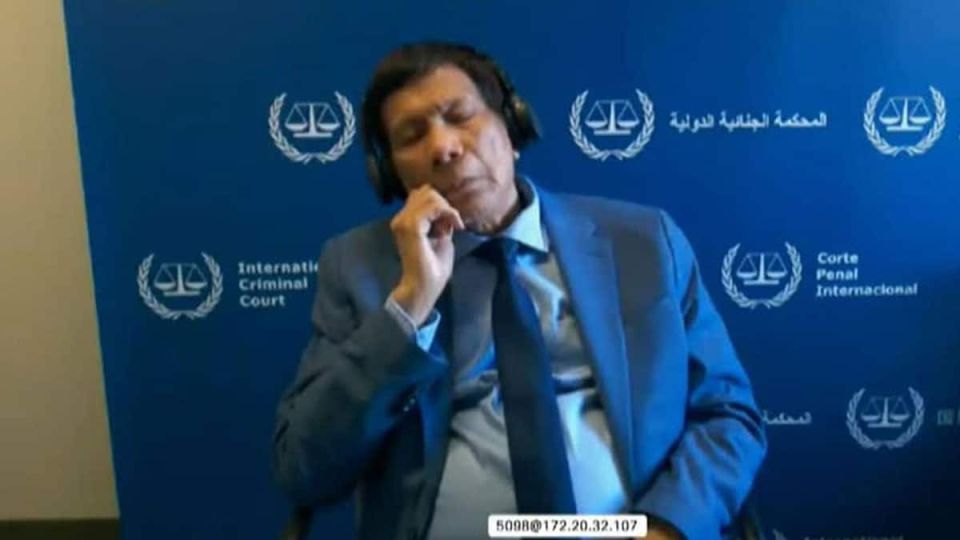
The only time he has been seen since his arrest and transfer to The Hague was at an initial appearance via video link, at which he appeared confused and exhausted.
He did not appear at the reading of the decision.
Lawyers Joel Butuyan and Gilbert Andres, the common legal representatives of victims in the case, earlier expressed hope for an Appeals Chamber ruling that would “uphold the victims’ rights,” adding that domestic courts in the Philippines had failed to investigate and prosecute government officials and uniformed officers behind the thousands of killings. /dl/cb/dm With a report from Kathleen de Villa