

December 3, 2025
THIMPHU – Needless to say, Zhemgang is Bhutan’s true eco-tourism capital, a district where 93.87 percent forest cover turns the landscape into a living, breathing wilderness.
Travelling from Trongsa toward Zhemgang, the landscape shifts effortlessly into a lushness that feels ancient. The road snakes along hillsides dense with broadleaf forests. And if you keep your eyes open long enough, the forest opens its secrets.
Maybe a rustle of leaves, maybe a flick of a golden tail. The golden langurs, Bhutan’s endemic treasures, appear like guardians of the forest with their golden fur, black faces, and long, graceful tails along the highway. They sit casually on treetops as if posing, and then swing across the branches with their tails trailing behind them. Here, even a casual roadside glance can reward you with rare wildlife.
Zhemgang is also a birder’s paradise. You can hear countless birds chirping and calling, music to the ears. And it is no coincidence that Kheng, the local name for the region, directly translates to “rich forest”.
Locals say, half joking and half serious, that even if all food imports stopped and all fields failed, Khengpas would not starve. The forest is their pantry, pharmacy, classroom, and spiritual abode, all at once.
They know at least four species of wild potatoes fit for eating, dozens of edible shoots, herbs, and fruits. This knowledge has been passed from parents to children like an heirloom. And this intimate relationship with the forest is what makes Zhemgang special. People here do not just live in the forest, they live with it.
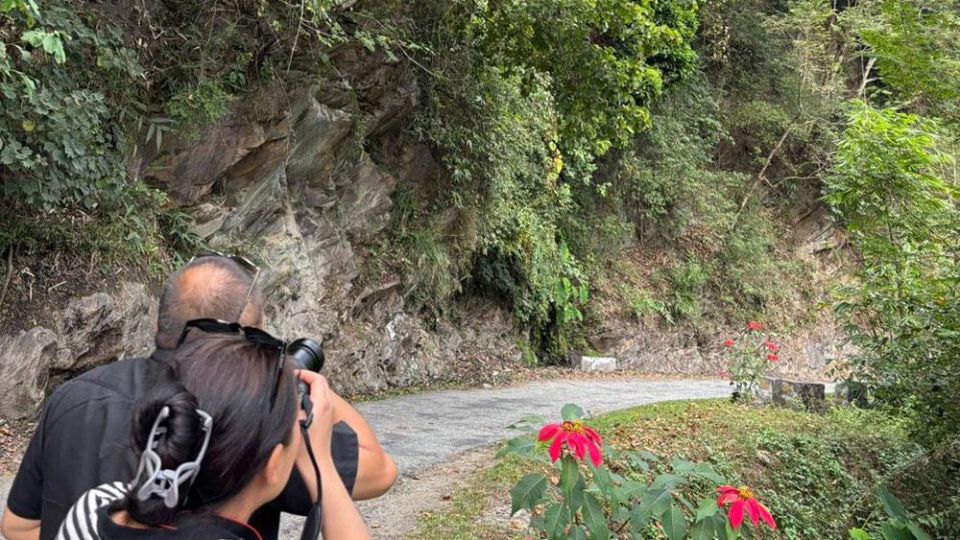
To understand Zhemgang, you must enter it with the same attentiveness its people carry in their bones. That is what we felt as my team drove toward Tingtibi for the Bhutan Bird Festival (BBF) from Trongsa. Our eyes and ears were alert in ways they never are in the city. Every chirp made us stop. Every flutter of wings felt like a clue.
To the untrained eyes, they were just birds of different feathers – brown, red, yellow. But somewhere in that flutter might be a critically endangered White-bellied Heron or a vulnerable hornbill gliding between trees.
And then, it happened. Circling the highway that winds from Zhemgang town down to Tingtibi, we spotted not one, but all three hornbill species found in Zhemgang – Rufous-necked Hornbill, Great Hornbill, and Wreathed Hornbill. Three vulnerable giants, casually flying over the road as if giving us a ceremonial welcome.
That is the thing about Zhemgang. Even if you come without knowledge of species or habitats, the forest slowly trains your senses. By the time we reached the festival grounds, we were showing photos of birds to forest officials with a kind of excited embarrassment.
“This one?”
“Oh, that is Wreathed Hornbill!”
“And that one?”
“That is the Rufous-necked Hornbill.”
In Zhemgang, the forest turns anyone into a curious adventurer.
The Bhutan Bird Festival (BBF) celebrated not just birds but the district’s entire wealth of biodiversity. Zhemgang Forest Division published pictorial books on birds, butterflies, fishes, reptiles and amphibians, and orchids – each updated yearly with newly sighted species.
The numbers alone tell a story of richness. The district has recorded 386 bird species, almost half of Bhutan’s total, making it one of the country’s greatest birding hotspots. Its lush forests and varied elevations also support 307 butterfly species, out of the roughly 757 known in Bhutan.
The rivers, particularly the Mangde Chhu and its tributaries, are home to 19 freshwater fish species, including the endangered Golden Mahseer. Reptile and amphibian diversity is equally impressive, with 47 snakes, 11 lizards, three turtles, and 17 frog species documented so far.
Zhemgang is also home to several critically endangered and endangered species, such as the orchid Paphiopedilum fairrieanum, the White-bellied Heron, Red Panda, Musk Deer, and the elusive Sapria himalayana, a rare parasitic flower reminiscent of the famed Rafflesia.
Three national parks – Royal Manas National Park, Jigme Singye Wangchuck National Park, and Phrumshengla National Park – along with Biological Corridor four, stitch together a landscape where wildlife moves freely from subtropical valleys to temperate forests and alpine heights.
The Mangdechhu, Chamkharchhu, Drangmechhu, and Kuri Gongri flow through this forest mosaic, eventually forming the mighty Manas River, one of the largest and most biodiverse river basins in the Eastern Himalayas.
Zhemgang’s landscape becomes even more alive after sunset. And our curiosity pulled my team and me deeper, prompting us to book a night wildlife safari on the first evening of the BBF.
The safari, arranged by forest officials, was a slow, deliberate journey along the highway toward Gelephu, riding in the open cabin of a Bolero with torches sweeping across the roadside vegetation and our hearts beating with hope.
Wildlife watching is a test of patience and humility. Sometimes you wait for hours and see nothing. That night, we saw… nothing. Or almost nothing.
A forest official accompanying us told us stories of where leopards usually emerge, where deer come to drink, where wild cats cross. We pictured each story vividly in our minds. And then, on our way back, something moved. We stopped. We leaned forward. We held our breath.
It was a cat. A domestic cat!
The other group returned and reported the same sighting: a domestic cat. Perhaps Zhemgang was teasing us, or perhaps the forest was reminding us that wildlife owes us nothing and that sightings are privileges, not guarantees.
But that is part of the magic. The forest reveals itself on its own terms. Some are lucky. Some are not. Many return again, simply because the forest keeps calling.
Zhemgang holds immense potential as an eco-tourism powerhouse – birding trails, river adventures, fly-fishing, wildlife safaris, orchid walks, butterfly explorations, cultural immersion with Kheng villages, and a forest so rich that every step feels like turning a page in a living encyclopedia. It is a place where even the air feels biodiverse.
And so we left Tingtibi with our cameras full, eyes sharper than when we arrived, ears tuned to forest whispers, hearts somehow lighter. Maybe we did not see the leopard. Maybe all we saw at night was a cat. But in Zhemgang, even a cat becomes part of the story, a reminder that the forest is generous, playful, and always alive.
Because in Zhemgang, your eyes are always on the forest.
And the forest?
It is always looking back.