

May 19, 2026
JAKARTA – Average food prices in Indonesia showed mixed movements on Monday, with several staple commodities such as rice, sugar and beef recording declines, while chili prices continued to climb sharply, according to the Bank Indonesia’s National Strategic Food Price Information Center (PIHPS).
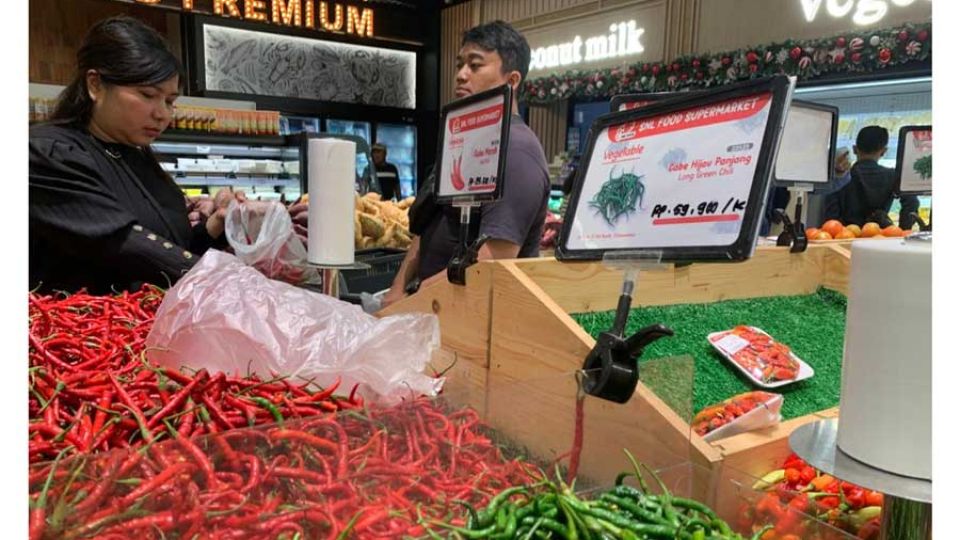
The steepest increase was recorded in red bird’s eye chili, which rose 7.17 percent to Rp 72,500 (US$4.10) per kilogram, followed by green bird’s eye chili, which also climbed 2.47 percent to Rp 51,800 per kg, while large red chili increased 1.57 percent to Rp 54,950 per kg.
Curly red chili prices, meanwhile, rose 0.87 percent to Rp 52,300 per kg, extending upward pressure across the chili category.
National Food Agency (Bapanas) deputy for food availability and stabilization I Gusti Ketut Astawa, previously said supplies of red bird’s eye chili from production centers had started to improve, helping ease price pressures that had previously intensified.
However, he noted that unfavorable weather conditions and attacks from plant pests and diseases had temporarily disrupted production in several areas.
Linda Al Amin, head of the West Java Food Security Agency (DKPP), said several agricultural commodities in the province had seen falling production and rising demand ahead of Idul Adha.
She noted that the recent spike in chili prices, for instance, was driven by supply shortages in key producing areas due to the dry season and pest attacks. Higher distribution costs, fueled by rising diesel prices, have also added to the pressure.
Shallot prices also edged higher by 0.74 percent to Rp 47,350 per kg, while in contrast, medium-sized garlic fell 2.82 percent to Rp 37,900 per kg.
Rice prices broadly eased across all categories, with lower-quality rice prices falling between 0.34 percent and 0.69 percent, while medium-quality rice recorded steeper declines, with category I dropping 1.24 percent to Rp 15,950 per kilogram and category II slipping 0.94 percent to Rp 15,850 per kg.
Premium rice prices also softened, as super-quality rice category I declined 0.29 percent to Rp 17,350 per kg and category II fell 0.59 percent to Rp 16,800 per kg.
Chairman of the regional board of the Indonesian Market Traders Association (APPSI), Ngadiran, said most commodity prices remained relatively stable, but noted that the price of subsidized cooking oil Minyakita in traditional markets was still far above the government’s highest retail price (HET).
“Minyakita’s HET is Rp 15,700, but prices in markets are still around Rp 20,000 to Rp 21,000 per liter,” Ngadiran said on Sunday as quoted by Kontan.
Previously, Statistics Indonesia (BPS) reported that inflation in April stood at 0.13 percent month-to-month, with the volatile food component recording monthly deflation of 0.88 percent, contributing 0.15 percentage points to overall deflation.
Amid ongoing global uncertainty, the government has vowed to maintain domestic food supplies at prices that remain “stable and affordable”, said State Secretary Prasetyo Hadi, while pointing to rising national rice reserves as a sign of strengthening food security.